



 Chat with AI
Exam 23: Project Management

Exam 1: Introduction to Operations Management74 Questions
Exam 2: Competitiveness70 Questions
Exam 3: Forecasting139 Questions
Exam 4: Product and Service Design78 Questions
Exam 4: RELIABILITY – Static12 Questions
Exam 6: Strategic Capacity Planning for Products and Services85 Questions
Exam 7: Decision Theory– Static114 Questions
Exam 8: Process Selection and Facility Layout132 Questions
Exam 9: Work Design and Measurement129 Questions
Exam 10: learning curve– Static61 Questions
Exam 11: Location Planning and Analysis62 Questions
Exam 12: The Transportation Model– Static20 Questions
Exam 13: Management of Quality97 Questions
Exam 14: Quality Control112 Questions
Exam 15: Acceptance Sampling– Static51 Questions
Exam 16: Aggregate Planning and Master Scheduling74 Questions
Exam 17: MRP and ERP81 Questions
Exam 18: Inventory Management128 Questions
Exam 19: JIT and Lean Operations79 Questions
Exam 20: Maintenance– Static36 Questions
Exam 21: Supply Chain Management87 Questions
Exam 22: Scheduling98 Questions
Exam 23: Project Management113 Questions
Exam 24: Management of Waiting Lines64 Questions
Exam 25: Linear Programming93 Questions
Select questions type


Once a project is approved and underway, project managers are only responsible for effectively managing time and costs which, if done well, will assure project completion on time and on budget.
(True/False)
4.9/5  (94)
(94) If the expected length of a path is more than 2.5 standard deviations less than a desired project completion time, the path will not be a factor in assessing the probability of finishing the project on time.
(True/False)
4.7/5 (95)
(95) If two consecutive activities on the same path each have two days of activity slack, this means that each of them can be delayed by two days without delaying the project.
(True/False)
4.9/5 (88)
(88) The earliest finish time for an activity is equal to the latest finish time minus the activity time.
(True/False)
4.9/5 (91)
(91) In the execution phase of a project's life cycle, activities are guided by decisions that were made in the __________ phase.
(Multiple Choice)
4.8/5 (80)
(80) There are four activities on the critical path. Coincidentally, their standard deviations are all equal to 4. The standard deviation of the critical path is therefore equal to:
(Multiple Choice)
4.8/5 (82)
(82) Project management differs from management of more traditional activities mainly because of:
(I) its limited time frame.
(II) its unique, defined set of activities.
(III) the requirement for use of the appropriate resources.
(IV) the need for planning and execution.
(Multiple Choice)
4.8/5 (79)
(79) Consider the following work breakdown structure: 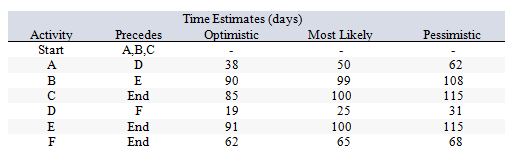 What is the probability that this project will be completed within 205 days?
 (Multiple Choice)
5.0/5 (83)
(83) Project risk events tend to be unlikely __________ a project, but that's also when they tend to be the __________.
(Multiple Choice)
4.7/5 (64)
(64) The path in a network with the average length of time to completion is called the critical path.
(True/False)
4.9/5 (52)
(52) A hierarchical listing of what must be done in a project is called a:
(Multiple Choice)
4.9/5 (84)
(84) Activity 7-8 is directly preceded by two activities-activity 5-7 and activity 6-7. Activity 5-7 has an expected time of five and an ES time of six. Activity 6-7 has an expected time of seven and an ES time of seven. Activity 7-8 has an expected time of 10. The ES for activity 7-8 is:
(Multiple Choice)
4.8/5 (81)
(81) Many activities have slack time; if we add these slack times together, this represents the potential improvement in early completion for the project.
(True/False)
4.8/5 (91)
(91) Suppose a project is subject to the following risk events (each with a given probability of occurring and a cost associated with that occurrence): Event Probability Cost( \0 00s) I .2 53 II .6 54 III .1 12 IV 3 21
Given these, Event _____ should probably get the most attention and Event _____ should probably get the least.
(Multiple Choice)
4.9/5 (65)
(65) Consider the following work breakdown structure:  What is the estimated slack time for activity D?
 (Multiple Choice)
4.7/5 (70)
(70) Activity 4-5 in a network diagram has an optimistic time estimate of five days, a most likely time estimate of seven days, and a pessimistic time estimate of 10 days. Its expected time (in days) is approximately:
(Multiple Choice)
4.8/5 (75)
(75) Some organizations use a matrix organization to integrate the activities of specialists within a functional framework.
(True/False)
4.8/5 (72)
(72) Which of the following leads to simulation being a useful tool with uncertain activity times?
(Multiple Choice)
4.8/5 (84)
(84) Project management software eliminates constraint violations when there are shared resources.
(True/False)
4.8/5 (91)
(91) One way that project management differs from management of more traditional activities is because of the limited time framework of projects.
(True/False)
4.8/5 (79)
(79) 
Filters
- Essay(0)
- Multiple Choice(0)
- Short Answer(0)
- True False(0)
- Matching(0)