



 Chat with AI
Exam 18: Short-Term Scheduling

Exam 1: Operations and Productivity126 Questions
Exam 2: Operations Strategy in a Global Environment135 Questions
Exam 3: Project Management123 Questions
Exam 4: Forecasting144 Questions
Exam 5: Design of Goods and Services137 Questions
Exam 6: Managing Quality130 Questions
Exam 7: Statistical Process Control154 Questions
Exam 8: Process Strategy131 Questions
Exam9: Capacity and Constraint Management107 Questions
Exam 10: Location Strategies140 Questions
Exam 11: Layout Strategies161 Questions
Exam 12: Human Resources, Job Design, and Work Measurement191 Questions
Exam 13: Supply-Chain Management145 Questions
Exam 14: Outsourcing as a Supply-Chain Strategy73 Questions
Exam 15: Inventory Management155 Questions
Exam 16: Aggregate Planning134 Questions
Exam 17: Material Requirements Planning MRP and ERP169 Questions
Exam 18: Short-Term Scheduling139 Questions
Exam 19: Just-In-Time and Lean Options137 Questions
Exam 20: Maintenance and Reliability130 Questions
Exam 21: Decision-Making Tools97 Questions
Exam 22: Linear Programming100 Questions
Exam 23: Transportation Models94 Questions
Exam 24: Waiting-Line Models135 Questions
Exam 25: Learning Curves111 Questions
Exam 26: Simulation93 Questions
Select questions type


The three components that can lead to competitive advantage through effective scheduling are
(Multiple Choice)
4.7/5  (74)
(74) Because of the significance of labor in the scheduling of services, behavioral and social issues, wage and hour law, and union contracts all complicate the scheduling process.
(True/False)
4.9/5 (77)
(77) Which of the following dispatching rules is typically the best technique for taking first those jobs with the most urgent needs?
(Multiple Choice)
4.7/5 (78)
(78) __________ is the assignment of jobs to work or processing centers.
(Short Answer)
4.9/5 (80)
(80) Johnson's rule sequences a set of jobs through two different machines or work centers in the same order.
(True/False)
4.9/5 (87)
(87) __________ is an input-output control system that uses cards to manage the amount of work in a work center.
(Short Answer)
4.8/5 (85)
(85) In services, the scheduling emphasis is usually on staffing levels, not materials.
(True/False)
4.8/5 (72)
(72) Which of the following is not tracked by scheduling optimization systems used in retail stores?
(Multiple Choice)
4.8/5 (77)
(77) The assignment method provides an optimum, one-to-one assignment of jobs to resources.
(True/False)
4.8/5 (78)
(78) In forward scheduling, jobs are scheduled as late as possible within the time allowed by the customer due dates.
(True/False)
4.9/5 (73)
(73) What is the primary disadvantage of the shortest processing time dispatch rule?
Is this a problem if there can be no new jobs arriving after the sequence is set?
(Essay)
4.8/5 (76)
(76) Short-term scheduling is important to efficiency and to cost reduction, but its impact is not of strategic importance.
(True/False)
4.8/5 (75)
(75) Given the following chart of jobs assigned with Johnson's rule suppose that all the jobs (A, B, C, etc) could be evenly divided into two tasks (such as A1 and A2, B1 and B2, etc). Suppose job B is divided into jobs B1 and B2, each with a body work time of 4.5 hours and a paint time of 2 hours. How much is makespan reduced by this splitting of B?
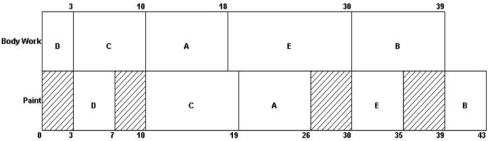
(Essay)
4.9/5 (73)
(73) Use Johnson's rule to determine the optimal sequencing for the five jobs to be processed on two machines in a fixed order (Machine 1 before Machine 2). The processing times in hours are given in the table below.
a. What is the optimal sequence?
b. What is the total flow time for this sequence?
c. Which job is the first to be scheduled?
Is it scheduled to be the first job or the last?
Explain.
Job Machine 1 Machine 2 A 10 11 B 8 17 C 14 10 13 7 10 8 25 9 G 6 15
(Essay)
4.7/5 (73)
(73) A Gantt load chart shows the loading and idle time of several departments, machines, or facilities.
(True/False)
4.7/5 (79)
(79) The critical ratio sequencing rule prioritizes the jobs based on the importance or value of the customers who have placed the orders.
(True/False)
5.0/5 (73)
(73) The priority rule that appears fair to customers in service systems is __________.
(Short Answer)
4.9/5 (85)
(85) Scheduling is rather straightforward in product-focused facilities because
(Multiple Choice)
4.8/5 (82)
(82) A work center had planned outputs of 10,15,13, and 20 hours with actual outputs of 12, 14, 13, and 18 hours. The cumulative deviation in output is
(Multiple Choice)
4.8/5 (77)
(77) In what ways does the problem of scheduling service systems differ from that of scheduling manufacturing systems?
(Essay)
4.8/5 (65)
(65) 
Filters
- Essay(0)
- Multiple Choice(0)
- Short Answer(0)
- True False(0)
- Matching(0)