



 Chat with AI
Exam 18: Short-Term Scheduling

Exam 1: Operations and Productivity126 Questions
Exam 2: Operations Strategy in a Global Environment135 Questions
Exam 3: Project Management123 Questions
Exam 4: Forecasting144 Questions
Exam 5: Design of Goods and Services137 Questions
Exam 6: Managing Quality130 Questions
Exam 7: Statistical Process Control154 Questions
Exam 8: Process Strategy131 Questions
Exam9: Capacity and Constraint Management107 Questions
Exam 10: Location Strategies140 Questions
Exam 11: Layout Strategies161 Questions
Exam 12: Human Resources, Job Design, and Work Measurement191 Questions
Exam 13: Supply-Chain Management145 Questions
Exam 14: Outsourcing as a Supply-Chain Strategy73 Questions
Exam 15: Inventory Management155 Questions
Exam 16: Aggregate Planning134 Questions
Exam 17: Material Requirements Planning MRP and ERP169 Questions
Exam 18: Short-Term Scheduling139 Questions
Exam 19: Just-In-Time and Lean Options137 Questions
Exam 20: Maintenance and Reliability130 Questions
Exam 21: Decision-Making Tools97 Questions
Exam 22: Linear Programming100 Questions
Exam 23: Transportation Models94 Questions
Exam 24: Waiting-Line Models135 Questions
Exam 25: Learning Curves111 Questions
Exam 26: Simulation93 Questions
Select questions type


Jack's Refrigeration Repair is under contract to repair, recondition, and/or refurbish commercial and industrial icemakers from restaurants, seafood processors, and similar organizations. Jack currently has five jobs to be scheduled, shown in the order in which they arrived.
Job Processing Time (hours) Due (hours) 20 50 10 35 50 90 15 35 55 75
a. Complete the following table. (Show your supporting calculations below).
b. Which dispatching rule has the best score for flow time?
c. Which dispatching rule has the best score for work-in-process (jobs in the system)?
d. Which dispatching rule has the best score for lateness?
e. What dispatching rule would you select?
Support your decision.
Dispatching Rule Job Sequence Average Flow Time Average Number of Jobs Average Lateness FCFS SPT EDD CR
(Essay)
5.0/5  (84)
(84) Explain, in your own words, what is meant by "level material use." In what types of facilities is it appropriate?
Explain.
(Essay)
4.9/5 (78)
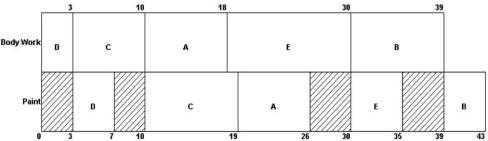
(78) Given the following chart of jobs assigned with Johnson's rule suppose that all the jobs (A, B, C, etc) could be evenly divided into two tasks (such as A1 and A2, B1 and B2, etc). Suppose job D is split into two equivalently sized sections, D1 and D2, each with a body work time of 1.5 hours and a paint time of 2 hours (D1 and D2 sum to 3 hours of body work and 4 hours of paint which is equivalent to D). How much is makespan reduced by this splitting of D?
(Essay)
4.7/5 (77)
(77) Which of the following statements regarding finite capacity scheduling (FCS) is False?
(Multiple Choice)
4.7/5 (66)
(66) What are some limitations of rule-based scheduling systems?
What alternatives are there to rules-based scheduling systems?
(Essay)
4.9/5 (82)
(82) Identify the types of planning files used in scheduling decisions. Which are used in manual systems, and which are used in automated systems?
(Essay)
4.8/5 (78)
(78) A scheduling technique used to achieve optimum, one-to-one matching of tasks and resources is
(Multiple Choice)
4.8/5 (91)
(91) Dispatching rules are typically judged by four effectiveness criteria: average completion time, utilization, average number of jobs in the system, and average job lateness.
(True/False)
4.9/5 (89)
(89) Process-focused facilities and repetitive facilities generate forward-looking schedules, but process-focused facilities do this with JIT and kanban while repetitive facilities generally use MRP.
(True/False)
4.8/5 (91)
(91) The first step in level material use is to combine orders into a few large batches in order to utilize economies of scale.
(True/False)
4.8/5 (81)
(81) There are two jobs to be assigned to two workers. If the profit for worker A on Job 1 is $5 and on Job 2 $8 and for worker B Job 1 profit is $10 and profit from job 2 is $12 how should the work be divided using the assignment method?
(Multiple Choice)
4.9/5 (70)
(70) A method of input-output control that uses a system of cards to limit the amount of work at a work center and also to control lead time and monitor backlog is
(Multiple Choice)
4.9/5 (84)
(84) Average completion time for a schedule sequence at a work center is the ratio of
(Multiple Choice)
4.7/5 (77)
(77) Which of the following best describes the strategic importance of short-term scheduling?
(Multiple Choice)
4.8/5 (79)
(79) A manufacturer has the following jobs waiting on a single work center. The firm has not decided which dispatching rule to apply in order to prioritize the jobs and fix them into the schedule. Processing time in 15-minute time blocks and due date for each job are in the table below.
Time Due Date Job 1 5 17 Job 2 4 20 Job 3 3 16 Job 4 7 9 Job 5 3 6 Job 6 5 7
a. Complete the following table. Show your supporting calculations below.
b. Which dispatching rule has the best score for flow time?
for work in process (jobs in the system)?
for lateness?
c. Is there ANY sequence that can avoid all lateness?
Explain or provide an example.
Average Dispatching Average Number of Average Rule Tob Sequence Flow Time Jobs Lateness EDD SPT LPT
(Essay)
4.8/5 (72)
(72) The jobs listed below needed to be completed. Assume that it is now day 140. If the jobs are sequenced according to longest processing time rule, what is the lateness of job A?
Job Processing Time (days) Job due date (days) A 20 180 B 30 200 C 10 175 D 16 230 E 18 210
(Multiple Choice)
4.8/5 (76)
(76) Which of the following is true regarding services scheduling?
(Multiple Choice)
4.9/5 (89)
(89) 
Filters
- Essay(0)
- Multiple Choice(0)
- Short Answer(0)
- True False(0)
- Matching(0)