



 Chat with AI
Exam 7: Global Markets in Action

Exam 1: What Is Economics212 Questions
Exam 2: The Economic Problem159 Questions
Exam 3: Demand and Supply197 Questions
Exam 4: Elasticity186 Questions
Exam 5: Efficiency and Equity119 Questions
Exam 6: Governments Actions in Markets130 Questions
Exam 7: Global Markets in Action138 Questions
Exam 8: Utility and Demand120 Questions
Exam 9: Possibilities, Preferences, and Choices124 Questions
Exam 10: Organizing Production111 Questions
Exam 11: Output and Costs142 Questions
Exam 12: Perfect Competition117 Questions
Exam 13: Monopoly118 Questions
Exam 14: Monopolistic Competition122 Questions
Exam 15: Oligopoly106 Questions
Exam 16: Externalities116 Questions
Exam 17: Public Goods and Common Resources98 Questions
Exam 18: Markets for Factors of Production128 Questions
Exam 19: Economic Inequality124 Questions
Exam 20: Measuring Gdp and Economic Growth133 Questions
Exam 21: Monitoring Jobs and Inflation121 Questions
Exam 22: Economic Growth98 Questions
Exam 23: Finance, Saving, and Investment141 Questions
Exam 24: Money, the Price Level, and Inflation126 Questions
Exam 25: The Exchange Rate and the Balance of Payments126 Questions
Exam 26: Aggregate Supply and Aggregate Demand136 Questions
Exam 27: Expenditure Multipliers171 Questions
Exam 28: The Business Cycle, Inflation, and Deflation110 Questions
Exam 29: Fiscal Policy97 Questions
Exam 30: Monetary Policy97 Questions
Exam 31: Macro Only: International Trade Policy126 Questions
Select questions type


Canada produces both lumber and wine. Canada exports lumber and imports wine. The rest of the world imports Canadian lumber and exports wine to Canada. Canada has a comparative advantage in producing ________. The rest of the world has a comparative advantage in producing ________.
(Multiple Choice)
4.9/5  (85)
(85) Table 7.2.1
 -Table 7.2.1 shows a country's demand and supply schedules. Based on Table 7.2.1, suppose the world price is $4 a unit. The country
 (Multiple Choice)
4.7/5 (89)
(89) Use the information below to answer the following questions.
Fact 7.3.2
With free trade between Australia and Canada, Australia would export beef to Canada. But Canada imposes an import quota on Australian beef.
-Refer to Fact 7.3.2. If Canada imposes an import quota on Australian beef, the price that Canadian consumers pay for beef will ________ and the quantity of beef produced in Canada will ________.
(Multiple Choice)
4.8/5 (88)
(88) A tariff is a tax that is imposed by the ________ country when an ________ good crosses its international boundary.
(Multiple Choice)
4.9/5 (85)
(85) Usually the imposition of trade barriers affecting a particular good benefits ________ people domestically, each of whom gains a ________.
(Multiple Choice)
4.9/5 (72)
(72) In a market that moves from a situation of no trade to a situation where a good is imported, in the importing country the price of the good ________, and producer surplus ________.
(Multiple Choice)
4.9/5 (74)
(74) Consider a country that sells some of its goods as exports. Who does NOT benefit?
(Multiple Choice)
4.9/5 (78)
(78) Table 7.1.1
Glazeland's Doughnut Market
 -Table 7.1.1 shows Glazeland's doughnut market before international trade. Glazeland opens up to international trade. If the world price is $0.60 a doughnut then Glazeland will produce ________ doughnuts and will ________ doughnuts.
 (Multiple Choice)
4.8/5 (78)
(78) A tariff on watches which are imported by Atlantis ________ the price of watches in Atlantis and ________.
(Multiple Choice)
4.7/5 (74)
(74) Increasing a tariff ________ the domestic quantity consumed of the good and ________ the domestic production of the good.
(Multiple Choice)
4.7/5 (81)
(81) Use the information below to answer the following questions.
Fact 7.3.1
Before 1995, trade between Canada and Mexico was subject to tariffs. In 1995, Mexico joined NAFTA and all Canadian and Mexican tariffs have gradually been removed.
-Refer to Fact 7.3.1. The quantity of Canadian exports to Mexico has ________, and the Canadian government's tariff revenue from trade with Mexico has ________.
(Multiple Choice)
4.9/5 (80)
(80) Refer to the figure below to answer the following questions.
 Figure 7.2.2
The figure shows the market for helicopters in Canada, where D is the domestic demand curve and S is the domestic supply curve. Canada trades helicopters with the rest of the world at a price of $36 million per helicopter.
-In Figure 7.2.2, Canada ________ helicopters per year.
Figure 7.2.2
The figure shows the market for helicopters in Canada, where D is the domestic demand curve and S is the domestic supply curve. Canada trades helicopters with the rest of the world at a price of $36 million per helicopter.
-In Figure 7.2.2, Canada ________ helicopters per year. (Multiple Choice)
4.8/5 (77)
(77) Refer to the figure below to answer the following questions.
 Figure 7.2.1
The figure shows the market for shirts in Canada, where D is the domestic demand curve and S is the domestic supply curve. The world price is $20 per shirt.
-In Figure 7.2.1, with international trade, Canadians buy ________ million shirts per year.
Figure 7.2.1
The figure shows the market for shirts in Canada, where D is the domestic demand curve and S is the domestic supply curve. The world price is $20 per shirt.
-In Figure 7.2.1, with international trade, Canadians buy ________ million shirts per year. (Multiple Choice)
4.9/5 (82)
(82) Refer to the figure below to answer the following questions.
 Figure 7.3.1
The figure shows the market for shirts in Canada, where D is the domestic demand curve and S is the domestic supply curve. The world price is $20 per shirt. Canada imposes a tariff on imported shirts of $4 per shirt.
-Refer to Figure 7.3.1. The tariff ________ the domestic production of shirts in Canada by ________ per year.
Figure 7.3.1
The figure shows the market for shirts in Canada, where D is the domestic demand curve and S is the domestic supply curve. The world price is $20 per shirt. Canada imposes a tariff on imported shirts of $4 per shirt.
-Refer to Figure 7.3.1. The tariff ________ the domestic production of shirts in Canada by ________ per year. (Multiple Choice)
4.7/5 (91)
(91) A country opens up to trade. In an export industry, surplus has been redistributed from
(Multiple Choice)
4.9/5 (84)
(84) Refer to the figure below to answer the following question.
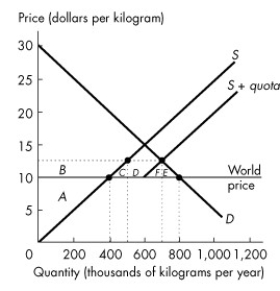 Figure 7.3.2
-Refer to Figure 7.3.2. The supply of peanuts in Canada is made up of Canadian grown peanuts and imported peanuts. Initially, Canada engages in free trade in the peanut market. Then Canada puts a quota on peanut imports. The graph shows the Canadian market for peanuts when the Canadian government puts a quota on peanut imports. The Canadian consumer surplus that is redistributed to Canadian producers is ________ and the quota creates a deadweight loss equal to ________.
Figure 7.3.2
-Refer to Figure 7.3.2. The supply of peanuts in Canada is made up of Canadian grown peanuts and imported peanuts. Initially, Canada engages in free trade in the peanut market. Then Canada puts a quota on peanut imports. The graph shows the Canadian market for peanuts when the Canadian government puts a quota on peanut imports. The Canadian consumer surplus that is redistributed to Canadian producers is ________ and the quota creates a deadweight loss equal to ________. (Multiple Choice)
5.0/5 (85)
(85) 
Filters
- Essay(0)
- Multiple Choice(0)
- Short Answer(0)
- True False(0)
- Matching(0)