



 Chat with AI
Exam 7: Global Markets in Action

Exam 1: What Is Economics212 Questions
Exam 2: The Economic Problem159 Questions
Exam 3: Demand and Supply197 Questions
Exam 4: Elasticity186 Questions
Exam 5: Efficiency and Equity119 Questions
Exam 6: Governments Actions in Markets130 Questions
Exam 7: Global Markets in Action138 Questions
Exam 8: Utility and Demand120 Questions
Exam 9: Possibilities, Preferences, and Choices124 Questions
Exam 10: Organizing Production111 Questions
Exam 11: Output and Costs142 Questions
Exam 12: Perfect Competition117 Questions
Exam 13: Monopoly118 Questions
Exam 14: Monopolistic Competition122 Questions
Exam 15: Oligopoly106 Questions
Exam 16: Externalities116 Questions
Exam 17: Public Goods and Common Resources98 Questions
Exam 18: Markets for Factors of Production128 Questions
Exam 19: Economic Inequality124 Questions
Exam 20: Measuring Gdp and Economic Growth133 Questions
Exam 21: Monitoring Jobs and Inflation121 Questions
Exam 22: Economic Growth98 Questions
Exam 23: Finance, Saving, and Investment141 Questions
Exam 24: Money, the Price Level, and Inflation126 Questions
Exam 25: The Exchange Rate and the Balance of Payments126 Questions
Exam 26: Aggregate Supply and Aggregate Demand136 Questions
Exam 27: Expenditure Multipliers171 Questions
Exam 28: The Business Cycle, Inflation, and Deflation110 Questions
Exam 29: Fiscal Policy97 Questions
Exam 30: Monetary Policy97 Questions
Exam 31: Macro Only: International Trade Policy126 Questions
Select questions type


The effects of offshore outsourcing from opening up call centres in India are similar to the effects from
(Multiple Choice)
4.8/5  (79)
(79) Canada exports athletic coaching services and imports computer tech support. The price of athletic coaching services in Canada is ________ with international trade than without international trade. As a result of trade in athletic coaching services, the Canadian producer surplus from athletic coaching services ________.
(Multiple Choice)
4.8/5 (77)
(77) Refer to the figure below to answer the following questions.
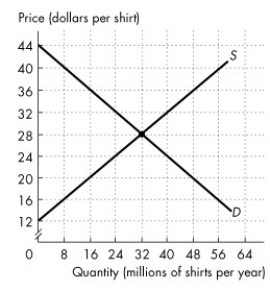 Figure 7.3.1
The figure shows the market for shirts in Canada, where D is the domestic demand curve and S is the domestic supply curve. The world price is $20 per shirt. Canada imposes a tariff on imported shirts of $4 per shirt.
-Refer to Figure 7.3.1. Canadian producers' ________ from the tariff is ________.
Figure 7.3.1
The figure shows the market for shirts in Canada, where D is the domestic demand curve and S is the domestic supply curve. The world price is $20 per shirt. Canada imposes a tariff on imported shirts of $4 per shirt.
-Refer to Figure 7.3.1. Canadian producers' ________ from the tariff is ________. (Multiple Choice)
4.8/5 (66)
(66) Which of the following are reasons economists consider valid for trade protection?
I. Protection penalizes countries that have weak environmental standards.
II. Protection limits dumping of low-wage jobs into the domestic economy.
III. Protection prevents low-wage jobs in foreign countries from lowering wages in Canada.
(Multiple Choice)
4.8/5 (97)
(97) A country opens up to trade. In an import industry, surplus has been redistributed from
(Multiple Choice)
4.9/5 (74)
(74) Refer to the figure below to answer the following questions.
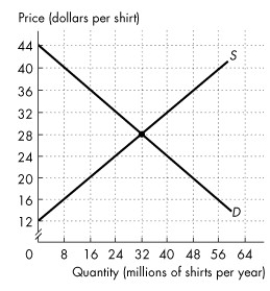 Figure 7.2.1
The figure shows the market for shirts in Canada, where D is the domestic demand curve and S is the domestic supply curve. The world price is $20 per shirt.
-In Figure 7.2.1, international trade ________ producer surplus in Canada by ________.
Figure 7.2.1
The figure shows the market for shirts in Canada, where D is the domestic demand curve and S is the domestic supply curve. The world price is $20 per shirt.
-In Figure 7.2.1, international trade ________ producer surplus in Canada by ________. (Multiple Choice)
4.9/5 (76)
(76) In one year, Brazil exported more than 1.8 billion kilograms of coffee to the rest of the world. We can conclude that
(Multiple Choice)
4.9/5 (98)
(98) Refer to the figure below to answer the following question.
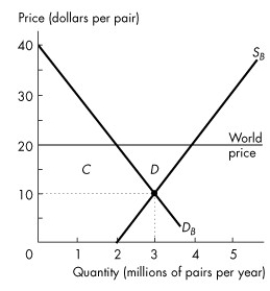 Figure 7.2.4
-Refer to Figure 7.2.4. The graph shows the demand for shoes in Brazil, DB, the supply of shoes produced in Brazil, SB, and the market equilibrium in Brazil when it does not trade internationally. If the world price of a pair of shoes is $20 and Brazil opens up and trades internationally, producer surplus in Brazil ________ and consumer surplus in Brazil ________.
Figure 7.2.4
-Refer to Figure 7.2.4. The graph shows the demand for shoes in Brazil, DB, the supply of shoes produced in Brazil, SB, and the market equilibrium in Brazil when it does not trade internationally. If the world price of a pair of shoes is $20 and Brazil opens up and trades internationally, producer surplus in Brazil ________ and consumer surplus in Brazil ________. (Multiple Choice)
4.9/5 (67)
(67) Import quotas ________ the price of imported goods and ________ the quantity consumed in the country imposing the quota.
(Multiple Choice)
4.9/5 (79)
(79) A country opens up to trade and becomes an importer of some good. Consumer surplus ________, and producer surplus ________.
(Multiple Choice)
4.9/5 (78)
(78) A tariff is imposed on a good. This ________ the quantity supplied and ________ the quantity demanded in the importing country.
(Multiple Choice)
4.8/5 (65)
(65) Refer to the figure below to answer the following questions.
Figure 7.3.1
The figure shows the market for shirts in Canada, where D is the domestic demand curve and S is the domestic supply curve. The world price is $20 per shirt. Canada imposes a tariff on imported shirts of $4 per shirt.
-Refer to Figure 7.3.1. The Canadian government's revenue from the tariff is ________.
Figure 7.3.1
The figure shows the market for shirts in Canada, where D is the domestic demand curve and S is the domestic supply curve. The world price is $20 per shirt. Canada imposes a tariff on imported shirts of $4 per shirt.
-Refer to Figure 7.3.1. The Canadian government's revenue from the tariff is ________. (Multiple Choice)
4.8/5 (85)
(85) Compared to the situation before international trade, after Canada imports a good, production in Canada ________ and consumption in Canada ________.
(Multiple Choice)
4.8/5 (76)
(76) Refer to the figure below to answer the following questions.
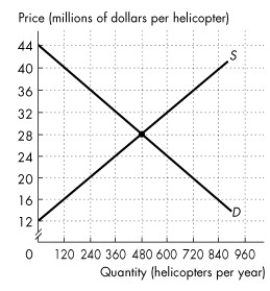 Figure 7.2.2
The figure shows the market for helicopters in Canada, where D is the domestic demand curve and S is the domestic supply curve. Canada trades helicopters with the rest of the world at a price of $36 million per helicopter.
-In Figure 7.2.2, with international trade, ________ helicopters per year are produced in Canada.
Figure 7.2.2
The figure shows the market for helicopters in Canada, where D is the domestic demand curve and S is the domestic supply curve. Canada trades helicopters with the rest of the world at a price of $36 million per helicopter.
-In Figure 7.2.2, with international trade, ________ helicopters per year are produced in Canada. (Multiple Choice)
4.9/5 (78)
(78) In a market that moves from a situation of no trade to a situation where a good is exported, in the exporting country the price of the good ________, and producer surplus ________.
(Multiple Choice)
4.7/5 (85)
(85) Goods and services that we buy from other countries are our
(Multiple Choice)
4.8/5 (77)
(77) Refer to the figure below to answer the following questions.
Figure 7.2.2
The figure shows the market for helicopters in Canada, where D is the domestic demand curve and S is the domestic supply curve. Canada trades helicopters with the rest of the world at a price of $36 million per helicopter.
-In Figure 7.2.2, international trade ________ producer surplus in Canada by ________.
Figure 7.2.2
The figure shows the market for helicopters in Canada, where D is the domestic demand curve and S is the domestic supply curve. Canada trades helicopters with the rest of the world at a price of $36 million per helicopter.
-In Figure 7.2.2, international trade ________ producer surplus in Canada by ________. (Multiple Choice)
4.9/5 (73)
(73) Use the information below to answer the following questions.
Fact 7.3.1
Before 1995, trade between Canada and Mexico was subject to tariffs. In 1995, Mexico joined NAFTA and all Canadian and Mexican tariffs have gradually been removed.
-Refer to Fact 7.3.1. When Canadian tariffs are removed from a good, Canadian consumers of the good ________, and Canadian producers of the good ________.
(Multiple Choice)
4.9/5 (81)
(81) 
Filters
- Essay(0)
- Multiple Choice(0)
- Short Answer(0)
- True False(0)
- Matching(0)