



 Chat with AI
Exam 23: Finance, Saving, and Investment

Exam 1: What Is Economics212 Questions
Exam 2: The Economic Problem159 Questions
Exam 3: Demand and Supply197 Questions
Exam 4: Elasticity186 Questions
Exam 5: Efficiency and Equity119 Questions
Exam 6: Governments Actions in Markets130 Questions
Exam 7: Global Markets in Action138 Questions
Exam 8: Utility and Demand120 Questions
Exam 9: Possibilities, Preferences, and Choices124 Questions
Exam 10: Organizing Production111 Questions
Exam 11: Output and Costs142 Questions
Exam 12: Perfect Competition117 Questions
Exam 13: Monopoly118 Questions
Exam 14: Monopolistic Competition122 Questions
Exam 15: Oligopoly106 Questions
Exam 16: Externalities116 Questions
Exam 17: Public Goods and Common Resources98 Questions
Exam 18: Markets for Factors of Production128 Questions
Exam 19: Economic Inequality124 Questions
Exam 20: Measuring Gdp and Economic Growth133 Questions
Exam 21: Monitoring Jobs and Inflation121 Questions
Exam 22: Economic Growth98 Questions
Exam 23: Finance, Saving, and Investment141 Questions
Exam 24: Money, the Price Level, and Inflation126 Questions
Exam 25: The Exchange Rate and the Balance of Payments126 Questions
Exam 26: Aggregate Supply and Aggregate Demand136 Questions
Exam 27: Expenditure Multipliers171 Questions
Exam 28: The Business Cycle, Inflation, and Deflation110 Questions
Exam 29: Fiscal Policy97 Questions
Exam 30: Monetary Policy97 Questions
Exam 31: Macro Only: International Trade Policy126 Questions
Select questions type


In the market for loanable funds, a larger government surplus leads to
(Multiple Choice)
4.8/5  (72)
(72) The tendency for private saving to increase in response to growing government deficits is known as the
(Multiple Choice)
4.9/5 (73)
(73) Suppose a bond promises to pay its holder $100 a year forever. The interest rate on the bond rises from 4 percent to 5 percent. The price of the bond
(Multiple Choice)
4.8/5 (63)
(63) Refer to the figure below to answer the following questions.
 Figure 23.2.2
-Refer to Figure 23.2.2. In Figure 23.2.2, a decrease in the real interest rate will result in a movement from point E to
Figure 23.2.2
-Refer to Figure 23.2.2. In Figure 23.2.2, a decrease in the real interest rate will result in a movement from point E to (Multiple Choice)
4.9/5 (75)
(75) The key Canadian financial institutions include all of the following except
(Multiple Choice)
4.9/5 (80)
(80) If the nominal interest rate is 11 percent and the inflation rate is 9 percent, then the real interest rate is approximately
(Multiple Choice)
4.8/5 (78)
(78) Use the table below to answer the following questions.
Table 23.3.7
The table shows an economy's demand for loanable funds schedule and supply of loanable funds schedule when the government's budget is balanced.
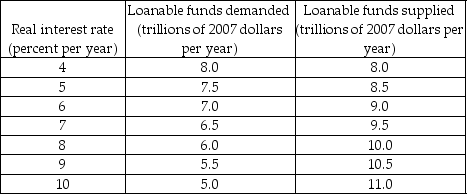 -Consider Table 23.3.7. If the government's budget becomes a deficit of $1.0 trillion, what is the quantity of investment?
 (Multiple Choice)
4.9/5 (85)
(85) Suppose that you took out a $1,000 loan in January and were required to pay $75 in annual interest. During the year, inflation was 6 percent. Which of the following statements is correct?
(Multiple Choice)
4.9/5 (69)
(69) Refer to the figure below to answer the following questions.
 Figure 23.2.3
-Refer to Figure 23.2.3. In Figure 23.2.3, if the real interest rate is 6 percent, the quantity of loanable funds demanded is
Figure 23.2.3
-Refer to Figure 23.2.3. In Figure 23.2.3, if the real interest rate is 6 percent, the quantity of loanable funds demanded is (Multiple Choice)
4.9/5 (79)
(79) Use the table below to answer the following questions.
Table 23.2.3
The table shows an economy's demand for loanable funds schedule and supply of loanable funds schedule.
 -Consider Table 23.2.3. If planned saving decreases by $1.0 trillion at each real interest rate, what is the new equilibrium real interest rate?
 (Multiple Choice)
4.9/5 (72)
(72) At the beginning of the year, Tom's Tubes had capital of 5 tube-inflating machines. During the year, Tom scrapped 2 old machines and purchased 3 new machines. Tom's net investment for the year is
(Multiple Choice)
4.8/5 (76)
(76) Use the table below to answer the following questions.
Table 23.3.6
The table shows an economy's demand for loanable funds schedule and supply of loanable funds schedule when the government's budget is balanced.
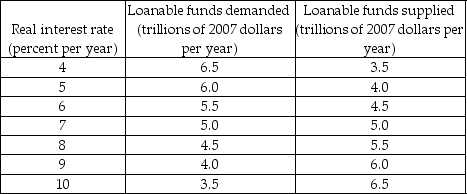 -Consider Table 23.3.6. If the Ricardo-Barro effect occurs, and if the government's budget becomes a deficit of $2.0 trillion, what is the real interest rate?
 (Multiple Choice)
4.7/5 (83)
(83) In the market for loanable funds, as the real interest rate rises, the ________ and the ________.
(Multiple Choice)
4.8/5 (77)
(77) Suppose Canada spends more on foreign goods and services than foreigners spend on our goods and services. Then
(Multiple Choice)
4.7/5 (81)
(81) A government budget deficit ________ the demand for loanable funds and ________ investment.
(Multiple Choice)
4.8/5 (92)
(92) Use the table below to answer the following questions.
Table 23.2.3
The table shows an economy's demand for loanable funds schedule and supply of loanable funds schedule.
-Consider Table 23.2.3. If planned investment decreases by $1.0 trillion at each real interest rate, what is the new equilibrium real interest rate?
-Consider Table 23.2.3. If planned investment decreases by $1.0 trillion at each real interest rate, what is the new equilibrium real interest rate? (Multiple Choice)
4.8/5 (78)
(78) A government budget surplus occurs, which ________ loanable funds. The real interest rate ________, household saving ________, and investment ________.
(Multiple Choice)
4.7/5 (92)
(92) 
Filters
- Essay(0)
- Multiple Choice(0)
- Short Answer(0)
- True False(0)
- Matching(0)