



 Chat with AI
Exam 23: Finance, Saving, and Investment

Exam 1: What Is Economics212 Questions
Exam 2: The Economic Problem159 Questions
Exam 3: Demand and Supply197 Questions
Exam 4: Elasticity186 Questions
Exam 5: Efficiency and Equity119 Questions
Exam 6: Governments Actions in Markets130 Questions
Exam 7: Global Markets in Action138 Questions
Exam 8: Utility and Demand120 Questions
Exam 9: Possibilities, Preferences, and Choices124 Questions
Exam 10: Organizing Production111 Questions
Exam 11: Output and Costs142 Questions
Exam 12: Perfect Competition117 Questions
Exam 13: Monopoly118 Questions
Exam 14: Monopolistic Competition122 Questions
Exam 15: Oligopoly106 Questions
Exam 16: Externalities116 Questions
Exam 17: Public Goods and Common Resources98 Questions
Exam 18: Markets for Factors of Production128 Questions
Exam 19: Economic Inequality124 Questions
Exam 20: Measuring Gdp and Economic Growth133 Questions
Exam 21: Monitoring Jobs and Inflation121 Questions
Exam 22: Economic Growth98 Questions
Exam 23: Finance, Saving, and Investment141 Questions
Exam 24: Money, the Price Level, and Inflation126 Questions
Exam 25: The Exchange Rate and the Balance of Payments126 Questions
Exam 26: Aggregate Supply and Aggregate Demand136 Questions
Exam 27: Expenditure Multipliers171 Questions
Exam 28: The Business Cycle, Inflation, and Deflation110 Questions
Exam 29: Fiscal Policy97 Questions
Exam 30: Monetary Policy97 Questions
Exam 31: Macro Only: International Trade Policy126 Questions
Select questions type


Approximately, the real interest rate ________ the inflation rate ________ the nominal interest rate.
(Multiple Choice)
4.7/5  (84)
(84) Choose the statement that is incorrect about trust and loan companies.
(Multiple Choice)
4.9/5 (75)
(75) Table 23.3.3
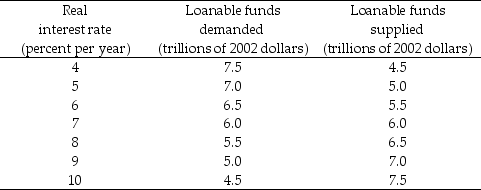 -Refer to Table 23.3.3. The table shows the demand for loanable funds schedule and the private supply of loanable funds schedule when the government's budget is balanced. If the Ricardo-Barro effect occurs, and if the government budget deficit is $2.0 trillion, the real interest rate is ________ percent a year and the quantity of investment is ________ trillion.
 (Multiple Choice)
4.9/5 (80)
(80) Which of the following will shift the supply of loanable funds curve leftward?
(Multiple Choice)
4.8/5 (75)
(75) Refer to the figure below to answer the following questions.
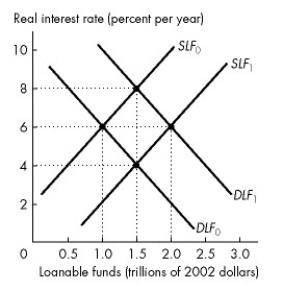 Figure 23.2.5
-Refer to Figure 23.2.5. In Figure 23.2.5, the supply of loanable funds curve is SLF₀ and the demand for loanable funds curve is DLF₀. An expansion that increases disposable income and expected profit
Figure 23.2.5
-Refer to Figure 23.2.5. In Figure 23.2.5, the supply of loanable funds curve is SLF₀ and the demand for loanable funds curve is DLF₀. An expansion that increases disposable income and expected profit (Multiple Choice)
4.9/5 (74)
(74) Technological progress that increases expected profit shifts the demand for loanable funds curve
(Multiple Choice)
4.8/5 (75)
(75) If the real interest rate rises from 3 percent to 5 percent,
(Multiple Choice)
4.8/5 (81)
(81) Use the table below to answer the following questions.
Table 23.3.6
The table shows an economy's demand for loanable funds schedule and supply of loanable funds schedule when the government's budget is balanced.
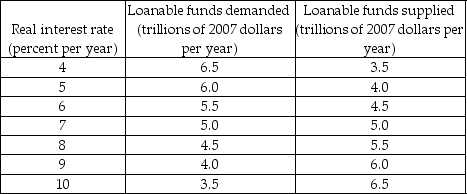 -Consider Table 23.3.6. If the Ricardo-Barro effect occurs, and if the government's budget becomes a deficit of $2.0 trillion, what is the quantity of investment?
 (Multiple Choice)
4.9/5 (78)
(78) Use the table below to answer the following questions.
Table 23.2.2
The table shows an economy's demand for loanable funds schedule and supply of loanable funds schedule.
 -Consider Table 23.2.2. What is the equilibrium quantity of investment?
 (Multiple Choice)
4.7/5 (74)
(74) If the real interest rate is above the equilibrium real interest rate,
(Multiple Choice)
4.9/5 (71)
(71) If the real interest rate is below the equilibrium real interest rate,
(Multiple Choice)
4.9/5 (72)
(72) Suppose the current real interest rate is 4 percent and the equilibrium real interest rate is 3 percent. Choose the correct statement.
(Multiple Choice)
4.8/5 (84)
(84) 
Filters
- Essay(0)
- Multiple Choice(0)
- Short Answer(0)
- True False(0)
- Matching(0)