



 Chat with AI
Exam 22: Economic Growth

Exam 1: What Is Economics212 Questions
Exam 2: The Economic Problem159 Questions
Exam 3: Demand and Supply197 Questions
Exam 4: Elasticity186 Questions
Exam 5: Efficiency and Equity119 Questions
Exam 6: Governments Actions in Markets130 Questions
Exam 7: Global Markets in Action138 Questions
Exam 8: Utility and Demand120 Questions
Exam 9: Possibilities, Preferences, and Choices124 Questions
Exam 10: Organizing Production111 Questions
Exam 11: Output and Costs142 Questions
Exam 12: Perfect Competition117 Questions
Exam 13: Monopoly118 Questions
Exam 14: Monopolistic Competition122 Questions
Exam 15: Oligopoly106 Questions
Exam 16: Externalities116 Questions
Exam 17: Public Goods and Common Resources98 Questions
Exam 18: Markets for Factors of Production128 Questions
Exam 19: Economic Inequality124 Questions
Exam 20: Measuring Gdp and Economic Growth133 Questions
Exam 21: Monitoring Jobs and Inflation121 Questions
Exam 22: Economic Growth98 Questions
Exam 23: Finance, Saving, and Investment141 Questions
Exam 24: Money, the Price Level, and Inflation126 Questions
Exam 25: The Exchange Rate and the Balance of Payments126 Questions
Exam 26: Aggregate Supply and Aggregate Demand136 Questions
Exam 27: Expenditure Multipliers171 Questions
Exam 28: The Business Cycle, Inflation, and Deflation110 Questions
Exam 29: Fiscal Policy97 Questions
Exam 30: Monetary Policy97 Questions
Exam 31: Macro Only: International Trade Policy126 Questions
Select questions type


When labour productivity decreases, there is ________ the production function and ________ in potential GDP.
(Multiple Choice)
4.9/5  (73)
(73) Use the figure below to answer the following question.
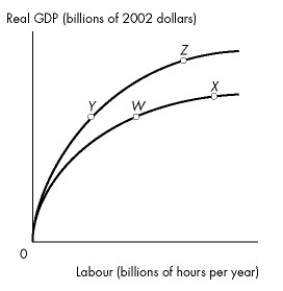 Figure 22.3.1
-Refer to Figure 22.3.1. The country of Kemper is on its aggregate production function at point W in the above figure. If the population increases with no change in capital or technology, the economy will
Figure 22.3.1
-Refer to Figure 22.3.1. The country of Kemper is on its aggregate production function at point W in the above figure. If the population increases with no change in capital or technology, the economy will (Multiple Choice)
4.8/5 (90)
(90) Ceteris paribus, an increase in labour productivity results in a
(Multiple Choice)
4.8/5 (63)
(63) Use the figure below to answer the following questions.
 Figure 22.3.2
-Refer to Figure 22.3.2. The equilibrium quantity of labour is
Figure 22.3.2
-Refer to Figure 22.3.2. The equilibrium quantity of labour is (Multiple Choice)
4.9/5 (83)
(83) The new growth theory holds that growth can persist indefinitely based on the major assumption that
(Multiple Choice)
4.8/5 (78)
(78) Use the figure below to answer the following questions.
Figure 22.3.2
-Refer to Figure 22.3.2. The equilibrium real wage rate is
Figure 22.3.2
-Refer to Figure 22.3.2. The equilibrium real wage rate is (Multiple Choice)
4.8/5 (87)
(87) For three years, there was no technological change in Longland but capital per hour of labour increased from $10 to $20 to $30 and real GDP per hour of labour increased from $3.80 to $5.70 to $7.13. Then in the fourth year, capital per hour of labour remained constant but real GDP per hour of labour increased to $10. Longland ________ experience diminishing returns because ________.
(Multiple Choice)
4.8/5 (67)
(67) Suppose a country is producing $20 million of real GDP. If the economy grows at 10 percent per year, approximately how many years will to take for real GDP to grow to $80 million?
(Multiple Choice)
4.8/5 (80)
(80) Real GDP per person in the country of Flip is $10,000, and the growth rate is 10 percent a year. Real GDP per person in the country of Flap is $20,000 and the growth rate is 5 percent a year. When will real GDP per person be greater in Flip than in Flap?
(Multiple Choice)
4.9/5 (75)
(75) Between 1926 and 2014 real GDP per person in Canada grew at an average rate of
(Multiple Choice)
4.9/5 (66)
(66) If new capital increases labour productivity, the supply of labour ________ and the demand for labour ________.
(Multiple Choice)
4.9/5 (72)
(72) When labour productivity increases, the demand for labour curve ________ and the supply of labour curve ________.
(Multiple Choice)
4.8/5 (96)
(96) Convergence between real GDP per person in Canada and Japan was relatively ________ during the 1960s; convergence has recently been ________.
(Multiple Choice)
4.7/5 (76)
(76) Growthland's real GDP per person was $112,000 in 2013 and $117,000 in 2014. What is the growth rate of Growthland's real GDP per person in 2014?
(Multiple Choice)
4.9/5 (76)
(76) During 2014, the country of Economia had real GDP of $115 billion and the population was 0.9 billion. In 2015, real GDP was $105 billion and the population was 0.85 billion. In 2014, real GDP per person was
(Multiple Choice)
4.9/5 (88)
(88) Use the information below to answer the following questions.
Fact 22.2.1
China was the largest economy for centuries because everyone had the same type of economy-subsistence-and so the country with the most people would be economically biggest. Then the Industrial Revolution sent the West on a more prosperous path. Now the world is returning to a common economy, this time technology- and information-based, so once again population triumphs.
-Consider Fact 22.2.1. China's was the world's largest economy until 1890 because
(Multiple Choice)
5.0/5 (91)
(91) If capital per worker decreases, real GDP per hour of labour
(Multiple Choice)
4.8/5 (69)
(69) 
Filters
- Essay(0)
- Multiple Choice(0)
- Short Answer(0)
- True False(0)
- Matching(0)