



 Chat with AI
Exam 22: Economic Growth

Exam 1: What Is Economics212 Questions
Exam 2: The Economic Problem159 Questions
Exam 3: Demand and Supply197 Questions
Exam 4: Elasticity186 Questions
Exam 5: Efficiency and Equity119 Questions
Exam 6: Governments Actions in Markets130 Questions
Exam 7: Global Markets in Action138 Questions
Exam 8: Utility and Demand120 Questions
Exam 9: Possibilities, Preferences, and Choices124 Questions
Exam 10: Organizing Production111 Questions
Exam 11: Output and Costs142 Questions
Exam 12: Perfect Competition117 Questions
Exam 13: Monopoly118 Questions
Exam 14: Monopolistic Competition122 Questions
Exam 15: Oligopoly106 Questions
Exam 16: Externalities116 Questions
Exam 17: Public Goods and Common Resources98 Questions
Exam 18: Markets for Factors of Production128 Questions
Exam 19: Economic Inequality124 Questions
Exam 20: Measuring Gdp and Economic Growth133 Questions
Exam 21: Monitoring Jobs and Inflation121 Questions
Exam 22: Economic Growth98 Questions
Exam 23: Finance, Saving, and Investment141 Questions
Exam 24: Money, the Price Level, and Inflation126 Questions
Exam 25: The Exchange Rate and the Balance of Payments126 Questions
Exam 26: Aggregate Supply and Aggregate Demand136 Questions
Exam 27: Expenditure Multipliers171 Questions
Exam 28: The Business Cycle, Inflation, and Deflation110 Questions
Exam 29: Fiscal Policy97 Questions
Exam 30: Monetary Policy97 Questions
Exam 31: Macro Only: International Trade Policy126 Questions
Select questions type


Of the following countries, which has the lowest level of real GDP per person?
(Multiple Choice)
5.0/5  (83)
(83) Which of the following ideas apply to the neoclassical growth theory?
I. The rate of technological change influences the rate of economic growth.
II. Technological change promotes saving and investment.
III. Convergence of economic growth rates across countries.
(Multiple Choice)
4.8/5 (98)
(98) Which of the following does not contribute to achieving faster growth?
(Multiple Choice)
4.9/5 (76)
(76) During the last 10 years, which of the following had the lowest level of real GDP per person?
(Multiple Choice)
4.9/5 (93)
(93) Between 1960 and 2010, growth rates in real GDP per person in Hong Kong, Korea, Singapore, Taiwan, and China ________ the growth rate of real GDP per person in Canada. China's real GDP per person in 2010 is approximately equal to real GDP per person in Hong Kong in ________.
(Multiple Choice)
4.9/5 (80)
(80) Use the table below to answer the following questions.
Table 22.3.1
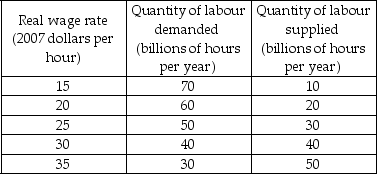
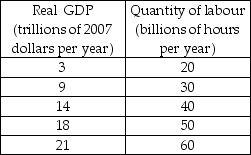 -Refer to Table 22.3.1. The tables show the labour market and the production function schedule for the country of Pickett. An increase in population changes the quantity of labour supplied by 20 billion hours at each real wage rate. Potential GDP
 (Multiple Choice)
4.9/5 (77)
(77) Which theory of economic growth argues that growth does not automatically slow down?
(Multiple Choice)
4.8/5 (89)
(89) Which of the following is a suggestion for increasing Canadian economic growth rates?
(Multiple Choice)
4.8/5 (74)
(74) Slowdonia's current growth rate of real GDP per person is 1 percent a year. How long will it take to double real GDP per person?
(Multiple Choice)
4.9/5 (88)
(88) Choose the statements concerning neoclassical growth theory which are true. 1. Neoclassical growth theory was developed in the late 19th century.
2. The rate of technological change influences the economic growth rate but economic growth does not influence the pace of technological change.
3. Economic growth will stop if technology stops advancing.
4. Technological change results from the choices people make in the pursuit of profit.
(Multiple Choice)
4.9/5 (87)
(87) According to the law of diminishing returns, along the aggregate production function, an additional unit of
(Multiple Choice)
4.8/5 (81)
(81) Knowledge capital is different from physical capital because knowledge capital
(Multiple Choice)
4.9/5 (74)
(74) Which one of the following quotations could be attributed to a supporter of the classical growth theory?
(Multiple Choice)
4.8/5 (89)
(89) 
Filters
- Essay(0)
- Multiple Choice(0)
- Short Answer(0)
- True False(0)
- Matching(0)