



 Chat with AI
Exam 8: A: Costs and the Supply of Goods

Exam 1: The Economic Approach210 Questions
Exam 2: A: Some Tools of the Economist224 Questions
Exam 2: B: Some Tools of the Economist33 Questions
Exam 3: A: Supply, Demand, and the Market Process225 Questions
Exam 3: B: Supply, Demand, and the Market Process180 Questions
Exam 4: A: Supply and Demand: Applications and Extensions233 Questions
Exam 4: B: Supply and Demand: Applications and Extensions98 Questions
Exam 5: Difficult Cases for the Market and the Role of Government168 Questions
Exam 6: The Economics of Collective Decision-Making180 Questions
Exam 7: Consumer Choice and Elasticity223 Questions
Exam 8: A: Costs and the Supply of Goods223 Questions
Exam 8: B: Costs and the Supply of Goods8 Questions
Exam 9: A: Price Takers and the Competitive Process237 Questions
Exam 9: B: Price Takers and the Competitive Process23 Questions
Exam 10: Price-Searcher Markets With Low Entry Barriers216 Questions
Exam 11: A: Price-Searcher Markets With High Entry Barriers229 Questions
Exam 11: B: Price-Searcher Markets With High Entry Barriers25 Questions
Exam 12: The Supply of and Demand for Productive Resources200 Questions
Exam 13: Earnings, Productivity, and the Job Market109 Questions
Exam 14: Investment, the Capital Market, and the Wealth of Nations129 Questions
Exam 15: Income Inequality and Poverty136 Questions
Exam 16: Appendix: Government Spending and Taxation79 Questions
Exam 17: Appendix: the Economics of Social Security54 Questions
Exam 18: Appendix: the Stock Market: Its Function, Performance, and Potential As an Investment Opportunity70 Questions
Exam 19: Appendix: Great Debates in Economics: Keynes Versus Hayek8 Questions
Exam 20: Appendix: the Crisis of 2008: Causes and Lessons for the Future64 Questions
Exam 21: Appendix: Lessons From the Great Depression60 Questions
Exam 22: Appendix: the Economics of Healthcare68 Questions
Exam 23: Appendix:education: Problems and Performance60 Questions
Exam 24: Appendix: Earnings Differences Between Men and Women47 Questions
Exam 26: Appendix: the Question of Resource Exhaustion61 Questions
Exam 25: Appendix: Do Labor Unions Increase the Wages of Workers74 Questions
Exam 27: Appendix: Difficult Environmental Cases and the Role of Government63 Questions
Select questions type


You purchased an automobile a year ago for $10,000. Its current market price is $6,000, and the expected market value one year from now is $4,000. If the interest rate is 10 percent, how much will it cost you to keep the car for an additional year (over and above operation and maintenance costs)?
(Multiple Choice)
4.7/5  (78)
(78) Which of the following would most likely cause a firm's cost curve to shift downward?
(Multiple Choice)
4.8/5 (71)
(71) As Product Co. adds the first four workers to its production process in the short run, its output rises from 0 to 12 to 25 to 35 to 43. Addition of the fifth worker will most likely lead to an output rate
(Multiple Choice)
4.9/5 (68)
(68) Long-run diseconomies of scale exist over the range of output for which the long-run average cost curve is
(Multiple Choice)
4.9/5 (80)
(80) Figure 8-8
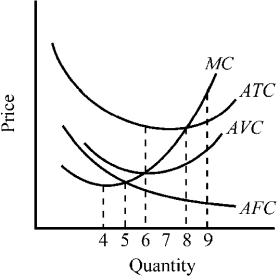 -In Figure 8-8, which output level would be most closely associated with the point where diminishing marginal returns have begun?
 (Multiple Choice)
4.8/5 (84)
(84) For a firm that wants to remain in business, which of the following costs could be avoided if it halted current production?
(Multiple Choice)
4.9/5 (89)
(89) The average variable cost curve and average total cost curve become closer together as output increases because
(Multiple Choice)
4.8/5 (75)
(75) When total revenue minus total economic cost is equal to zero, the firm is
(Multiple Choice)
4.8/5 (83)
(83) Which of the following must be true if average total costs are declining?
(Multiple Choice)
5.0/5 (79)
(79) Which of the following explains why business owners have a strong incentive to strive for operational efficiency?
(Multiple Choice)
4.8/5 (92)
(92) Figure 8-7
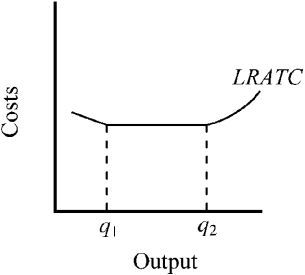 -Which of the following is true for Figure 8-7?
 (Multiple Choice)
4.9/5 (70)
(70) Ron works for Betty at Betty's Pizza Palace. Betty has many work rules, and Ron believes if there were fewer rules and more flexibility, he could do a better job. Betty probably has the rules because
(Multiple Choice)
4.7/5 (72)
(72) Which of the following is most likely to reduce the incidence of employee shirking?
(Multiple Choice)
4.8/5 (65)
(65) As output rises, marginal product eventually diminishes and
(Multiple Choice)
4.8/5 (78)
(78) Figure 8-12
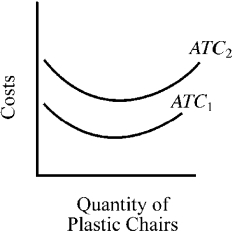 -In Figure 8-12, which of the following would most likely cause the average total cost curve of a firm producing molded plastic chairs to shift from ATC₁ to ATC₂?
 (Multiple Choice)
4.8/5 (64)
(64) Figure 8-4
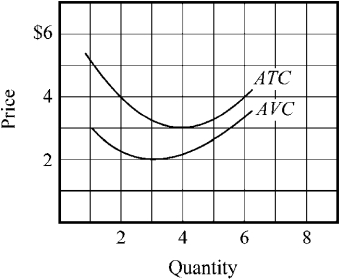 -Using Figure 8-4, calculate the firm's total cost of producing four units of output.
 (Multiple Choice)
4.9/5 (91)
(91) Long-run economies of scale exist when the long-run average cost curve
(Multiple Choice)
4.8/5 (82)
(82) 
Filters
- Essay(0)
- Multiple Choice(0)
- Short Answer(0)
- True False(0)
- Matching(0)