



 Chat with AI
Exam 8: A: Costs and the Supply of Goods

Exam 1: The Economic Approach210 Questions
Exam 2: A: Some Tools of the Economist224 Questions
Exam 2: B: Some Tools of the Economist33 Questions
Exam 3: A: Supply, Demand, and the Market Process225 Questions
Exam 3: B: Supply, Demand, and the Market Process180 Questions
Exam 4: A: Supply and Demand: Applications and Extensions233 Questions
Exam 4: B: Supply and Demand: Applications and Extensions98 Questions
Exam 5: Difficult Cases for the Market and the Role of Government168 Questions
Exam 6: The Economics of Collective Decision-Making180 Questions
Exam 7: Consumer Choice and Elasticity223 Questions
Exam 8: A: Costs and the Supply of Goods223 Questions
Exam 8: B: Costs and the Supply of Goods8 Questions
Exam 9: A: Price Takers and the Competitive Process237 Questions
Exam 9: B: Price Takers and the Competitive Process23 Questions
Exam 10: Price-Searcher Markets With Low Entry Barriers216 Questions
Exam 11: A: Price-Searcher Markets With High Entry Barriers229 Questions
Exam 11: B: Price-Searcher Markets With High Entry Barriers25 Questions
Exam 12: The Supply of and Demand for Productive Resources200 Questions
Exam 13: Earnings, Productivity, and the Job Market109 Questions
Exam 14: Investment, the Capital Market, and the Wealth of Nations129 Questions
Exam 15: Income Inequality and Poverty136 Questions
Exam 16: Appendix: Government Spending and Taxation79 Questions
Exam 17: Appendix: the Economics of Social Security54 Questions
Exam 18: Appendix: the Stock Market: Its Function, Performance, and Potential As an Investment Opportunity70 Questions
Exam 19: Appendix: Great Debates in Economics: Keynes Versus Hayek8 Questions
Exam 20: Appendix: the Crisis of 2008: Causes and Lessons for the Future64 Questions
Exam 21: Appendix: Lessons From the Great Depression60 Questions
Exam 22: Appendix: the Economics of Healthcare68 Questions
Exam 23: Appendix:education: Problems and Performance60 Questions
Exam 24: Appendix: Earnings Differences Between Men and Women47 Questions
Exam 26: Appendix: the Question of Resource Exhaustion61 Questions
Exam 25: Appendix: Do Labor Unions Increase the Wages of Workers74 Questions
Exam 27: Appendix: Difficult Environmental Cases and the Role of Government63 Questions
Select questions type


The increase in total output that results from a unit increase in the employment of a variable input is equal to the input's
(Multiple Choice)
4.8/5  (72)
(72) Which of the following is not an advantage of the corporate structure over proprietorship and partnership forms of business organization?
(Multiple Choice)
4.7/5 (84)
(84) Which of the following would increase a firm's average total costs?
(Multiple Choice)
4.8/5 (82)
(82) Which of the following explains most accurately why the firm's short-run marginal cost curve will eventually rise?
(Multiple Choice)
4.8/5 (85)
(85) If a firm increases its output and finds that its average total cost decreases as a result, this implies that
(Multiple Choice)
4.7/5 (86)
(86) If most firms in an industry are earning a 7 percent rate of return on their assets, but your business is earning 9 percent, your rate of economic profit is
(Multiple Choice)
4.7/5 (78)
(78) Figure 8-14
The following question(s) refer(s) to the below cost curves for one very small firm in a large market.
 -Refer to Figure 8-14. If the firm produces 10 units of output, its average total cost is
 (Multiple Choice)
4.9/5 (80)
(80) The table below presents the schedule of total costs for Sharpie's Pencil Company.  Beyond 110,000 units, the per-unit marginal cost of producing an additional 10,000 pencils is
 (Multiple Choice)
4.8/5 (78)
(78) Which of the following will become smaller and smaller as the firm expands output?
(Multiple Choice)
4.8/5 (75)
(75) Figure 8-4
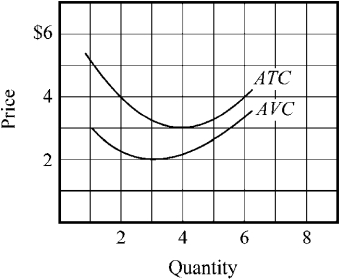 -According to Figure 8-4, at what output would a properly constructed marginal cost curve cross the ATC curve?
 (Multiple Choice)
4.7/5 (92)
(92) If General Electric finds that when it doubles both its plant size and the amount of associated inputs, its output level does not double, then
(Multiple Choice)
4.8/5 (81)
(81) Figure 8-8
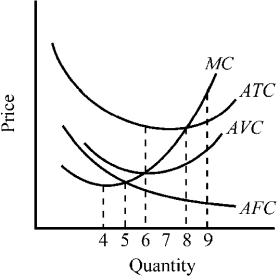 -In Figure 8-8, which output minimizes per-unit cost?
 (Multiple Choice)
4.9/5 (96)
(96) If a firm produces nothing, which of the following costs will be zero?
(Multiple Choice)
4.7/5 (72)
(72) The upward-sloping portion of a long-run average total cost curve is the result of
(Multiple Choice)
4.9/5 (77)
(77) 
Filters
- Essay(0)
- Multiple Choice(0)
- Short Answer(0)
- True False(0)
- Matching(0)