



 Chat with AI
Exam 13: Fiscal Policy

Exam 1: Economics: Foundations and Models160 Questions
Exam 2: Choices and Trade Offs in the Market192 Questions
Exam 3: Where Prices Come From: the Interaction of Demand and Supply201 Questions
Exam 4: Gdp: Measuring Total Production, Income and Economic Growth123 Questions
Exam 5: Economic Growth, the Financial System and Business Cycles132 Questions
Exam 6: Long-Run Economic Growth: Sources and Policies118 Questions
Exam 7: Unemployment120 Questions
Exam 8: Inflation110 Questions
Exam 9: Aggregate Expenditure and Output in the Short Run138 Questions
Exam 10: Aggregate Demand and Aggregate Supply Analysis134 Questions
Exam 11: Money, Banks and the Reserve Bank of Australia123 Questions
Exam 12: Monetary Policy116 Questions
Exam 13: Fiscal Policy163 Questions
Exam 14: Macroeconomics in an Open Economy141 Questions
Exam 15: The International Financial System145 Questions
Select questions type


Explain why the 'tax multiplier' is different from the government 'purchases multiplier'.
_____________________________________________________________________________________________
_____________________________________________________________________________________________
(Essay)
4.7/5  (87)
(87) Tax reduction and simplification should ________ long-run aggregate supply and ________ aggregate demand.
(Multiple Choice)
4.9/5 (91)
(91) 'Expansionary fiscal policy' is used by the government in an attempt to fight rising inflation.
(True/False)
4.9/5 (81)
(81) Assume in a closed economy that taxes are fixed and the marginal propensity to consume is equal to 0.8. What is the government purchases multiplier?
(Multiple Choice)
4.8/5 (77)
(77) The federal government debt ________ when the federal government runs a deficit and ________ when the federal government runs a surplus.
(Multiple Choice)
4.8/5 (69)
(69) Refer to Figure 13.5 for the following question.
Figure 13.5
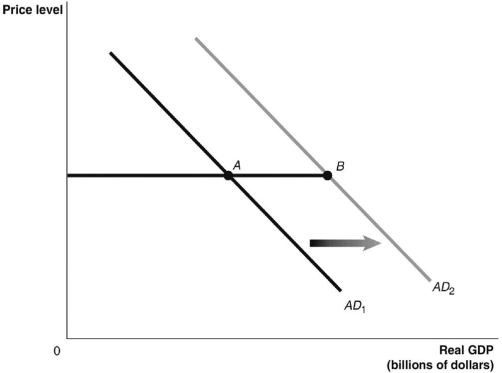 -Refer to Figure 13.5. If government purchases increase by $100 billion and lead to an ultimate increase in aggregate demand as shown in the graph, the difference in real GDP between point A and point B will be:
 (Multiple Choice)
4.9/5 (73)
(73) In 2015/2016, after social security and welfare payments, which of the following is the second largest category of Australian federal government expenditures at nearly 16% of the total?
(Multiple Choice)
4.8/5 (76)
(76) Which is the largest source of federal government revenue and which is the largest single area of government expenditure in Australia?
_____________________________________________________________________________________________
_____________________________________________________________________________________________
(Essay)
4.9/5 (83)
(83) The structural budget deficit calculates the budget surplus or deficit if the economy was:
(Multiple Choice)
5.0/5 (69)
(69) To counteract the effect of automatic stabilisers during a recession and keep the budget balanced, the federal government would need to ________ government spending, or ________ taxes, which would ________ aggregate demand.
(Multiple Choice)
4.8/5 (83)
(83) Which of the following is a government 'expenditure' and not a government 'purchase'?
(Multiple Choice)
4.8/5 (74)
(74) 'Fiscal policy' (discretionary fiscal policy)is defined as changes in federal ________ and ________ to achieve macroeconomic objectives such as price stability, healthy rates of economic growth and high employment.
(Multiple Choice)
4.8/5 (86)
(86) Refer to Figure 13.3 for the following question.
Figure 13.3
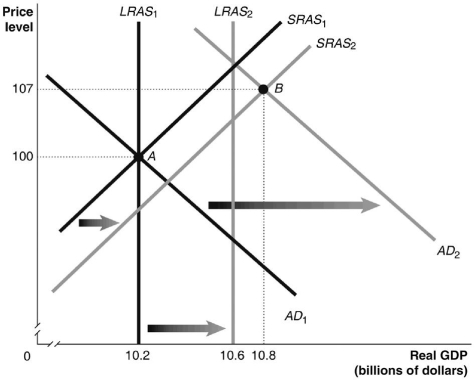 -Refer to Figure 13.3. Given that the economy has moved from A to B in the graph above, which of the following would be the appropriate fiscal policy to achieve potential GDP?
 (Multiple Choice)
4.8/5 (88)
(88) Explain why accurately timing the fiscal policy may be more difficult than accurately timing of monetary policy.
_____________________________________________________________________________________________
_____________________________________________________________________________________________
(Essay)
4.8/5 (80)
(80) Which of the following is considered 'expansionary fiscal policy'?
(Multiple Choice)
4.9/5 (71)
(71) Slow growth in aggregate demand leads to ________ inflation and ________ unemployment.
(Multiple Choice)
4.9/5 (67)
(67) What is the difference between 'federal purchases' and 'federal expenditures'?
_____________________________________________________________________________________________
_____________________________________________________________________________________________
(Essay)
4.8/5 (82)
(82) Refer to Figure 13.4 for the following questions.
Figure 13.4
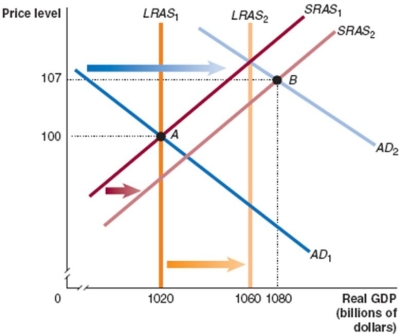 -In Figure 13.4, if fiscal policy is successful at moving the economy from point B to equilibrium at potential GDP, which of the following will occur?
 (Multiple Choice)
4.9/5 (63)
(63) Explain how lowered taxes on capital gains and dividends might increase aggregate supply.
_____________________________________________________________________________________________
_____________________________________________________________________________________________
(Essay)
4.8/5 (82)
(82) 
Filters
- Essay(0)
- Multiple Choice(0)
- Short Answer(0)
- True False(0)
- Matching(0)