



 Chat with AI
Exam 13: Fiscal Policy

Exam 1: Economics: Foundations and Models160 Questions
Exam 2: Choices and Trade Offs in the Market192 Questions
Exam 3: Where Prices Come From: the Interaction of Demand and Supply201 Questions
Exam 4: Gdp: Measuring Total Production, Income and Economic Growth123 Questions
Exam 5: Economic Growth, the Financial System and Business Cycles132 Questions
Exam 6: Long-Run Economic Growth: Sources and Policies118 Questions
Exam 7: Unemployment120 Questions
Exam 8: Inflation110 Questions
Exam 9: Aggregate Expenditure and Output in the Short Run138 Questions
Exam 10: Aggregate Demand and Aggregate Supply Analysis134 Questions
Exam 11: Money, Banks and the Reserve Bank of Australia123 Questions
Exam 12: Monetary Policy116 Questions
Exam 13: Fiscal Policy163 Questions
Exam 14: Macroeconomics in an Open Economy141 Questions
Exam 15: The International Financial System145 Questions
Select questions type


Show the effects of tax reduction and simplification using the dynamic aggregate demand and supply model. To simplify the analysis, assume that the aggregate demand curve does not change. How does the analysis change if the tax change does not change labour supply and has little or no effect on savings and investment?
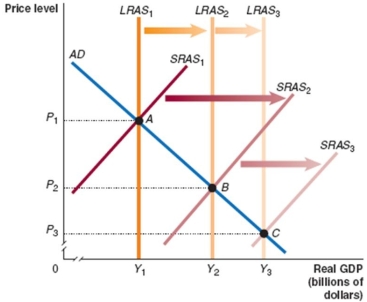 _____________________________________________________________________________________________
_____________________________________________________________________________________________
_____________________________________________________________________________________________ (Essay)
4.9/5  (75)
(75) Use the following information to explain and draw a graph showing the short-run and long-run Phillips curves.
Natural rate of unemployment = 5%
Current rate of unemployment = 3%
Expected inflation rate = 2.9%
Current inflation rate = 6.2%
_____________________________________________________________________________________________
_____________________________________________________________________________________________
(Essay)
4.9/5 (76)
(76) The nominal wage, expected inflation, and actual inflation for a hypothetical economy in 2018 are presented in the following table. Calculate the actual and expected real wage, assuming the price level is 100 in 2017. Explain how firms will use this information in terms of hiring and what will happen to the unemployment rate.
 _____________________________________________________________________________________________
_____________________________________________________________________________________________
_____________________________________________________________________________________________ (Essay)
4.9/5 (83)
(83) Suppose real GDP is $13 trillion, potential GDP is $13.5 trillion, and the government plans to use fiscal policy to restore the economy to potential GDP. Assuming a constant price level, the government would need to increase government purchases by:
(Multiple Choice)
4.8/5 (71)
(71) Refer to Figure 13.6 for the following questions.
Figure 13.6
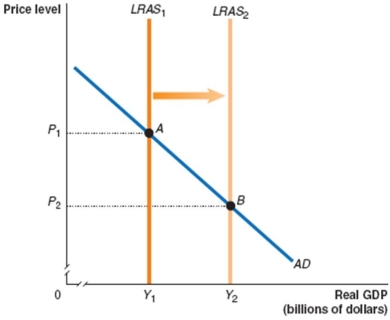 -Suppose the federal government reduces income taxes. Assume that the movement from A to B in Figure 13.6 represents normal growth in the economy before the tax change. If the tax change is not effective and labour supply and savings do not increase because of the tax change, then the tax change will:
 (Multiple Choice)
4.8/5 (77)
(77) 'Contractionary fiscal policy' aims to reduce the rate of increase in aggregate demand.
(True/False)
4.9/5 (85)
(85) What is the government purchases multiplier if the tax rate is 0.20 and the marginal propensity to consume from disposable income is 0.80? Assume the economy is closed.
(Multiple Choice)
4.9/5 (96)
(96) Suppose real GDP is $1.3 trillion and potential GDP is $1.35 trillion. If the government increases government purchases by $0.5 trillion, then the economy will be brought to equilibrium at potential GDP.
(True/False)
4.9/5 (77)
(77) If the government purchases multiplier equals 2, and real GDP is $14 trillion with potential GDP $14.5 trillion, then government purchases would need to increase by ________ to restore the economy to potential GDP.
(Multiple Choice)
4.8/5 (80)
(80) Refer to Figure 13.2 for the following question.
Figure 13.2
 -In Figure 13.2, suppose the economy in Year 1 is at point A and expected in Year 2 to be at point B. Which of the following policies could the government use to move the economy to point C?
 (Multiple Choice)
4.9/5 (83)
(83) Refer to Figure 13.7 for the following questions.
Figure 13.7
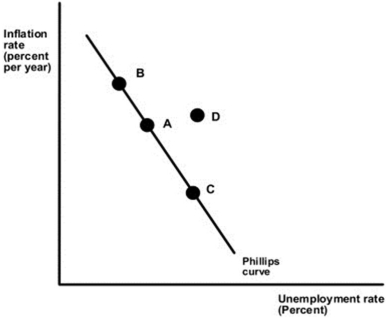 -Suppose that the economy is at point A on the Phillips curve in Figure 13.7. If the aggregate demand curve shifts to right by the same amount as long-run aggregate supply, then the economy will:
 (Multiple Choice)
4.9/5 (83)
(83) If the equilibrium real GDP were higher than potential GDP, then a contractionary fiscal policy would cause the inflation rate to be ________ and real GDP to be ________.
(Multiple Choice)
5.0/5 (76)
(76) In 2015/2016, the largest share of Australian federal government welfare payments went to:
(Multiple Choice)
4.7/5 (80)
(80) What did Milton Friedman and Edmund Phelps argue about the long-run Phillips curve?
_____________________________________________________________________________________________
_____________________________________________________________________________________________
(Essay)
5.0/5 (94)
(94) The structural budget deficit indicates what the budget deficit is during a recession.
(True/False)
4.9/5 (76)
(76) Short-run resource crowding out is likely to be less of a problem when the economy is:
(Multiple Choice)
4.9/5 (79)
(79) Both Milton Friedman and Edmund Phelps argued that if the long-run aggregate supply curve was vertical, then the slope of the long-run Phillips curve must be:
(Multiple Choice)
4.8/5 (71)
(71) The government purchases multiplier will be larger if the marginal income tax rate increases.
(True/False)
4.9/5 (76)
(76) Assume that the economy is in the state described by the following table.
 Draw a dynamic aggregate demand and aggregate supply diagram to illustrate the state of the economy in year 1 and year 2, assuming that no policy is pursued. Then illustrate the appropriate fiscal policy to use in this situation. Assume that the policy results in the economy producing at potential GDP. Provide an explanation.
 _____________________________________________________________________________________________
Draw a dynamic aggregate demand and aggregate supply diagram to illustrate the state of the economy in year 1 and year 2, assuming that no policy is pursued. Then illustrate the appropriate fiscal policy to use in this situation. Assume that the policy results in the economy producing at potential GDP. Provide an explanation.
_____________________________________________________________________________________________
_____________________________________________________________________________________________ (Essay)
4.7/5 (88)
(88) 
Filters
- Essay(0)
- Multiple Choice(0)
- Short Answer(0)
- True False(0)
- Matching(0)