



 Chat with AI
Exam 13: Fiscal Policy

Exam 1: Economics: Foundations and Models160 Questions
Exam 2: Choices and Trade Offs in the Market192 Questions
Exam 3: Where Prices Come From: the Interaction of Demand and Supply201 Questions
Exam 4: Gdp: Measuring Total Production, Income and Economic Growth123 Questions
Exam 5: Economic Growth, the Financial System and Business Cycles132 Questions
Exam 6: Long-Run Economic Growth: Sources and Policies118 Questions
Exam 7: Unemployment120 Questions
Exam 8: Inflation110 Questions
Exam 9: Aggregate Expenditure and Output in the Short Run138 Questions
Exam 10: Aggregate Demand and Aggregate Supply Analysis134 Questions
Exam 11: Money, Banks and the Reserve Bank of Australia123 Questions
Exam 12: Monetary Policy116 Questions
Exam 13: Fiscal Policy163 Questions
Exam 14: Macroeconomics in an Open Economy141 Questions
Exam 15: The International Financial System145 Questions
Select questions type


An equal decrease in government purchases and taxes will cause:
(Multiple Choice)
4.8/5  (93)
(93) If a(n)________________ in government purchases leads to a(n)____________ in interest rates, the effect is called crowding out.
(Multiple Choice)
4.9/5 (70)
(70) If policy makers implement expansionary fiscal policy and do not take into account crowding out, equilibrium GDP is likely to:
(Multiple Choice)
4.9/5 (82)
(82) In the case of an upward-sloping aggregate supply curve, the change in real GDP brought about by a change in government spending will be less than that predicted by the simple government purchases multiplier.
(True/False)
4.8/5 (80)
(80) Suppose that the nominal wage, the expected and actual price levels, and the expected and actual inflation rates for a hypothetical economy in 2016 are presented in the following table. What is the actual real wage rate in 2016?

(Multiple Choice)
4.8/5 (80)
(80) Refer to Figure 13.1 for the following questions.
Figure 13.1
 -If the economy moves from A to B in Figure 13.1, which of the following would be the appropriate fiscal policy to achieve potential GDP?
 (Multiple Choice)
4.7/5 (90)
(90) Refer to Figure 13.6 for the following questions.
Figure 13.6
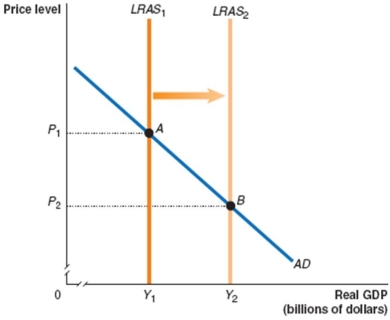 -Suppose the federal government reduces income taxes. Assume that the movement from A to B in Figure 13.6 represents normal growth in the economy before the tax change. Also assume that aggregate demand does not change. If the tax change is effective and labour supply and savings increase because of the tax change, then the tax change will:
 (Multiple Choice)
4.9/5 (86)
(86) Assume that the federal government gives a $5 billion tax cut. Assume that tax rates are fixed, the economy is closed, and the marginal propensity to consume is 0.75. What happens to equilibrium GDP?
(Multiple Choice)
4.9/5 (74)
(74) Suppose that the federal budget is balanced when GDP is at potential GDP. If equilibrium GDP falls below potential:
(Multiple Choice)
4.9/5 (67)
(67) The tax multiplier is calculated as 'one minus the government purchases multiplier'.
(True/False)
4.9/5 (89)
(89) What is 'fiscal policy' and who is responsible for fiscal policy?
_____________________________________________________________________________________________
_____________________________________________________________________________________________
(Essay)
4.8/5 (78)
(78) What is 'long-run crowding out'?
_____________________________________________________________________________________________
_____________________________________________________________________________________________
(Essay)
4.9/5 (84)
(84) Which of the following is an example of discretionary fiscal policy?
(Multiple Choice)
4.9/5 (77)
(77) Consider the hypothetical information in the following table for potential GDP, real GDP and the price level in 2016 and in 2017 if the government does not use fiscal policy.
 If the government wants control inflation while keeping real GDP at its potential level in 2017, it should:
 (Multiple Choice)
4.8/5 (77)
(77) Increases in government spending will lower the long-term growth rate of GDP if it lowers ________ spending and the government purchases ________ goods and not ________ goods.
(Multiple Choice)
4.9/5 (65)
(65) 
Filters
- Essay(0)
- Multiple Choice(0)
- Short Answer(0)
- True False(0)
- Matching(0)