



 Chat with AI
Exam 13: Fiscal Policy

Exam 1: Economics: Foundations and Models160 Questions
Exam 2: Choices and Trade Offs in the Market192 Questions
Exam 3: Where Prices Come From: the Interaction of Demand and Supply201 Questions
Exam 4: Gdp: Measuring Total Production, Income and Economic Growth123 Questions
Exam 5: Economic Growth, the Financial System and Business Cycles132 Questions
Exam 6: Long-Run Economic Growth: Sources and Policies118 Questions
Exam 7: Unemployment120 Questions
Exam 8: Inflation110 Questions
Exam 9: Aggregate Expenditure and Output in the Short Run138 Questions
Exam 10: Aggregate Demand and Aggregate Supply Analysis134 Questions
Exam 11: Money, Banks and the Reserve Bank of Australia123 Questions
Exam 12: Monetary Policy116 Questions
Exam 13: Fiscal Policy163 Questions
Exam 14: Macroeconomics in an Open Economy141 Questions
Exam 15: The International Financial System145 Questions
Select questions type


Use the dynamic aggregate demand and aggregate supply model and start with Year 1 in a long-run macroeconomic equilibrium. For Year 2, graph aggregate demand, long-run aggregate supply, and short-run aggregate supply such that the condition of the economy will induce the government to conduct contractionary fiscal policy. Briefly explain the condition of the economy and what the government is attempting to do.
_____________________________________________________________________________________________
_____________________________________________________________________________________________
(Essay)
4.7/5  (77)
(77) Calculate the government purchases multiplier if the marginal propensity to consume equals 0.80, the tax rate is 0.10, and the marginal propensity to import equals 0.20.
(Multiple Choice)
4.8/5 (84)
(84) The increase in revenue taxation received by the government during an economic boom is due to discretionary fiscal policy.
(True/False)
4.7/5 (85)
(85) Increasing government debt relative to GDP does not cause which of the following?
(Multiple Choice)
4.8/5 (97)
(97) If workers fail to believe that rising inflation will eventually result in comparable increases in wages, but firms do understand this, then there is a:
(Multiple Choice)
4.9/5 (75)
(75) Long lags associated with the legislative process in implementing fiscal policy can make it more difficult to use than monetary policy.
(True/False)
4.7/5 (80)
(80) Expansionary fiscal policy ________ the price level and ________ equilibrium real GDP.
(Multiple Choice)
4.9/5 (72)
(72) A law requiring the government to balance its budget in each year would serve as an 'automatic destabiliser'.
(True/False)
4.8/5 (71)
(71) The 'Phillips curve' shows the short-run relationship between:
(Multiple Choice)
4.9/5 (79)
(79) Government expenditure in Australia as a percentage of GDP has consistently trended upward since the 1960s.
(True/False)
4.9/5 (91)
(91) What is 'expansionary fiscal policy' and under what circumstances would it be used?
_____________________________________________________________________________________________
_____________________________________________________________________________________________
(Essay)
4.9/5 (83)
(83) Government budget deficits can lead to higher real interest rates, which will reduce private investment.
(True/False)
4.9/5 (73)
(73) If the government wants to try to reduce unemployment, it could ________ spending and/or taxes should be ________.
(Multiple Choice)
4.7/5 (85)
(85) Suppose that the current equilibrium GDP for a country is $14.5 trillion and that potential GDP is $14.3 trillion. Will decreasing government purchases by $200 billion or raising taxes by $200 billion restore the economy to potential GDP? Briefly explain why.
_____________________________________________________________________________________________
_____________________________________________________________________________________________
(Essay)
4.9/5 (84)
(84) If 'crowding out' occurs, an increase in government spending:
(Multiple Choice)
4.9/5 (76)
(76) Suppose the economy is in the state described by the following table.
 What problem will occur in the economy if no policy is pursued? What fiscal policy tools could be used to combat the problem? Draw a dynamic aggregate demand and supply graph to illustrate the appropriate fiscal policy to use in this situation.
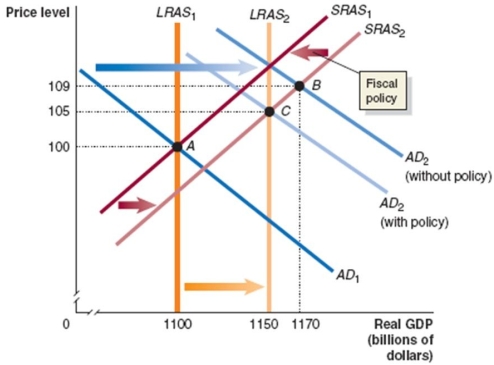 _____________________________________________________________________________________________
What problem will occur in the economy if no policy is pursued? What fiscal policy tools could be used to combat the problem? Draw a dynamic aggregate demand and supply graph to illustrate the appropriate fiscal policy to use in this situation.
_____________________________________________________________________________________________
_____________________________________________________________________________________________ (Essay)
5.0/5 (74)
(74) If the economy were in a recession, we would expect government expenditure to be:
(Multiple Choice)
4.8/5 (79)
(79) 
Filters
- Essay(0)
- Multiple Choice(0)
- Short Answer(0)
- True False(0)
- Matching(0)