



 Chat with AI
Exam 17: Monetary Policy

Exam 1: Economics: Foundations and Models444 Questions
Exam 2: Trade-Offs, comparative Advantage, and the Market System498 Questions
Exam 3: Where Prices Come From: the Interaction of Demand and Supply475 Questions
Exam 4: Market Efficiency and Market Failure465 Questions
Exam 5: The Economics of Health Care334 Questions
Exam 6: Firms, the Stock Market, and Corporate Governance250 Questions
Exam 7: Consumer Choice and Elasticity380 Questions
Exam 8: Technology, production, and Costs276 Questions
Exam 9: Firms in Perfectly Competitive Markets297 Questions
Exam 10: Monopoly and Antitrust Policy271 Questions
Exam 11: Monopolistic Competition and Oligopoly414 Questions
Exam 12: Gdp: Measuring Total Production and Income266 Questions
Exam 13: Unemployment and Inflation292 Questions
Exam 14: Economic Growth, the Financial System, and Business Cycles257 Questions
Exam 15: Aggregate Demand and Aggregate Supply Analysis284 Questions
Exam 16: Money, banks, and the Federal Reserve System279 Questions
Exam 17: Monetary Policy277 Questions
Exam 18: Fiscal Policy282 Questions
Exam 19: Comparative Advantage, international Trade, and Exchange Rates446 Questions
Select questions type


Table 17-8
Year Potential Real GDP Real GDP Price Level 2013 \ 13.5 trillion \ 13.5 trillion 142 2014 14.0 trillion 14.4 trillion 150
-Refer to Table 17-8.The hypothetical information in the table shows what the values for real GDP and the price level will be in 2014 if the Federal Reserve does not use monetary policy:
a.If the Fed wants to keep real GDP at its potential level in 2014,should it use an expansionary policy or a contractionary policy? Should the trading desk buy T-bills or sell them?
b.Suppose the Fed's policy is successful in keeping real GDP at its potential level in 2014.State whether each of the following will be higher or lower than if the Fed had taken no action:
(i) Real GDP
(ii) Full-employment real GDP
(iii) The inflation rate
(iv) The unemployment rate
c.Draw an aggregate demand and aggregate supply graph to illustrate your answer.Be sure that your graph contains LRAS curves for 2013 and 2014; SRAS curves 2013 and 2014; AD curve for 2013 and 2014,with and without monetary policy actions; and equilibrium real GDP and the price level in 2014 with and without policy.
(Essay)
4.8/5  (93)
(93) Figure 17-1
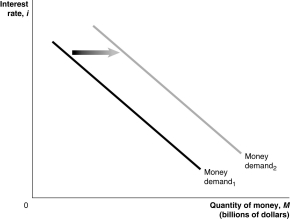 -Refer to Figure 17-1.In the figure,the money demand curve would move from Money demand₁ to Money demand₂ if
 (Multiple Choice)
4.7/5 (82)
(82) From an initial long-run macroeconomic equilibrium,if the Federal Reserve anticipated that next year aggregate demand would grow significantly faster than long-run aggregate supply,then the Federal Reserve would most likely
(Multiple Choice)
4.9/5 (87)
(87) Expansionary monetary policy refers to the Fed's increasing the money supply and increasing interest rates to increase real GDP.
(True/False)
4.8/5 (91)
(91) Monetary policy refers to the actions the Federal Reserve takes to manage
(Multiple Choice)
4.7/5 (67)
(67) Present two arguments as to why the Fed should adopt inflation targeting as a framework for monetary policy.
(Essay)
4.9/5 (77)
(77) The money market model is concerned with ________ and the loanable funds market model is concerned with ________.
(Multiple Choice)
4.8/5 (68)
(68) What is a mortgage? What were the important developments in the mortgage market during the years after 1970?
(Essay)
4.8/5 (86)
(86) Table 17-3
Year Potential Real GDP Real GDP Price Level 2014 \ 14.0 trillion \ 14.0 trillion 150 2015 14.5 trillion 14.8 trillion 154
-Refer to Table 17-3.Consider the hypothetical information in the table above for potential real GDP,real GDP and the price level in 2014 and in 2015 if the Federal Reserve does not use monetary policy.If the Fed uses monetary policy successfully to keep real GDP at its potential level in 2015,which of the following will be lower than if the Fed had taken no action?
(Multiple Choice)
4.9/5 (81)
(81) An advantage of the personal consumption expenditures price index (PCE)over the Consumer Price Index (CPI)as a measure of inflation is that the PCE
(Multiple Choice)
5.0/5 (64)
(64) Inflation targeting,typically,has been accompanied by lower inflation.
(True/False)
4.8/5 (79)
(79) Would the Federal Reserve respond more aggressively with interest rate cuts in a recession caused by a decrease in spending,as in the 2001 recession,than in a recession caused by an increase in oil prices,as in the 1974-75 recession?
(Essay)
4.8/5 (78)
(78) In the Taylor rule,does the target for the federal funds rate respond differently for a recession caused by a decrease in aggregate demand and for a recession caused by a decrease in short-run aggregate supply? Explain whether there is or is not a difference in how the target for the federal funds rate changes.
(Essay)
4.9/5 (72)
(72) The Fed uses a "core" price index,one that excludes food and energy prices to measure inflation.It does so because
(Multiple Choice)
4.7/5 (81)
(81) If the probability of losing your job remains ________,a recession would be a good time to purchase a home because the Fed usually ________ interest rates during this time.
(Multiple Choice)
4.7/5 (71)
(71) 
Filters
- Essay(0)
- Multiple Choice(0)
- Short Answer(0)
- True False(0)
- Matching(0)