



 Chat with AI
Exam 13: Monopoly and Antitrust Policy

Exam 1: Economics: Foundations and Models145 Questions
Exam 2: Trade-Offs, Comparative Advantage, and the Market System151 Questions
Exam 3: Where Prices Come From: the Interaction of Demand and Supply159 Questions
Exam 4: Economic Efficiency, Government Price Setting, and Taxes127 Questions
Exam 5: Externalities, Environmental Policy, and Public Goods141 Questions
Exam 6: Elasticity: the Responsiveness of Demand and Supply149 Questions
Exam 7: Comparative Advantage and the Gains From International Trade125 Questions
Exam 8: Consumer Choice and Behavioral Economics154 Questions
Exam 9: Technology, Production, and Costs169 Questions
Exam 10: Firms in Perfectly Competitive Markets153 Questions
Exam 11: Monopolistic Competition140 Questions
Exam 12: Oligopoly: Firms in Less Competitive Markets130 Questions
Exam 13: Monopoly and Antitrust Policy146 Questions
Exam 14: The Markets for Labour and Other Factors of Production149 Questions
Exam 15: Public Choice, Taxes, and the Distribution of Income134 Questions
Exam 16: Pricing Strategy132 Questions
Exam 17: Firms, the Stock Market, and Corporate Governance137 Questions
Select questions type


A monopoly is defined as a firm that has the largest market share in an industry.
(True/False)
5.0/5  (72)
(72) Which of the following is the best example of a monopoly if we use a broader definition of monopoly?
(Multiple Choice)
4.9/5 (83)
(83) A vertical merger is one that takes place between two companies producing different goods or services for one specific finished product.
(True/False)
4.7/5 (80)
(80) Figure 13.2
 Figure 13.2 above shows the demand and cost curves facing a monopolist.
-Refer to Figure 13.2.Suppose the monopolist represented in the diagram above produces positive output.What is the profit/loss per unit?
Figure 13.2 above shows the demand and cost curves facing a monopolist.
-Refer to Figure 13.2.Suppose the monopolist represented in the diagram above produces positive output.What is the profit/loss per unit? (Multiple Choice)
4.7/5 (84)
(84) Figure 13.10
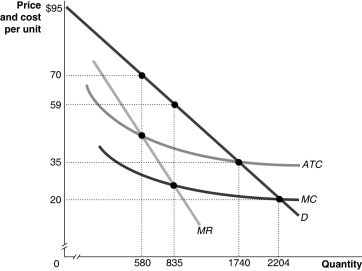 -Refer to Figure 13.10 to answer the following questions.
a.What quantity will this monopoly produce and what price will it charge?
b.Suppose the monopoly is regulated.If the regulatory agency wants to achieve economic efficiency, what price should it require the monopoly to charge?
c.To achieve economic efficiency, what quantity will the regulated monopoly produce?
d.Will the regulated monopoly make a profit if it charges the price that will achieve economic efficiency?
e.Suppose the government decides to regulate the monopoly by imposing a price ceiling of $35.What quantity will the monopoly produce and what price will the monopoly charge?
f.With the price ceiling of $35, what profit will the monopoly earn?
-Refer to Figure 13.10 to answer the following questions.
a.What quantity will this monopoly produce and what price will it charge?
b.Suppose the monopoly is regulated.If the regulatory agency wants to achieve economic efficiency, what price should it require the monopoly to charge?
c.To achieve economic efficiency, what quantity will the regulated monopoly produce?
d.Will the regulated monopoly make a profit if it charges the price that will achieve economic efficiency?
e.Suppose the government decides to regulate the monopoly by imposing a price ceiling of $35.What quantity will the monopoly produce and what price will the monopoly charge?
f.With the price ceiling of $35, what profit will the monopoly earn? (Essay)
4.8/5 (76)
(76) What is the relationship between marginal revenue and average revenue for a monopolist and is it the same for a perfect competitor?
(Essay)
4.8/5 (75)
(75) If we use a narrow definition of monopoly, then a monopoly is defined as a firm
(Multiple Choice)
5.0/5 (77)
(77) What is a monopoly? Can a firm be a monopoly if close substitutes for its product exists?
(Essay)
4.8/5 (73)
(73) If a theatre company expects $250,000 in ticket revenue from five performances and $288,000 in ticket revenue if it adds a sixth performance, the
(Multiple Choice)
4.8/5 (85)
(85) Figure 13.2
Figure 13.2 above shows the demand and cost curves facing a monopolist.
-Refer to Figure 13.2.What happens to the monopolist represented in the diagram in the long run?
Figure 13.2 above shows the demand and cost curves facing a monopolist.
-Refer to Figure 13.2.What happens to the monopolist represented in the diagram in the long run? (Multiple Choice)
4.7/5 (86)
(86) The De Beers Company, one of the longest-lived monopolies, is facing increasing competition.One source of competition comes from people who might resell their previously owned diamonds.Why is De Beers worried that people might resell their previously owned diamonds?
(Multiple Choice)
4.8/5 (92)
(92) In the short-run, even if a monopoly's total revenue does not cover its variable costs, it should continue to produce because ultimately in the long run, the monopoly will start earning profits.
(True/False)
4.8/5 (77)
(77) Figure 13.3
 Figure 13.3 shows the demand and cost curves for a monopolist.
-Refer to Figure 13.3.What is likely to happen to this monopoly in the long run?
Figure 13.3 shows the demand and cost curves for a monopolist.
-Refer to Figure 13.3.What is likely to happen to this monopoly in the long run? (Multiple Choice)
4.9/5 (84)
(84) A natural monopoly is characterized by large fixed costs relative to variable costs.
(True/False)
4.7/5 (69)
(69) Figure 13.3
Figure 13.3 shows the demand and cost curves for a monopolist.
-Refer to Figure 13.3.What is the profit-maximizing/loss-minimizing output level?
Figure 13.3 shows the demand and cost curves for a monopolist.
-Refer to Figure 13.3.What is the profit-maximizing/loss-minimizing output level? (Multiple Choice)
4.9/5 (83)
(83) Figure 13.9
 Figure 13.9 shows the cost and demand curves for the Erickson Power Company.
-Refer to Figure 13.9.Why won't regulators require that Erickson Power produce the economically efficient output level?
Figure 13.9 shows the cost and demand curves for the Erickson Power Company.
-Refer to Figure 13.9.Why won't regulators require that Erickson Power produce the economically efficient output level? (Multiple Choice)
4.7/5 (72)
(72) 
Filters
- Essay(0)
- Multiple Choice(0)
- Short Answer(0)
- True False(0)
- Matching(0)