



 Chat with AI
Exam 13: Monopoly and Antitrust Policy

Exam 1: Economics: Foundations and Models145 Questions
Exam 2: Trade-Offs, Comparative Advantage, and the Market System151 Questions
Exam 3: Where Prices Come From: the Interaction of Demand and Supply159 Questions
Exam 4: Economic Efficiency, Government Price Setting, and Taxes127 Questions
Exam 5: Externalities, Environmental Policy, and Public Goods141 Questions
Exam 6: Elasticity: the Responsiveness of Demand and Supply149 Questions
Exam 7: Comparative Advantage and the Gains From International Trade125 Questions
Exam 8: Consumer Choice and Behavioral Economics154 Questions
Exam 9: Technology, Production, and Costs169 Questions
Exam 10: Firms in Perfectly Competitive Markets153 Questions
Exam 11: Monopolistic Competition140 Questions
Exam 12: Oligopoly: Firms in Less Competitive Markets130 Questions
Exam 13: Monopoly and Antitrust Policy146 Questions
Exam 14: The Markets for Labour and Other Factors of Production149 Questions
Exam 15: Public Choice, Taxes, and the Distribution of Income134 Questions
Exam 16: Pricing Strategy132 Questions
Exam 17: Firms, the Stock Market, and Corporate Governance137 Questions
Select questions type


A merger between Rona building supplies and West Fraser Timber Co Ltd would be an example of a
(Multiple Choice)
4.8/5  (85)
(85) For which of the following firms is patent protection of vital importance?
(Multiple Choice)
4.7/5 (76)
(76) Figure 13.8
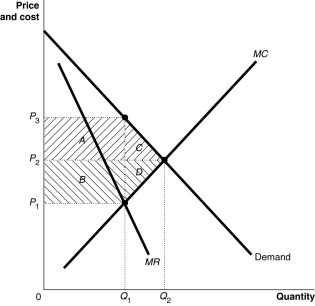 -Refer to Figure 13.8.From the monopoly graph above, identify the following:
a.The profit maximizing price
b.The profit maximizing quantity
c.The area representing deadweight loss
d.The area representing the transfer of consumer surplus to the monopoly
-Refer to Figure 13.8.From the monopoly graph above, identify the following:
a.The profit maximizing price
b.The profit maximizing quantity
c.The area representing deadweight loss
d.The area representing the transfer of consumer surplus to the monopoly (Essay)
4.7/5 (72)
(72) Table 13.2
Price per Dose Quantity Demanded (dose) Total Cost of Production (dollars) \ 80 0 \ 80 72 1 82 64 2 88 56 3 100 48 4 124 40 5 164 32 6 208 24 7 268 16 8 340
Onawy Inc. has been granted a patent for its birch root toothache balm. Table 13.2 shows the demand and the total cost schedule for the firm.
-Refer to Table 13.2.What is Onawy's profit-maximizing output?
(Multiple Choice)
4.8/5 (79)
(79) Long-run economic profits would most likely exist in which market structure?
(Multiple Choice)
4.8/5 (65)
(65) If a monopolist's price is $50 at the output where marginal revenue equals marginal cost and average total cost is $43, then the average profit is $7.
(True/False)
4.8/5 (89)
(89) A firm that has the ability to control to some degree the price of the product it sells
(Multiple Choice)
4.9/5 (80)
(80) Figure 13.4
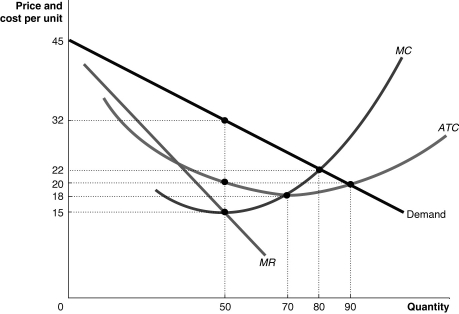 -Refer to Figure 13.4.Use the figure above to answer the following questions.
A)What is the profit-maximizing quantity and what price will the monopolist charge?
B)What is the total revenue at the profit-maximizing output level?
C)What is the total cost at the profit-maximizing output level?
D)What is the profit?
E)What is the profit per unit (average profit)at the profit-maximizing output level?
F)If this industry was organized as a perfectly competitive industry, what would be the profit-maximizing price and quantity?
-Refer to Figure 13.4.Use the figure above to answer the following questions.
A)What is the profit-maximizing quantity and what price will the monopolist charge?
B)What is the total revenue at the profit-maximizing output level?
C)What is the total cost at the profit-maximizing output level?
D)What is the profit?
E)What is the profit per unit (average profit)at the profit-maximizing output level?
F)If this industry was organized as a perfectly competitive industry, what would be the profit-maximizing price and quantity? (Essay)
4.9/5 (79)
(79) Research has shown that most economic profits from selling a prescription drug are eliminated 20 years after the drug is first offered for sale.The main reason for the elimination of profits is
(Multiple Choice)
4.9/5 (73)
(73) Figure 13.6
 -Refer to Figure 13.6.What is the area that represents producer surplus under a monopoly?
 (Multiple Choice)
4.9/5 (72)
(72) In regulating a natural monopoly, the price strategy that ensures the highest possible output and zero profit is one that sets price
(Multiple Choice)
4.7/5 (83)
(83) Which of the following statements is consistent with the views of Joseph Schumpeter?
(Multiple Choice)
4.8/5 (77)
(77) Figure 13.3
 Figure 13.3 shows the demand and cost curves for a monopolist.
-Refer to Figure 13.3.What is the amount of the monopoly's profit?
Figure 13.3 shows the demand and cost curves for a monopolist.
-Refer to Figure 13.3.What is the amount of the monopoly's profit? (Multiple Choice)
4.7/5 (81)
(81) If a monopolist's marginal revenue is $25 a unit and its marginal cost is $25, then
(Multiple Choice)
4.9/5 (82)
(82) Economic efficiency requires that a natural monopoly's price be
(Multiple Choice)
4.7/5 (76)
(76) In reality, because few markets are perfectly competitive, some loss of economic efficiency occurs in the market for nearly every good or service.
(True/False)
5.0/5 (75)
(75) 
Filters
- Essay(0)
- Multiple Choice(0)
- Short Answer(0)
- True False(0)
- Matching(0)