



 Chat with AI
Exam 13: Monopoly and Antitrust Policy

Exam 1: Economics: Foundations and Models145 Questions
Exam 2: Trade-Offs, Comparative Advantage, and the Market System151 Questions
Exam 3: Where Prices Come From: the Interaction of Demand and Supply159 Questions
Exam 4: Economic Efficiency, Government Price Setting, and Taxes127 Questions
Exam 5: Externalities, Environmental Policy, and Public Goods141 Questions
Exam 6: Elasticity: the Responsiveness of Demand and Supply149 Questions
Exam 7: Comparative Advantage and the Gains From International Trade125 Questions
Exam 8: Consumer Choice and Behavioral Economics154 Questions
Exam 9: Technology, Production, and Costs169 Questions
Exam 10: Firms in Perfectly Competitive Markets153 Questions
Exam 11: Monopolistic Competition140 Questions
Exam 12: Oligopoly: Firms in Less Competitive Markets130 Questions
Exam 13: Monopoly and Antitrust Policy146 Questions
Exam 14: The Markets for Labour and Other Factors of Production149 Questions
Exam 15: Public Choice, Taxes, and the Distribution of Income134 Questions
Exam 16: Pricing Strategy132 Questions
Exam 17: Firms, the Stock Market, and Corporate Governance137 Questions
Select questions type


To maximize profit, a monopolist will produce and sell a quantity such that for the last unit sold, marginal revenue equals marginal cost, and charges a price given by the demand curve at that output level.
(True/False)
4.8/5  (65)
(65) Table 13.1
Price per Unit Quantity Demanded (units) Total Cost of Production (dollars) \ 85 10 \ 530 80 11 540 75 12 550 70 13 560 65 14 575 60 15 595 55 16 625
A monopoly producer of foreign language translation software faces a demand and cost structure as given in Table 13.1.
-Refer to Table 13.1.What is the firm's profit-maximizing output and what is the price charged to sell this output?
(Multiple Choice)
4.9/5 (82)
(82) For a natural monopoly, the marginal cost of producing an additional unit of its product is relatively small.
(True/False)
4.8/5 (78)
(78) Figure 13.9
 Figure 13.9 shows the cost and demand curves for the Erickson Power Company.
-Refer to Figure 13.9.The profit-maximizing price is
Figure 13.9 shows the cost and demand curves for the Erickson Power Company.
-Refer to Figure 13.9.The profit-maximizing price is (Multiple Choice)
4.8/5 (72)
(72) Which of the following is a characteristic shared by a perfectly competitive firm and a monopoly?
(Multiple Choice)
5.0/5 (75)
(75) Which of the following statements applies to a monopolist but not to a perfectly competitive firm at their profit maximizing outputs?
(Multiple Choice)
4.9/5 (85)
(85) When a proposed merger between two companies is reviewed by the government, the relevant market is defined by
(Multiple Choice)
4.8/5 (87)
(87) Table 13.2
Price per Dose Quantity Demanded (dose) Total Cost of Production (dollars) \ 80 0 \ 80 72 1 82 64 2 88 56 3 100 48 4 124 40 5 164 32 6 208 24 7 268 16 8 340
Onawy Inc. has been granted a patent for its birch root toothache balm. Table 13.2 shows the demand and the total cost schedule for the firm.
-Refer to Table 13.2.What is the economically efficient output level?
(Multiple Choice)
4.9/5 (76)
(76) Firms do not have market power in which of the following market structures?
(Multiple Choice)
4.8/5 (81)
(81) In 2011, Microsoft filed a complaint with the European Commission accusing Google of taking steps to monopolize the Internet search engine business.Microsoft's primary complaint was that
(Multiple Choice)
4.7/5 (82)
(82) Figure 13.9
Figure 13.9 shows the cost and demand curves for the Erickson Power Company.
-Refer to Figure 13.9.The firm would maximize profit by producing
Figure 13.9 shows the cost and demand curves for the Erickson Power Company.
-Refer to Figure 13.9.The firm would maximize profit by producing (Multiple Choice)
4.9/5 (84)
(84) Figure 13.7
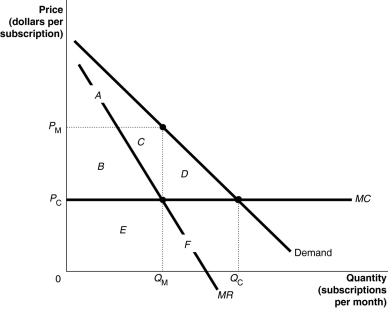 Assume Shaw Cable has a monopoly to provide cable TV in Vancouver. Figure 13.7 shows the cable television market in Vancouver.
-Refer to Figure 13.7.What is the size of the deadweight loss prior to Telus entering the market and what happens to this deadweight loss after Telus does enter the market?
Assume Shaw Cable has a monopoly to provide cable TV in Vancouver. Figure 13.7 shows the cable television market in Vancouver.
-Refer to Figure 13.7.What is the size of the deadweight loss prior to Telus entering the market and what happens to this deadweight loss after Telus does enter the market? (Multiple Choice)
4.9/5 (87)
(87) Figure 13.5
 Figure 13.5 shows the demand and cost curves for a monopolist.
-Refer to Figure 13.5.At the profit-maximizing quantity, what is the difference between the monopoly's price and the marginal cost of production?
Figure 13.5 shows the demand and cost curves for a monopolist.
-Refer to Figure 13.5.At the profit-maximizing quantity, what is the difference between the monopoly's price and the marginal cost of production? (Multiple Choice)
4.8/5 (71)
(71) Competition Bureau would never approve a proposed merger between two firms that could significantly increase the newly merged firm's market power even if the efficiency gains from the newly merged firm could make consumers better off.
(True/False)
4.8/5 (82)
(82) Figure 13.9
Figure 13.9 shows the cost and demand curves for the Erickson Power Company.
-Refer to Figure 13.9.Erickson Power is a natural monopoly because
Figure 13.9 shows the cost and demand curves for the Erickson Power Company.
-Refer to Figure 13.9.Erickson Power is a natural monopoly because (Multiple Choice)
4.8/5 (81)
(81) Figure 13.7
Assume Shaw Cable has a monopoly to provide cable TV in Vancouver. Figure 13.7 shows the cable television market in Vancouver.
-Refer to Figure 13.7.Following the entry of Telus, the subscription price falls from PM to PC.What is the increase in consumer surplus as a result of this change?
Assume Shaw Cable has a monopoly to provide cable TV in Vancouver. Figure 13.7 shows the cable television market in Vancouver.
-Refer to Figure 13.7.Following the entry of Telus, the subscription price falls from PM to PC.What is the increase in consumer surplus as a result of this change? (Multiple Choice)
4.8/5 (94)
(94) Figure 13.2
 Figure 13.2 above shows the demand and cost curves facing a monopolist.
-Refer to Figure 13.2.Suppose the monopolist represented in the diagram above produces positive output.What is the profit-maximizing/loss-minimizing output level?
Figure 13.2 above shows the demand and cost curves facing a monopolist.
-Refer to Figure 13.2.Suppose the monopolist represented in the diagram above produces positive output.What is the profit-maximizing/loss-minimizing output level? (Multiple Choice)
4.8/5 (78)
(78) Figure 13.5
Figure 13.5 shows the demand and cost curves for a monopolist.
-Refer to Figure 13.5.What is the difference between the monopoly output and the perfectly competitive output?
Figure 13.5 shows the demand and cost curves for a monopolist.
-Refer to Figure 13.5.What is the difference between the monopoly output and the perfectly competitive output? (Multiple Choice)
4.8/5 (81)
(81) Market power in Canada causes a huge loss of economic efficiency.
(True/False)
4.7/5 (72)
(72) 
Filters
- Essay(0)
- Multiple Choice(0)
- Short Answer(0)
- True False(0)
- Matching(0)