



 Chat with AI
Exam 11: Monopolistic Competition

Exam 1: Economics: Foundations and Models145 Questions
Exam 2: Trade-Offs, Comparative Advantage, and the Market System151 Questions
Exam 3: Where Prices Come From: the Interaction of Demand and Supply159 Questions
Exam 4: Economic Efficiency, Government Price Setting, and Taxes127 Questions
Exam 5: Externalities, Environmental Policy, and Public Goods141 Questions
Exam 6: Elasticity: the Responsiveness of Demand and Supply149 Questions
Exam 7: Comparative Advantage and the Gains From International Trade125 Questions
Exam 8: Consumer Choice and Behavioral Economics154 Questions
Exam 9: Technology, Production, and Costs169 Questions
Exam 10: Firms in Perfectly Competitive Markets153 Questions
Exam 11: Monopolistic Competition140 Questions
Exam 12: Oligopoly: Firms in Less Competitive Markets130 Questions
Exam 13: Monopoly and Antitrust Policy146 Questions
Exam 14: The Markets for Labour and Other Factors of Production149 Questions
Exam 15: Public Choice, Taxes, and the Distribution of Income134 Questions
Exam 16: Pricing Strategy132 Questions
Exam 17: Firms, the Stock Market, and Corporate Governance137 Questions
Select questions type


Figure 11.6
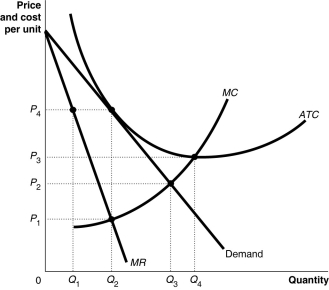 -Refer to Figure 11.6.The firm represented in the diagram
 (Multiple Choice)
4.9/5  (89)
(89) A monopolistically competitive industry that earns economic profits in the short run will
(Multiple Choice)
4.8/5 (77)
(77) Does the fact that monopolistically competitive firms do not achieve productive efficiency or allocative efficiency mean that there is a significant loss in consumer welfare?
(Essay)
4.9/5 (81)
(81) In the short run, a profit-maximizing firm's decision to produce should be guided by whether
(Multiple Choice)
4.9/5 (73)
(73) Under perfect competition, we have one firm selling a perfectly unique product for the entire market, whereas under monopolistic competition we have many firms selling differentiated products to the entire market.
(True/False)
4.9/5 (71)
(71) Firms such as Caribou Coffee and Diedrich Coffee operate hundreds of coffeehouses nationwide while firms such as Dunn Brothers Coffee operate only in four states.How would you characterize these stores?
(Multiple Choice)
4.7/5 (86)
(86) Table 11.1
Quantity Price (dollars) Total Revenue (dollars) 1 \ 7.50 \ 7.50 2 7.00 14.00 3 6.50 19.50 4 6.00 24.00 5 5.50 27.50 6 5.00 30.00
-Refer to Table 11.1.What is the marginal revenue of the 3rd unit?
(Multiple Choice)
4.9/5 (77)
(77) The financial situation at Starbucks in the late 2000s illustrates the fact that maintaining long-run profits in a monopolistically competitive market is
(Multiple Choice)
4.9/5 (74)
(74) If a typical monopolistically competitive firm is making short-run losses, then
(Multiple Choice)
5.0/5 (83)
(83) Figure 11.6
-Refer to Figure 11.6.What is the amount of excess capacity?
-Refer to Figure 11.6.What is the amount of excess capacity? (Multiple Choice)
4.8/5 (72)
(72) Figure 11.10
 -Refer to Figure 11.10.In the long run, why will the firm produce Qf units and not Qg units, which has a lower its average cost of production?
 (Multiple Choice)
4.8/5 (88)
(88) Table 11.2
Quantity (cases) Price (dollars) Total Revenue (dollars) Total Cost (dollars) 1 \ 75 \ 75 \ 60 2 70 140 85 3 65 195 105 4 60 240 115 5 55 275 130 6 50 300 155 7 45 315 190 8 40 320 230 9 35 315 280
Eco Energy is a monopolistically competitive producer of a sports beverage called Power On. Table 11.2 shows the firm's demand and cost schedules.
-Refer to Table 11.2.What is likely to happen to the product's price in the long run?
(Multiple Choice)
4.8/5 (85)
(85) Arturo runs a Robin's Donuts franchise.He is selling 250 iced cappuccinos per week at a price of $2.75.If he lowers the price to $2.70, he will sell 251 iced cappuccinos.What is the marginal revenue of the 251st iced cappuccino? If selling the extra iced cappuccino adds $0.20 to Arturo's costs, what will be the effect on his profit from selling 251 iced cappuccinos instead of 250?
(Essay)
4.9/5 (76)
(76) Table 11.2
Quantity (cases) Price (dollars) Total Revenue (dollars) Total Cost (dollars) 1 \ 75 \ 75 \ 60 2 70 140 85 3 65 195 105 4 60 240 115 5 55 275 130 6 50 300 155 7 45 315 190 8 40 320 230 9 35 315 280
Eco Energy is a monopolistically competitive producer of a sports beverage called Power On. Table 11.2 shows the firm's demand and cost schedules.
-Refer to Table 11.2.What is the marginal profit from producing and selling the 5th case?
(Multiple Choice)
4.9/5 (82)
(82) If price exceeds average variable cost but is less than average total cost, a firm
(Multiple Choice)
4.8/5 (76)
(76) As customers switch from renting DVDs to downloading or streaming movies from the Internet, Netflix will likely find it ________ to remain profitable as they face ________ competition with streaming movies than with mail order DVD rental.
(Multiple Choice)
4.8/5 (71)
(71) Figure 11.6
-Refer to Figure 11.6.What is the monopolistic competitor's profit maximizing price?
-Refer to Figure 11.6.What is the monopolistic competitor's profit maximizing price? (Multiple Choice)
4.9/5 (75)
(75) A monopolistically competitive firm maximizes profit where
(Multiple Choice)
4.9/5 (80)
(80) Figure 11.10
-Refer to Figure 11.10.Suppose the firm is currently producing Qf units.What happens if it increases its output to Qg units?
-Refer to Figure 11.10.Suppose the firm is currently producing Qf units.What happens if it increases its output to Qg units? (Multiple Choice)
4.8/5 (82)
(82) 
Filters
- Essay(0)
- Multiple Choice(0)
- Short Answer(0)
- True False(0)
- Matching(0)