



 Chat with AI
Exam 11: Monopolistic Competition

Exam 1: Economics: Foundations and Models145 Questions
Exam 2: Trade-Offs, Comparative Advantage, and the Market System151 Questions
Exam 3: Where Prices Come From: the Interaction of Demand and Supply159 Questions
Exam 4: Economic Efficiency, Government Price Setting, and Taxes127 Questions
Exam 5: Externalities, Environmental Policy, and Public Goods141 Questions
Exam 6: Elasticity: the Responsiveness of Demand and Supply149 Questions
Exam 7: Comparative Advantage and the Gains From International Trade125 Questions
Exam 8: Consumer Choice and Behavioral Economics154 Questions
Exam 9: Technology, Production, and Costs169 Questions
Exam 10: Firms in Perfectly Competitive Markets153 Questions
Exam 11: Monopolistic Competition140 Questions
Exam 12: Oligopoly: Firms in Less Competitive Markets130 Questions
Exam 13: Monopoly and Antitrust Policy146 Questions
Exam 14: The Markets for Labour and Other Factors of Production149 Questions
Exam 15: Public Choice, Taxes, and the Distribution of Income134 Questions
Exam 16: Pricing Strategy132 Questions
Exam 17: Firms, the Stock Market, and Corporate Governance137 Questions
Select questions type


Figure 11.6
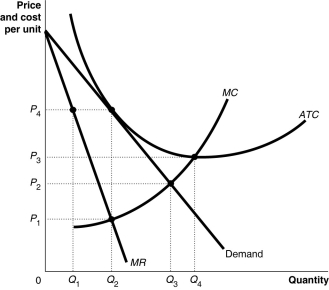 -Refer to Figure 11.6.What is the productively efficient output for the firm represented in the diagram?
 (Multiple Choice)
4.8/5  (79)
(79) Which of the following characteristics is not common to monopolistic competition and perfect competition?
(Multiple Choice)
4.9/5 (85)
(85) Table 11.1
Quantity Price (dollars) Total Revenue (dollars) 1 \ 7.50 \ 7.50 2 7.00 14.00 3 6.50 19.50 4 6.00 24.00 5 5.50 27.50 6 5.00 30.00
-Refer to Table 11.1.What portion of the marginal revenue of the 4th unit is due to the output effect and what portion is due to the price effect?
(Multiple Choice)
4.8/5 (82)
(82) A monopolistically competitive firm can convince buyers that its product has value by differentiating its product to suit consumers' preferences.
(True/False)
5.0/5 (86)
(86) Which of the following is an example of a factor that a firm's owners and managers can control in making the firm successful?
(Multiple Choice)
4.9/5 (74)
(74) Figure 11.9
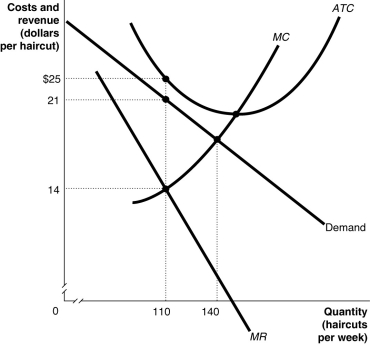 -Refer to Figure 11.9.Figure 11.9 depicts a monopolistically competitive barber shop.Use the diagram to answer the following questions.
a.Suppose the average variable cost of production is $15 when output equals 110 haircuts and $15.25 when output equals 140 haircuts.If the firm wants to maximize its profit or minimize its losses, how many haircuts will it produce and what price should it charge? Explain your answer.
b.Calculate the firm's profit or loss.
c.What is likely to happen in this industry over time as it moves to its new long-run equilibrium?
d.Suppose the barber shop depicted in the diagram remains in the industry.Is this barber shop likely to produce this same quantity of haircuts as in part (a)in the long run?
-Refer to Figure 11.9.Figure 11.9 depicts a monopolistically competitive barber shop.Use the diagram to answer the following questions.
a.Suppose the average variable cost of production is $15 when output equals 110 haircuts and $15.25 when output equals 140 haircuts.If the firm wants to maximize its profit or minimize its losses, how many haircuts will it produce and what price should it charge? Explain your answer.
b.Calculate the firm's profit or loss.
c.What is likely to happen in this industry over time as it moves to its new long-run equilibrium?
d.Suppose the barber shop depicted in the diagram remains in the industry.Is this barber shop likely to produce this same quantity of haircuts as in part (a)in the long run? (Essay)
4.9/5 (88)
(88) The reason that the coffeehouse market is monopolistically competitive rather than perfectly competitive is because
(Multiple Choice)
4.9/5 (91)
(91) Complete the following table.
Energy Drinks Consumed per Week Price (P) Total Revenue (TR) Average Revenue (AR) Marginal Revenue (MR) 0 \ 6.00 1 5.50 2 5.00 3 4.50 4 4.00 5 3.50 6 3.00 7 2.50 8 2.00
(Essay)
5.0/5 (86)
(86) Unlike a perfectly competitive firm, for a monopolistically competitive firm
(Multiple Choice)
4.8/5 (84)
(84) One of your classmates asserts that advertising, marketing research, and brand management are redundant expenditures because a firm can obtain the same information by simply looking at what customers are already buying.Which of the following is not a response you might offer her?
(Multiple Choice)
5.0/5 (84)
(84) Explain the differences between total revenue, average revenue, and marginal revenue.
(Essay)
4.8/5 (83)
(83) You are planning to open a new Italian restaurant in your hometown where there are three other Italian restaurants.You plan to distinguish your restaurant from your competitors by offering northern Italian cuisine and using locally grown organic produce.What is likely to happen in the restaurant market in your hometown after you open?
(Multiple Choice)
4.9/5 (80)
(80) Figure 11.10
 -Refer to Figure 11.10.What is the productively efficient output for the firm represented in the diagram?
 (Multiple Choice)
4.9/5 (76)
(76) Figure 11.8
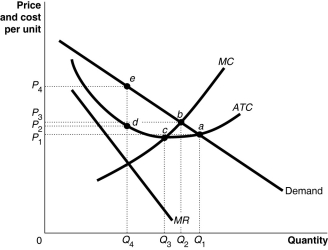 -Refer to Figure 11.8 to answer the following questions.
a.What is the profit-maximizing output level?
b.What is the profit-maximizing price?
c.What is the average total cost at the profit-maximizing output level?
d.What area represents the firm's profit?
e.At which output level are economies of scale exhausted?
f.Does this graph most likely represent the long run or the short run? Why?
-Refer to Figure 11.8 to answer the following questions.
a.What is the profit-maximizing output level?
b.What is the profit-maximizing price?
c.What is the average total cost at the profit-maximizing output level?
d.What area represents the firm's profit?
e.At which output level are economies of scale exhausted?
f.Does this graph most likely represent the long run or the short run? Why? (Essay)
4.8/5 (91)
(91) If buyers of a monopolistically competitive product feel the products of different sellers are strongly differentiated, then the demand for each seller's product is
(Multiple Choice)
4.9/5 (80)
(80) Assume that price exceeds average variable cost over the relevant range of demand.If a monopolistically competitive firm is producing at an output where marginal revenue is $111.11 and marginal cost is $118, then to maximize profits the firm should increase its output.
(True/False)
4.9/5 (83)
(83) Figure 11.10
-Refer to Figure 11.10.What is the amount of excess capacity?
-Refer to Figure 11.10.What is the amount of excess capacity? (Multiple Choice)
4.8/5 (69)
(69) Which of the following is a disadvantage of trademarking a firm's product?
(Multiple Choice)
4.9/5 (70)
(70) In the long-run equilibrium, a monopolistically competitive firm earning normal profit produces the allocatively efficient output level.
(True/False)
4.9/5 (80)
(80) 
Filters
- Essay(0)
- Multiple Choice(0)
- Short Answer(0)
- True False(0)
- Matching(0)