



 Chat with AI
Exam 11: Monopolistic Competition

Exam 1: Economics: Foundations and Models145 Questions
Exam 2: Trade-Offs, Comparative Advantage, and the Market System151 Questions
Exam 3: Where Prices Come From: the Interaction of Demand and Supply159 Questions
Exam 4: Economic Efficiency, Government Price Setting, and Taxes127 Questions
Exam 5: Externalities, Environmental Policy, and Public Goods141 Questions
Exam 6: Elasticity: the Responsiveness of Demand and Supply149 Questions
Exam 7: Comparative Advantage and the Gains From International Trade125 Questions
Exam 8: Consumer Choice and Behavioral Economics154 Questions
Exam 9: Technology, Production, and Costs169 Questions
Exam 10: Firms in Perfectly Competitive Markets153 Questions
Exam 11: Monopolistic Competition140 Questions
Exam 12: Oligopoly: Firms in Less Competitive Markets130 Questions
Exam 13: Monopoly and Antitrust Policy146 Questions
Exam 14: The Markets for Labour and Other Factors of Production149 Questions
Exam 15: Public Choice, Taxes, and the Distribution of Income134 Questions
Exam 16: Pricing Strategy132 Questions
Exam 17: Firms, the Stock Market, and Corporate Governance137 Questions
Select questions type


Which of the following statements is true about marginal revenue?
(Multiple Choice)
4.8/5  (70)
(70) Assuming that the total market size remains constant, a monopolistically competitive firm earning profits in the short run will find the demand for its product decreasing in the long run because
(Multiple Choice)
4.8/5 (85)
(85) Assume price exceeds average variable cost over the relevant range of demand.If a monopolistically competitive firm is producing at an output where marginal revenue is $23 and marginal cost is $19, then to maximize profits the firm should
(Multiple Choice)
5.0/5 (83)
(83) In the long run, what happens to the demand curve facing a monopolistically competitive firm that is earning short-run profits?
(Multiple Choice)
4.8/5 (82)
(82) How would a marketing campaign directed at single women improve the chances of success at a place like a cigar bar?
(Essay)
4.9/5 (92)
(92) For a monopolistically competitive firm, price equals average revenue.
(True/False)
4.9/5 (83)
(83) Long-run equilibrium under monopolistic competition is similar to that under perfect competition in that
(Multiple Choice)
4.7/5 (85)
(85) Table 11.3
Quantity Price (dollars) Total Revenue (dollars) Total Variable Cost (dollars) Total Cost (dollars) 0 \ 21 \ 0 \ 0 \ 50 1 20 20 16 66 2 19 38 31 81 3 18 54 45 95 4 17 68 59 109 5 16 80 75 125 6 15 90 93 143 7 14 98 112 162 8 13 104 140 190 9 12 108 180 230 10 11 110 230 280
Table 11.3 shows the demand and cost schedules for a monopolistically competitive firm.
-Refer to Table 11.3.What is its average variable cost of production at its optimal output level?
(Multiple Choice)
4.8/5 (75)
(75) A monopolistically competitive industry that earns economic profits in the short run will face a more elastic demand curve in the long run.
(True/False)
4.9/5 (83)
(83) Table 11.2
Quantity (cases) Price (dollars) Total Revenue (dollars) Total Cost (dollars) 1 \ 75 \ 75 \ 60 2 70 140 85 3 65 195 105 4 60 240 115 5 55 275 130 6 50 300 155 7 45 315 190 8 40 320 230 9 35 315 280
Eco Energy is a monopolistically competitive producer of a sports beverage called Power On. Table 11.2 shows the firm's demand and cost schedules.
-Refer to Table 11.2.What is the output (Q)that maximizes profit and what is the price (P)charged?
(Multiple Choice)
4.8/5 (61)
(61) The key characteristics of a monopolistically competitive market structure include
(Multiple Choice)
4.8/5 (73)
(73) Figure 11.3
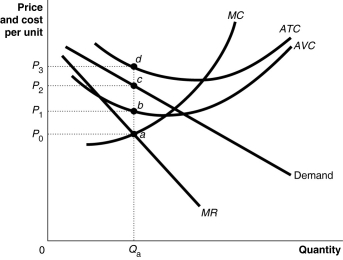 Figure 11.3 shows short-run cost and demand curves for a monopolistically competitive firm in the market for designer watches.
-Refer to Figure 11.3.What is the area that represents the total variable cost of production?
Figure 11.3 shows short-run cost and demand curves for a monopolistically competitive firm in the market for designer watches.
-Refer to Figure 11.3.What is the area that represents the total variable cost of production? (Multiple Choice)
4.8/5 (75)
(75) Juicy Couture has been successful in selling women's clothing using an unusual strategy.
According to an article in the Wall Street Journal, the key to the firm's strategy is to "limit distribution to maintain the brand's exclusive cachet, even if that means sacrificing sales, a brand-management technique once used only for high-end luxury brands." In 2006, Juicy clothes were sold in only four department stores: Neiman Marcus, Saks, Bloomingdale's, and Nordstrom.In 2006, its sales have more than quadrupled since 2002.
Source: Rachel Dodes, "From Track Suits to Fast Track," Wall Street Journal, September 13, 2006.
How does limiting the number of stores in which Juicy's products are sold contribute to its success?
(Multiple Choice)
4.8/5 (75)
(75) Figure 11.6
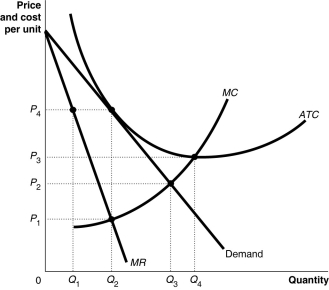 -Refer to Figure 11.6.What is the allocatively efficient output for the firm represented in the diagram?
 (Multiple Choice)
4.8/5 (88)
(88) Why do most firms in monopolistic competition typically make zero profit in the long run?
(Multiple Choice)
4.9/5 (77)
(77) If a monopolistically competitive firm breaks even, the firm is earning as much in this industry as it could in any other comparable industry.
(True/False)
4.9/5 (89)
(89) JoJo's Cigar Bar is attempting to set itself apart from its competition by marketing to single women.This is an example of
(Multiple Choice)
4.8/5 (85)
(85) A monopolistically competitive firm faces a downward-sloping demand curve because
(Multiple Choice)
4.9/5 (85)
(85) 
Filters
- Essay(0)
- Multiple Choice(0)
- Short Answer(0)
- True False(0)
- Matching(0)