



 Chat with AI
Exam 9: Technology, Production, and Costs

Exam 1: Economics: Foundations and Models145 Questions
Exam 2: Trade-Offs, Comparative Advantage, and the Market System151 Questions
Exam 3: Where Prices Come From: the Interaction of Demand and Supply159 Questions
Exam 4: Economic Efficiency, Government Price Setting, and Taxes127 Questions
Exam 5: Externalities, Environmental Policy, and Public Goods141 Questions
Exam 6: Elasticity: the Responsiveness of Demand and Supply149 Questions
Exam 7: Comparative Advantage and the Gains From International Trade125 Questions
Exam 8: Consumer Choice and Behavioral Economics154 Questions
Exam 9: Technology, Production, and Costs169 Questions
Exam 10: Firms in Perfectly Competitive Markets153 Questions
Exam 11: Monopolistic Competition140 Questions
Exam 12: Oligopoly: Firms in Less Competitive Markets130 Questions
Exam 13: Monopoly and Antitrust Policy146 Questions
Exam 14: The Markets for Labour and Other Factors of Production149 Questions
Exam 15: Public Choice, Taxes, and the Distribution of Income134 Questions
Exam 16: Pricing Strategy132 Questions
Exam 17: Firms, the Stock Market, and Corporate Governance137 Questions
Select questions type


A firm has successfully adopted a positive technological change when
(Multiple Choice)
4.7/5  (81)
(81) 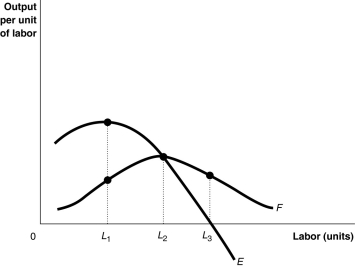 -Refer to Figure 9.2.The curve labeled "E" is
A Toyota plant president was quoted as saying, "Demand for high volumes saps your energy.Over a period of time, it eroded our focus [and] thinned out the expertise and knowledge we painstakingly built up over the years." Based on this quote, what must be true of the plant's average cost of production curve?
(Multiple Choice)
4.8/5 (86)
(86) In economics, what is the difference between the short run and the long run?
(Essay)
4.9/5 (84)
(84) An important reason why diseconomies of scale arise is because firms may have to hire lower skilled workers as firms expand.
(True/False)
4.8/5 (80)
(80) If a firm produces 20 units of output and incurs a total cost of $1,000 and a variable cost is $700, calculate the firm's average fixed cost of production if it expands output to 25 units.
(Multiple Choice)
4.9/5 (87)
(87) If the marginal cost curve is below the average variable cost curve, then
(Multiple Choice)
4.9/5 (84)
(84) In the short run, if marginal product is at its maximum, then
(Multiple Choice)
4.8/5 (79)
(79) The short run is the time period during which a firm has at least one input constraint.
(True/False)
4.8/5 (83)
(83) Economies of scale exist as a firm increases its size in the long run because of all of the following except
(Multiple Choice)
4.8/5 (88)
(88) An isoquant is a curve that shows all the combinations of two inputs that will produce the same level of output.
(True/False)
4.9/5 (81)
(81) Which of the following is an example of positive technological change?
(Multiple Choice)
4.8/5 (89)
(89) If the firm is producing no output in the short run, then its total costs are zero.
(True/False)
4.7/5 (86)
(86) Table 9.3
Quantity of Lanterns Fixed Cost (dollars) Variable Cost (dollars) Total Cost (dollars) Average Total Cost (dollars) 75 200 170 370 4.93 80 200 230 430 5.36 90 200 7.67 100 200 810 115 200 11.8 117 200 1264 1464 12.5 120 200 1480
Table 9.3 shows cost data for Lotus Lanterns, a producer of whimsical night lights.
-Refer to Table 9.3.What is the variable cost of production when the firm produces 115 lanterns?
(Multiple Choice)
5.0/5 (90)
(90) If 11 workers can produce a total of 54 units of a product and a 12th worker has a marginal product of 6 units, then the average product of 12 workers is
(Multiple Choice)
4.9/5 (68)
(68) The absolute value of the slope of an isocost line equals the ratio of
(Multiple Choice)
4.8/5 (77)
(77) 
Filters
- Essay(0)
- Multiple Choice(0)
- Short Answer(0)
- True False(0)
- Matching(0)