



 Chat with AI
Exam 2: Trade-Offs, Comparative Advantage, and the Market System

Exam 1: Economics: Foundations and Models145 Questions
Exam 2: Trade-Offs, Comparative Advantage, and the Market System151 Questions
Exam 3: Where Prices Come From: the Interaction of Demand and Supply159 Questions
Exam 4: Economic Efficiency, Government Price Setting, and Taxes127 Questions
Exam 5: Externalities, Environmental Policy, and Public Goods141 Questions
Exam 6: Elasticity: the Responsiveness of Demand and Supply149 Questions
Exam 7: Comparative Advantage and the Gains From International Trade125 Questions
Exam 8: Consumer Choice and Behavioral Economics154 Questions
Exam 9: Technology, Production, and Costs169 Questions
Exam 10: Firms in Perfectly Competitive Markets153 Questions
Exam 11: Monopolistic Competition140 Questions
Exam 12: Oligopoly: Firms in Less Competitive Markets130 Questions
Exam 13: Monopoly and Antitrust Policy146 Questions
Exam 14: The Markets for Labour and Other Factors of Production149 Questions
Exam 15: Public Choice, Taxes, and the Distribution of Income134 Questions
Exam 16: Pricing Strategy132 Questions
Exam 17: Firms, the Stock Market, and Corporate Governance137 Questions
Select questions type


Without an increase in the supplies of factors of production, how can a nation achieve economic growth?
(Multiple Choice)
4.8/5  (73)
(73) Table 2.4
One Digital Camera Wheat (per pound) China 100 hours 4 hours South Korea 60 hours 3 hours
Table 2.4 shows the number of labour hours required to produce a digital camera and a pound of wheat in China and South Korea.
-Refer to Table 2.4.If the two countries specialize and trade, who should export digital cameras?
(Multiple Choice)
4.9/5 (82)
(82) Figure 2.11
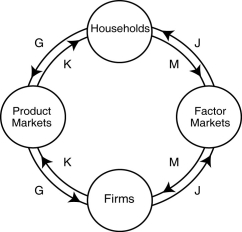 -Refer to Figure 2.11.Which two arrows in the diagram depict the following transaction: Barney earns $250 for selling scissors and razors to Floyd's Barber Shop.
 (Multiple Choice)
4.8/5 (70)
(70) The production possibilities frontier shows the ________ combinations of two products that may be produced in a particular time period with available resources.
(Multiple Choice)
4.9/5 (87)
(87) Table 2.4
One Digital Camera Wheat (per pound) China 100 hours 4 hours South Korea 60 hours 3 hours
Table 2.4 shows the number of labour hours required to produce a digital camera and a pound of wheat in China and South Korea.
-Refer to Table 2.4.What is South Korea's opportunity cost of producing one pound of wheat?
(Multiple Choice)
4.8/5 (77)
(77) The production possibilities frontier model assumes which of the following?
(Multiple Choice)
4.8/5 (83)
(83) Figure 2.7
 Figure 2.7 shows the production possibilities frontiers for Pakistan and Indonesia. Each country produces two goods, cotton and cashews.
-Refer to Figure 2.7.Which country has a comparative advantage in the production of cotton?
Figure 2.7 shows the production possibilities frontiers for Pakistan and Indonesia. Each country produces two goods, cotton and cashews.
-Refer to Figure 2.7.Which country has a comparative advantage in the production of cotton? (Multiple Choice)
4.8/5 (80)
(80) Table 2.3
Serena Haley Bracelets 8 9 Necklaces 16 12
Table 2.3 shows the output per week of two jewelers, Serena and Haley. They can either devote their time to making bracelets or making necklaces.
-Refer to Table 2.3.What is Serena's opportunity cost of making a bracelet?
(Multiple Choice)
4.9/5 (80)
(80) The federal government supports health care spending through the Canada Health Transfer.As the population ages and the number of people who are over 65 continues to rise, government spending on health care will
(Multiple Choice)
4.7/5 (82)
(82) Which of the following is an example of spending on goods and services in the circular flow model?
(Multiple Choice)
4.8/5 (92)
(92) Table 2.4
One Digital Camera Wheat (per pound) China 100 hours 4 hours South Korea 60 hours 3 hours
Table 2.4 shows the number of labour hours required to produce a digital camera and a pound of wheat in China and South Korea.
-Refer to Table 2.4.If the two countries specialize and trade, who should export wheat?
(Multiple Choice)
4.8/5 (72)
(72) Figure 2.2
 Figure 2.2 above shows the production possibilities frontier for Atikamekw Cree (ca. 1600)with a historical tradition of fishing and farming. Assume they produce two goods: fish and grains
-Refer to Figure 2.2.Suppose Atikamekw Cree are currently producing 60 kilograms of grain per period.How much fish is it also producing, assuming that resources are fully utilized?
Figure 2.2 above shows the production possibilities frontier for Atikamekw Cree (ca. 1600)with a historical tradition of fishing and farming. Assume they produce two goods: fish and grains
-Refer to Figure 2.2.Suppose Atikamekw Cree are currently producing 60 kilograms of grain per period.How much fish is it also producing, assuming that resources are fully utilized? (Multiple Choice)
4.9/5 (72)
(72) In a two-good, two country world, if one country has an absolute advantage in the production of both goods, it cannot benefit by trading with the other country.
(True/False)
4.9/5 (76)
(76) Table 2.5
Digital Camera Wheat (bushels) China 100 hours 5 hours South Korea 90 hours 3 hours
-Refer to Table 2-5.This table shows the number of labour hours required to produce a digital camera and a bushel of wheat in China and South Korea.
a.If each country has a total of 9000 labour hours to devote to the production of the two goods, draw the production possibilities frontier for each country.Put "Digital Camera" on the horizontal axis and "Wheat" on the vertical axis.Be sure to identify the intercept values on your graphs.
b.Suppose each country allocates 60% its labour hours to wheat production and 40% to the production of digital cameras.Complete Table 2-6 below to show each country's output of the two products.
Table 2.6: Production and Consumption with no Trade
Digital Camera Output Wheat Output (bushels) China South Korea Total
c.If the two countries do not trade and consume whatever they produce, identify the current production and consumption point for each country on their respective production possibilities frontiers.Label China's consumption point "C" and South Korea's consumption point, "K."
d.Suppose the two countries specialize and trade.Who should produce digital cameras and who should produce wheat? Explain your answer.
e.Complete Table 2-7 below to show each country's output with specialization.
Table 2.7: Output with Specialization
Digital Camera Output Wheat Output (bushels) China South Korea Total
f.Did specialization increase the combined output for the two countries without any increase in resources? If so, by how much?
g.Suppose China and South Korea agree to trade so that in exchange for 1,200 bushels of wheat, the exporter of wheat receives 48 digital cameras.Complete Table 2-8 below to show each country's consumption bundle after trade.
Table 2.8: Consumption with Trade
Digital Camera Wheat (bushels) China South Korea
h.Show the consumption points after trade on each country's production possibilities frontier.Label these points "B" for China and "J" for South Korea.
i.Has trade made the two countries better off? Explain your answer.
(Essay)
4.9/5 (79)
(79) Stricter laws and regulations to protect intellectual property rights
(Multiple Choice)
5.0/5 (84)
(84) All of the following are critical functions of the government in facilitating the operation of a market economy except
(Multiple Choice)
4.8/5 (82)
(82) Figure 2.11
-Refer to Figure 2.11.Which two arrows in the diagram depict the following transaction: Dorian Gray hires "Wild Oscar," a professional portrait artist, to paint his picture.
-Refer to Figure 2.11.Which two arrows in the diagram depict the following transaction: Dorian Gray hires "Wild Oscar," a professional portrait artist, to paint his picture. (Multiple Choice)
4.9/5 (69)
(69) Specializing in the production of a good or service in which one has a comparative advantage enables a country to do all of the following except
(Multiple Choice)
4.9/5 (87)
(87) Is it possible for a firm to have an absolute advantage in producing something without having a comparative advantage? Why or why not?
(Essay)
4.9/5 (75)
(75) 
Filters
- Essay(0)
- Multiple Choice(0)
- Short Answer(0)
- True False(0)
- Matching(0)