



 Chat with AI
Exam 2: Trade-Offs, Comparative Advantage, and the Market System

Exam 1: Economics: Foundations and Models145 Questions
Exam 2: Trade-Offs, Comparative Advantage, and the Market System151 Questions
Exam 3: Where Prices Come From: the Interaction of Demand and Supply159 Questions
Exam 4: Economic Efficiency, Government Price Setting, and Taxes127 Questions
Exam 5: Externalities, Environmental Policy, and Public Goods141 Questions
Exam 6: Elasticity: the Responsiveness of Demand and Supply149 Questions
Exam 7: Comparative Advantage and the Gains From International Trade125 Questions
Exam 8: Consumer Choice and Behavioral Economics154 Questions
Exam 9: Technology, Production, and Costs169 Questions
Exam 10: Firms in Perfectly Competitive Markets153 Questions
Exam 11: Monopolistic Competition140 Questions
Exam 12: Oligopoly: Firms in Less Competitive Markets130 Questions
Exam 13: Monopoly and Antitrust Policy146 Questions
Exam 14: The Markets for Labour and Other Factors of Production149 Questions
Exam 15: Public Choice, Taxes, and the Distribution of Income134 Questions
Exam 16: Pricing Strategy132 Questions
Exam 17: Firms, the Stock Market, and Corporate Governance137 Questions
Select questions type


If a country produces only two goods, it is possible to have a comparative advantage in the production of both those goods.
(True/False)
4.7/5  (87)
(87) Table 2.4
One Digital Camera Wheat (per pound) China 100 hours 4 hours South Korea 60 hours 3 hours
Table 2.4 shows the number of labour hours required to produce a digital camera and a pound of wheat in China and South Korea.
-Refer to Table 2.4.What is China's opportunity cost of producing one pound of wheat?
(Multiple Choice)
4.8/5 (70)
(70) The natural resources used in production are made available in the
(Multiple Choice)
4.8/5 (78)
(78) Figure 2.2
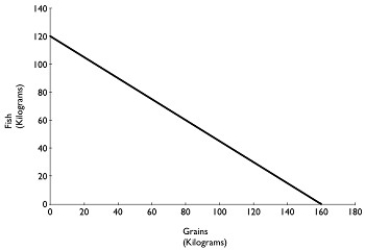 Figure 2.2 above shows the production possibilities frontier for Atikamekw Cree (ca. 1600)with a historical tradition of fishing and farming. Assume they produce two goods: fish and grains
-Refer to Figure 2.2.The linear production possibilities frontier in the figure indicates that
Figure 2.2 above shows the production possibilities frontier for Atikamekw Cree (ca. 1600)with a historical tradition of fishing and farming. Assume they produce two goods: fish and grains
-Refer to Figure 2.2.The linear production possibilities frontier in the figure indicates that (Multiple Choice)
4.9/5 (87)
(87) The payment received by suppliers of entrepreneurial skills is called interest.
(True/False)
4.9/5 (80)
(80) Figure 2.2
Figure 2.2 above shows the production possibilities frontier for Atikamekw Cree (ca. 1600)with a historical tradition of fishing and farming. Assume they produce two goods: fish and grains
-Refer to Figure 2.2.What is the opportunity cost of one kilogram of grain?
Figure 2.2 above shows the production possibilities frontier for Atikamekw Cree (ca. 1600)with a historical tradition of fishing and farming. Assume they produce two goods: fish and grains
-Refer to Figure 2.2.What is the opportunity cost of one kilogram of grain? (Multiple Choice)
4.8/5 (81)
(81) Figure 2.4
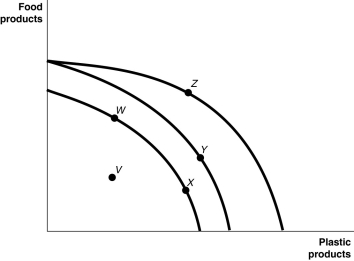 Figure 2.4 shows various points on three different production possibilities frontiers for a nation.
-Refer to Figure 2.4.Consider the following movements:
a)from point V to point W
b)from point W to point Y
c)from point Y to point Z
Which of the movements listed above represents economic growth?
Figure 2.4 shows various points on three different production possibilities frontiers for a nation.
-Refer to Figure 2.4.Consider the following movements:
a)from point V to point W
b)from point W to point Y
c)from point Y to point Z
Which of the movements listed above represents economic growth? (Multiple Choice)
4.9/5 (79)
(79) For each bottle of wine that Italy produces, it gives up the opportunity to make 10 pounds of cheese.France can produce 1 bottle of wine for every 25 pounds of cheese it produces.Which of the following is true about the comparative advantage between the two countries?
(Multiple Choice)
4.8/5 (76)
(76) Figure 2.4
Figure 2.4 shows various points on three different production possibilities frontiers for a nation.
-Refer to Figure 2.4.Consider the following events:
a)an increase in the unemployment rate
b)a decrease in a nation's money supply
c)a war that kills a significant portion of a nation's population
Which of the events listed above could cause a movement from Y to W?
Figure 2.4 shows various points on three different production possibilities frontiers for a nation.
-Refer to Figure 2.4.Consider the following events:
a)an increase in the unemployment rate
b)a decrease in a nation's money supply
c)a war that kills a significant portion of a nation's population
Which of the events listed above could cause a movement from Y to W? (Multiple Choice)
4.9/5 (75)
(75) How does Adam Smith's idea of the "invisible hand" apply to the various parts, made by many different manufacturers in many different countries, that are used by Apple to produce an iPad?
(Essay)
4.9/5 (70)
(70) For a person to have a comparative advantage in producing a product, she must be able to produce that product at a lower opportunity cost than her competitors.
(True/False)
4.8/5 (82)
(82) Table 2.4
One Digital Camera Wheat (per pound) China 100 hours 4 hours South Korea 60 hours 3 hours
Table 2.4 shows the number of labour hours required to produce a digital camera and a pound of wheat in China and South Korea.
-Refer to Table 2.4.Does either China or South Korea have an absolute advantage and if so, in what product?
(Multiple Choice)
4.9/5 (77)
(77) Increasing opportunity cost is represented by a ________ production possibilities frontier.
(Multiple Choice)
4.8/5 (62)
(62) If the production possibilities frontier is ________, then opportunity costs are constant as more of one good is produced.
(Multiple Choice)
4.8/5 (68)
(68) Suppose your expenses for this term are as follows: tuition: $5,000, room and board: $6,500, books and other educational supplies: $1,500.Further, during the term, you can only work part-time and earn $3,500 instead of your full-time salary of $14,000.What is the opportunity cost of going to college this term, assuming that your room and board expenses would be the same even if you did not go to college?
(Multiple Choice)
4.7/5 (79)
(79) The points outside the production possibilities frontier are
(Multiple Choice)
4.7/5 (66)
(66) On a diagram of a production possibility frontier, opportunity cost is represented by the production possibility frontier shifting outward.
(True/False)
4.8/5 (88)
(88) Table 2.1
Production choices for Tomaso's Trattoria
Choice Quantity of Pizzas Produced Quantity of Calzones Produced A 48 0 B 36 15 C 24 30 D 12 45 E 0 60
-Refer to Table 2.1.Assume Tomaso's Trattoria only produces pizzas and calzones.A combination of 24 pizzas and 15 calzones would appear
(Multiple Choice)
4.8/5 (81)
(81) Table 2.4
One Digital Camera Wheat (per pound) China 100 hours 4 hours South Korea 60 hours 3 hours
Table 2.4 shows the number of labour hours required to produce a digital camera and a pound of wheat in China and South Korea.
-Refer to Table 2.4.South Korea has a comparative advantage in the production of
(Multiple Choice)
4.9/5 (82)
(82) 
Filters
- Essay(0)
- Multiple Choice(0)
- Short Answer(0)
- True False(0)
- Matching(0)