



 Chat with AI
Exam 2: Trade-Offs, Comparative Advantage, and the Market System

Exam 1: Economics: Foundations and Models145 Questions
Exam 2: Trade-Offs, Comparative Advantage, and the Market System151 Questions
Exam 3: Where Prices Come From: the Interaction of Demand and Supply159 Questions
Exam 4: Economic Efficiency, Government Price Setting, and Taxes127 Questions
Exam 5: Externalities, Environmental Policy, and Public Goods141 Questions
Exam 6: Elasticity: the Responsiveness of Demand and Supply149 Questions
Exam 7: Comparative Advantage and the Gains From International Trade125 Questions
Exam 8: Consumer Choice and Behavioral Economics154 Questions
Exam 9: Technology, Production, and Costs169 Questions
Exam 10: Firms in Perfectly Competitive Markets153 Questions
Exam 11: Monopolistic Competition140 Questions
Exam 12: Oligopoly: Firms in Less Competitive Markets130 Questions
Exam 13: Monopoly and Antitrust Policy146 Questions
Exam 14: The Markets for Labour and Other Factors of Production149 Questions
Exam 15: Public Choice, Taxes, and the Distribution of Income134 Questions
Exam 16: Pricing Strategy132 Questions
Exam 17: Firms, the Stock Market, and Corporate Governance137 Questions
Select questions type


The basis for trade is comparative advantage, not absolute advantage.
(True/False)
5.0/5  (65)
(65) Table 2.5
Digital Camera Wheat (bushels) China 100 hours 5 hours South Korea 90 hours 3 hours
-Refer to Table 2.5.This table shows the number of labor hours required to produce a digital cameras and a bushel of wheat in China and South Korea.
a.Which country has an absolute advantage in the production of digital cameras?
b.Which country has an absolute advantage in the production of wheat?
c.What is China's opportunity cost of producing one digital camera?
d.What is South Korea's opportunity cost of producing one digital camera?
e.What is China's opportunity cost of producing one bushel of wheat?
f.What is South Korea's opportunity cost of producing one bushel of wheat?
g.If each country specializes in the production of the product in which it has a comparative advantage, who should produce digital cameras?
h.If each country specializes in the production of the product in which it has a comparative advantage, who should produce wheat?
(Essay)
4.9/5 (82)
(82) A decrease in the unemployment rate may be represented as a movement from a point on the production possibilities frontier to a point outside the frontier.
(True/False)
5.0/5 (87)
(87) Each person goes about her daily business seeking to maximize her own self interests.In doing so, she contributes to the welfare of society at large.This is the idea underlying Adam Smith's "invisible hand."
(True/False)
4.8/5 (81)
(81) Which of the following statements about an entrepreneur is false?
(Multiple Choice)
4.8/5 (79)
(79) The attainable production points on a production possibility curve are
(Multiple Choice)
4.8/5 (90)
(90) Figure 2.8
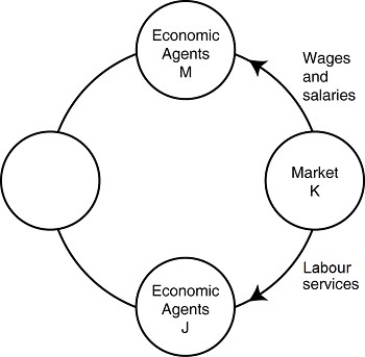 -Refer to Figure 2.8.One segment of the circular flow diagram in the figure shows the flow of wages and salaries from market K to economic agents M.What is market K and who are economic agents M?
 (Multiple Choice)
4.8/5 (70)
(70) What shape does a production possibilities frontier take if it displays increasing opportunity costs? What shape does a production possibilities frontier take if it displays constant opportunity costs? Which shape is most common in production situations? Why are both types presented in the text?
(Essay)
4.8/5 (68)
(68) Figure 2.6
 Toyota finds the emission standards too difficult to meet to bring its diesel-engine offerings to North America. They have instead focused their research on hybrid-engine technology. Assume Toyota chooses to produce both hybrid-engine vehicles and diesel-engine vehicles for its Prius brand. Figure 2.6 shows changes to its production possibilities frontier in response to new developments and different strategic production decisions.
-Refer to Figure 2.6.In response to changing consumer demands, Toyota has cut back on the production of hybrids and increased its production of diesel-powered vehicles.This strategy is best represented by the
Toyota finds the emission standards too difficult to meet to bring its diesel-engine offerings to North America. They have instead focused their research on hybrid-engine technology. Assume Toyota chooses to produce both hybrid-engine vehicles and diesel-engine vehicles for its Prius brand. Figure 2.6 shows changes to its production possibilities frontier in response to new developments and different strategic production decisions.
-Refer to Figure 2.6.In response to changing consumer demands, Toyota has cut back on the production of hybrids and increased its production of diesel-powered vehicles.This strategy is best represented by the (Multiple Choice)
4.9/5 (80)
(80) All of the following are examples of spending on factors of production in the circular flow model except
(Multiple Choice)
4.9/5 (86)
(86) Which of the following would shift a nation's production possibilities frontier outward?
(Multiple Choice)
4.9/5 (84)
(84) Which of the following are separate flows (shown in different parts of the model)in the circular flow model?
(Multiple Choice)
4.8/5 (83)
(83) Table 2.1
Production choices for Tomaso's Trattoria
Choice Quantity of Pizzas Produced Quantity of Calzones Produced A 48 0 B 36 15 C 24 30 D 12 45 E 0 60
-Refer to Table 2.1.Assume Tomaso's Trattoria only produces pizzas and calzones.A combination of 36 pizzas and 30 calzones would appear
(Multiple Choice)
4.7/5 (84)
(84) Bella can produce either a combination of 60 silk roses and 80 silk leaves or a combination of 70 silk roses and 55 silk leaves.If she now produces 60 silk roses and 80 silk leaves, what is the opportunity cost of producing an additional 10 silk roses?
(Multiple Choice)
4.8/5 (81)
(81) Consider the following items:
a)the novel "The DaVinci Code" by Dan Brown
b)"The Spirited Shipper," an innovative wine shipping box
c)a Swiss chef's award-winning recipe
d)an original fabric design, for example, the fabric used for "Coach" bags and luggage
Which of the items listed is an example of intellectual property?
(Multiple Choice)
4.9/5 (79)
(79) Figure 2.9
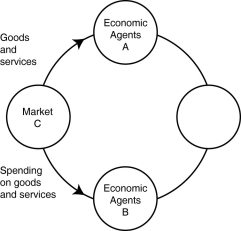 -Refer to Figure 2.9.One segment of the circular flow diagram in the figure shows the flow of goods and services from market C to economic agents A.What is market C and who are economic agents A?
 (Multiple Choice)
4.7/5 (72)
(72) An outward shift of a nation's production possibilities frontier represents
(Multiple Choice)
4.8/5 (65)
(65) 
Filters
- Essay(0)
- Multiple Choice(0)
- Short Answer(0)
- True False(0)
- Matching(0)