



 Chat with AI
Exam 14: Down the Rabbit Hole: Relativity and Black Holes

Exam 1: Getting Started: Science, astronomy, and Being Human70 Questions
Exam 2: A Universe Made, a Universe Discovered71 Questions
Exam 3: A Universe of Universal Laws71 Questions
Exam 4: A Universe of Universal Laws70 Questions
Exam 5: The Architecture and Birth of Planetary Systems70 Questions
Exam 6: Home Base: Earth and Moon70 Questions
Exam 7: Sibling Worlds: Mercury, Venus, and Mars70 Questions
Exam 8: Gas, ice, and Stone: the Outer Planets70 Questions
Exam 9: Life and the Search for Habitable Worlds70 Questions
Exam 10: The Sun As a Star70 Questions
Exam 11: Measuring the Stars: the Main Sequence and Its Meaning70 Questions
Exam 12: Nursery of the Stars: the Interstellar Medium and Star Formation70 Questions
Exam 13: To the Graveyard of Stars: the End Points of Stellar Evolution70 Questions
Exam 14: Down the Rabbit Hole: Relativity and Black Holes70 Questions
Exam 15: Our City of Stars: the Milky Way70 Questions
Exam 16: A Universe of Galaxies69 Questions
Exam 17: The Cosmic Web: the Large-Scale Structure of the Universe70 Questions
Exam 18: Cosmology70 Questions
Select questions type


The general theory of relativity includes an explanation of:
(Multiple Choice)
4.8/5  (64)
(64) Which of the following did Einstein determine to be a constant of nature?
(Multiple Choice)
4.8/5 (82)
(82) Two observers in different frames of reference will measure different:
(Multiple Choice)
4.9/5 (74)
(74) A spaceship moves at 3/5 the speed of light relative to an observer.How long will each tick of a clock on the spaceship take,relative to an identical clock held by the observer?
(Multiple Choice)
4.7/5 (70)
(70) Two observers travel perpendicular to each other,as shown in the figure below.If observer B shone a light toward observer A,what velocity would observer A measure the beam to have? 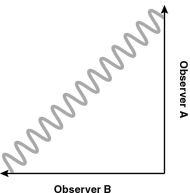
(Multiple Choice)
5.0/5 (77)
(77) Which of the following objects has the strongest tidal forces,assuming that each has the same mass?
(Multiple Choice)
4.9/5 (80)
(80) An astronaut falls into a black hole that has 100 times the mass of the Sun.The astronaut sends signals to her partner,who sits at rest a large distance from the black hole.How far from the black hole's center is the astronaut when her signals can no longer reach her partner?
(Short Answer)
4.8/5 (90)
(90) Suppose a supermassive black hole moves across the line of sight to a distant star,as shown in the figure below.How will the star appear to change to an observer on Earth? 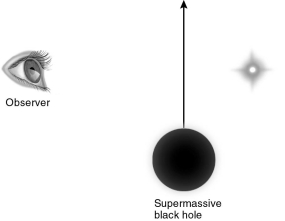
(Multiple Choice)
4.9/5 (68)
(68) 
Filters
- Essay(0)
- Multiple Choice(0)
- Short Answer(0)
- True False(0)
- Matching(0)