



 Chat with AI
Exam 14: Down the Rabbit Hole: Relativity and Black Holes

Exam 1: Getting Started: Science, astronomy, and Being Human70 Questions
Exam 2: A Universe Made, a Universe Discovered71 Questions
Exam 3: A Universe of Universal Laws71 Questions
Exam 4: A Universe of Universal Laws70 Questions
Exam 5: The Architecture and Birth of Planetary Systems70 Questions
Exam 6: Home Base: Earth and Moon70 Questions
Exam 7: Sibling Worlds: Mercury, Venus, and Mars70 Questions
Exam 8: Gas, ice, and Stone: the Outer Planets70 Questions
Exam 9: Life and the Search for Habitable Worlds70 Questions
Exam 10: The Sun As a Star70 Questions
Exam 11: Measuring the Stars: the Main Sequence and Its Meaning70 Questions
Exam 12: Nursery of the Stars: the Interstellar Medium and Star Formation70 Questions
Exam 13: To the Graveyard of Stars: the End Points of Stellar Evolution70 Questions
Exam 14: Down the Rabbit Hole: Relativity and Black Holes70 Questions
Exam 15: Our City of Stars: the Milky Way70 Questions
Exam 16: A Universe of Galaxies69 Questions
Exam 17: The Cosmic Web: the Large-Scale Structure of the Universe70 Questions
Exam 18: Cosmology70 Questions
Select questions type


A black hole,originally with a mass of 10³ MSᵤn,accretes gas and grows so that its event horizon increases in radius by a factor of 10.What is the final mass of the black hole?

Free
(Multiple Choice)
4.7/5  (85)
(85) Correct Answer: Verified
C
How did physicists try to detect the luminiferous aether in the late 19th century?
Free
(Multiple Choice)
4.9/5 (85)
(85) Correct Answer:Verified
VerifiedD
Experiments to measure the properties of the luminiferous aether were problematic for scientists in the early 20th century because there was no evidence for:
Free
(Multiple Choice)
4.8/5 (76)
(76) Correct Answer:Verified
VerifiedA
The first evidence for supermassive black holes at the centers of galaxies came from:
(Multiple Choice)
4.9/5 (67)
(67) Imagine that a spaceship is traveling at half the speed of light relative to an observer.The spaceship shoots a laser in the direction of its motion.How fast is the laser traveling relative to the observer?
(Multiple Choice)
4.7/5 (84)
(84) In which wavelength range is material falling into stellar-mass black holes most likely to be detected?
(Multiple Choice)
5.0/5 (81)
(81) What stops the collapse of the most massive stars at the end of their lives?
(Multiple Choice)
4.7/5 (72)
(72) What is the observational evidence that black hole jets are launched very close to the event horizon?
(Multiple Choice)
4.8/5 (76)
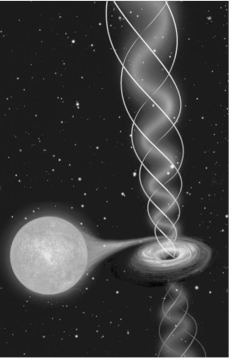
(76) The figure below shows a relativistic jet of material escaping an astronomical object.The jet is represented by the twisted gray columns.What is represented by the twisted lines and orange disk? What is at the center of such a system?
(Essay)
4.9/5 (73)
(73) Which of the following effects must be accounted for to make accurate measurements with global positioning system satellites?
(Multiple Choice)
4.8/5 (85)
(85) If the speed of light were infinite,how would black holes change?
(Multiple Choice)
4.8/5 (86)
(86) Which of the following sets of numbers completely characterizes a black hole?
(Multiple Choice)
4.8/5 (74)
(74) An airline pilot spends a considerable fraction of his life traveling at a speed of several hundred kilometers per hour relative to his identical twin brother.How does the pilot's lifetime compare to that of his brother,all other things being equal?
(Multiple Choice)
4.9/5 (92)
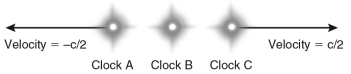
(92) Three identical clocks are held by observers moving as shown in the figure below.Compare the rates at which the three clocks tick,as measured by observer B.
(Essay)
5.0/5 (82)
(82) 
Filters
- Essay(0)
- Multiple Choice(0)
- Short Answer(0)
- True False(0)
- Matching(0)