



 Chat with AI
Exam 18: Cosmology

Exam 1: Getting Started: Science, astronomy, and Being Human70 Questions
Exam 2: A Universe Made, a Universe Discovered71 Questions
Exam 3: A Universe of Universal Laws71 Questions
Exam 4: A Universe of Universal Laws70 Questions
Exam 5: The Architecture and Birth of Planetary Systems70 Questions
Exam 6: Home Base: Earth and Moon70 Questions
Exam 7: Sibling Worlds: Mercury, Venus, and Mars70 Questions
Exam 8: Gas, ice, and Stone: the Outer Planets70 Questions
Exam 9: Life and the Search for Habitable Worlds70 Questions
Exam 10: The Sun As a Star70 Questions
Exam 11: Measuring the Stars: the Main Sequence and Its Meaning70 Questions
Exam 12: Nursery of the Stars: the Interstellar Medium and Star Formation70 Questions
Exam 13: To the Graveyard of Stars: the End Points of Stellar Evolution70 Questions
Exam 14: Down the Rabbit Hole: Relativity and Black Holes70 Questions
Exam 15: Our City of Stars: the Milky Way70 Questions
Exam 16: A Universe of Galaxies69 Questions
Exam 17: The Cosmic Web: the Large-Scale Structure of the Universe70 Questions
Exam 18: Cosmology70 Questions
Select questions type


What were the two most common nuclei in the Universe ten minutes after the Big Bang,and what were their relative abundances?

Free
(Essay)
4.8/5  (72)
(72) Correct Answer: Verified
By mass,there was three times as much hydrogen as helium.
Cosmic inflation was driven by:
Free
(Multiple Choice)
5.0/5 (70)
(70) Correct Answer:Verified
VerifiedB
Suppose that an exotic quantum process keeps the Universe's temperature elevated during the first several years after the Big Bang.Which of the following would occur?
Free
(Multiple Choice)
4.8/5 (72)
(72) Correct Answer:Verified
VerifiedA
What process produced the initial density perturbations that would later grow into galaxies and galaxy clusters?
(Multiple Choice)
4.8/5 (85)
(85) Arrange the following events in order,from soonest after the Big Bang to most recent:
(Multiple Choice)
4.8/5 (89)
(89) The figure below shows two spectra of the relic radiation from the recombination era.By how much has the Universe expanded between the times these spectra would have been taken?
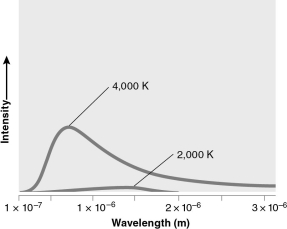
(Short Answer)
4.9/5 (69)
(69) To what accuracy are the relative densities of dark energy and dark matter known,according to current cosmological measurements?
(Multiple Choice)
4.9/5 (78)
(78) An astronomer images the most distant source of light observable in the Big Bang model.What kind of telescope did he or she use?
(Short Answer)
5.0/5 (91)
(91) Which of the following astronomers helped discover the cosmic microwave background?
(Multiple Choice)
4.8/5 (83)
(83) According to our present understanding,in the distant future the Universe will:
(Multiple Choice)
4.9/5 (76)
(76) The classic Big Bang model attributes the initial moment of creation to:
(Multiple Choice)
4.8/5 (88)
(88) A photon is emitted from a galaxy with a wavelength of 100 nm.By the time it reaches a telescope on Earth,the photon has a wavelength of 800 nm.By what factor has the Universe expanded between the photon's emission and detection?
(Multiple Choice)
5.0/5 (63)
(63) Of the following,who is responsible for creating the Big Bang model?
(Multiple Choice)
4.8/5 (70)
(70) Which of the following isotopes is NOT a potential probe of the first three minutes of the Universe's history?
(Multiple Choice)
4.8/5 (87)
(87) An astronomer discovers that the abundance of helium in the first galaxies to form in our Universe is only half that of small galaxies near the Milky Way.This would provide evidence:
(Multiple Choice)
4.9/5 (64)
(64) An alternate universe is filled with normal matter and dark matter,but not dark energy.If its density is twice the critical value,which curve on the figure below might represent its size? 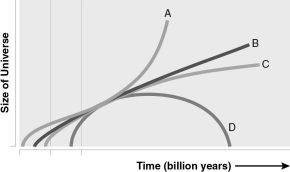
(Multiple Choice)
4.7/5 (93)
(93) How does inflation solve the paradox of universal uniformity?
(Multiple Choice)
4.9/5 (67)
(67) What are the three most important observational pillars for the Big Bang model?
(Essay)
4.8/5 (82)
(82) 
Filters
- Essay(0)
- Multiple Choice(0)
- Short Answer(0)
- True False(0)
- Matching(0)