



 Chat with AI
Exam 6: Home Base: Earth and Moon

Exam 1: Getting Started: Science, astronomy, and Being Human70 Questions
Exam 2: A Universe Made, a Universe Discovered71 Questions
Exam 3: A Universe of Universal Laws71 Questions
Exam 4: A Universe of Universal Laws70 Questions
Exam 5: The Architecture and Birth of Planetary Systems70 Questions
Exam 6: Home Base: Earth and Moon70 Questions
Exam 7: Sibling Worlds: Mercury, Venus, and Mars70 Questions
Exam 8: Gas, ice, and Stone: the Outer Planets70 Questions
Exam 9: Life and the Search for Habitable Worlds70 Questions
Exam 10: The Sun As a Star70 Questions
Exam 11: Measuring the Stars: the Main Sequence and Its Meaning70 Questions
Exam 12: Nursery of the Stars: the Interstellar Medium and Star Formation70 Questions
Exam 13: To the Graveyard of Stars: the End Points of Stellar Evolution70 Questions
Exam 14: Down the Rabbit Hole: Relativity and Black Holes70 Questions
Exam 15: Our City of Stars: the Milky Way70 Questions
Exam 16: A Universe of Galaxies69 Questions
Exam 17: The Cosmic Web: the Large-Scale Structure of the Universe70 Questions
Exam 18: Cosmology70 Questions
Select questions type


Why is the Moon's rotation period equal to its orbital period?

Free
(Essay)
4.7/5  (79)
(79) Correct Answer: Verified
This is tidal locking.The tides raised on the Moon by Earth exert a drag that slows its rotation.
"Snowball Earth" phases of geologic history were most likely caused by a(n):
Free
(Multiple Choice)
4.9/5 (84)
(84) Correct Answer:Verified
VerifiedB
A meteor contains fifteen times as much argon-40 as potassium-40.If the half-life of potassium-40 is 1.25 billion years,how long ago did the meteor form?
Free
(Multiple Choice)
4.9/5 (77)
(77) Correct Answer:Verified
VerifiedC
What does the lack of a large-scale lunar magnetic field imply about the Moon's interior?
(Essay)
4.7/5 (77)
(77) Which of the following sequences correctly characterizes the composition of Earth's layers,from its center to its surface?
(Multiple Choice)
4.8/5 (83)
(83) What kind of tides occur during a lunar eclipse? How do they compare to the average amplitude of tides averaged over a month?
(Essay)
4.8/5 (90)
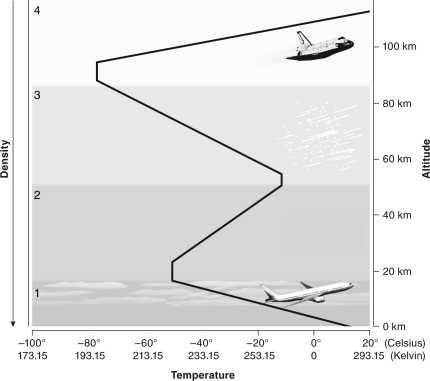
(90) The figure below shows the layers of Earth's atmosphere,along with their temperature profiles labeled 1-4 from bottom to top.Name each of these layers,from Earth's surface upward.
(Essay)
4.9/5 (70)
(70) How would the surface of Earth change if its deep interior had no radioactive elements?
(Multiple Choice)
4.8/5 (84)
(84) The lack of potassium in lunar rocks supported the impact hypothesis because:
(Multiple Choice)
5.0/5 (90)
(90) What is responsible for heating the stratosphere? What about the ionosphere?
(Essay)
4.8/5 (89)
(89) Imagine that an earthquake occurs above a massive pool of molten lava.How would this pool affect the propagation of seismic waves?
(Essay)
5.0/5 (99)
(99) Which moon in the Solar System has the largest mass relative to the planet it orbits?
(Multiple Choice)
4.8/5 (68)
(68) An atomic nucleus that transforms from one element to another has undergone:
(Multiple Choice)
4.9/5 (80)
(80) Without an atmosphere,Earth's surface temperature would be below the freezing point of water.What is responsible for the heating that allows liquid oceans to form?
(Short Answer)
4.8/5 (86)
(86) The layer of Earth shown in the figure below is called the: 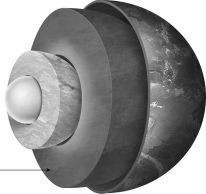
(Multiple Choice)
4.8/5 (83)
(83) Suppose that a major earthquake occurs in southern California.A seismograph on the opposite side of Earth would see:
(Multiple Choice)
4.9/5 (76)
(76) 
Filters
- Essay(0)
- Multiple Choice(0)
- Short Answer(0)
- True False(0)
- Matching(0)