



 Chat with AI
Exam 6: Home Base: Earth and Moon

Exam 1: Getting Started: Science, astronomy, and Being Human70 Questions
Exam 2: A Universe Made, a Universe Discovered71 Questions
Exam 3: A Universe of Universal Laws71 Questions
Exam 4: A Universe of Universal Laws70 Questions
Exam 5: The Architecture and Birth of Planetary Systems70 Questions
Exam 6: Home Base: Earth and Moon70 Questions
Exam 7: Sibling Worlds: Mercury, Venus, and Mars70 Questions
Exam 8: Gas, ice, and Stone: the Outer Planets70 Questions
Exam 9: Life and the Search for Habitable Worlds70 Questions
Exam 10: The Sun As a Star70 Questions
Exam 11: Measuring the Stars: the Main Sequence and Its Meaning70 Questions
Exam 12: Nursery of the Stars: the Interstellar Medium and Star Formation70 Questions
Exam 13: To the Graveyard of Stars: the End Points of Stellar Evolution70 Questions
Exam 14: Down the Rabbit Hole: Relativity and Black Holes70 Questions
Exam 15: Our City of Stars: the Milky Way70 Questions
Exam 16: A Universe of Galaxies69 Questions
Exam 17: The Cosmic Web: the Large-Scale Structure of the Universe70 Questions
Exam 18: Cosmology70 Questions
Select questions type


A shield volcano is most likely to be associated with a(n):
(Multiple Choice)
4.9/5  (68)
(68) The figure below shows the tidal bulge of Earth generated by the Moon.What will happen in the future as a result of this configuration? 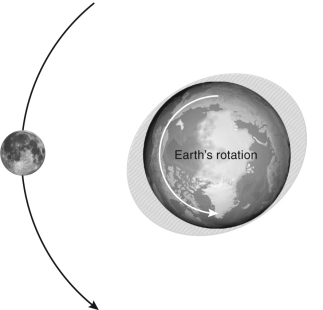
(Multiple Choice)
4.9/5 (73)
(73) A planet with the same radius as Earth is just barely able to retain oxygen in its atmosphere.Another planet with an identical temperature is twice as massive as the first.What is the maximum radius of the second planet if it is also to retain oxygen in its atmosphere?
(Essay)
4.9/5 (68)
(68) Suppose that Earth's magnetic poles were along the equator.How would that affect the aurorae,and why?
(Essay)
4.8/5 (78)
(78) Our understanding of Earth's interior comes primarily from:
(Multiple Choice)
4.8/5 (88)
(88) The wave shown in the figure below is most similar to a(n): 
(Multiple Choice)
4.7/5 (85)
(85) The oxygen in Earth's atmosphere was first created 2.3 billion years ago by:
(Multiple Choice)
4.7/5 (82)
(82) Why are rocks on the ocean floors all younger than about 200 million years?
(Essay)
4.9/5 (85)
(85) 
Filters
- Essay(0)
- Multiple Choice(0)
- Short Answer(0)
- True False(0)
- Matching(0)