



 Chat with AI
Exam 13: To the Graveyard of Stars: the End Points of Stellar Evolution

Exam 1: Getting Started: Science, astronomy, and Being Human70 Questions
Exam 2: A Universe Made, a Universe Discovered71 Questions
Exam 3: A Universe of Universal Laws71 Questions
Exam 4: A Universe of Universal Laws70 Questions
Exam 5: The Architecture and Birth of Planetary Systems70 Questions
Exam 6: Home Base: Earth and Moon70 Questions
Exam 7: Sibling Worlds: Mercury, Venus, and Mars70 Questions
Exam 8: Gas, ice, and Stone: the Outer Planets70 Questions
Exam 9: Life and the Search for Habitable Worlds70 Questions
Exam 10: The Sun As a Star70 Questions
Exam 11: Measuring the Stars: the Main Sequence and Its Meaning70 Questions
Exam 12: Nursery of the Stars: the Interstellar Medium and Star Formation70 Questions
Exam 13: To the Graveyard of Stars: the End Points of Stellar Evolution70 Questions
Exam 14: Down the Rabbit Hole: Relativity and Black Holes70 Questions
Exam 15: Our City of Stars: the Milky Way70 Questions
Exam 16: A Universe of Galaxies69 Questions
Exam 17: The Cosmic Web: the Large-Scale Structure of the Universe70 Questions
Exam 18: Cosmology70 Questions
Select questions type


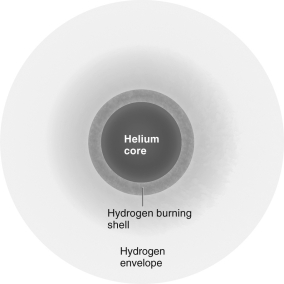
According to recent models of supernovas,a massive star's envelope stops collapsing because:
(Multiple Choice)
5.0/5  (80)
(80) 
At the tip of the red giant branch,a star is half as hot as it was on the main sequence and 100 times larger.How does its luminosity compare to its value on the main sequence?
(Multiple Choice)
4.9/5 (80)
(80) In order from most to least common,what are the possible remnants of stars that run out of fuel for fusion?
(Multiple Choice)
4.9/5 (72)
(72) What kind of astronomical object could form from the situation shown in the figure below? 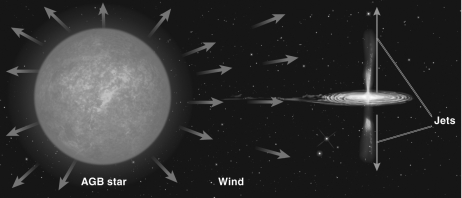
(Multiple Choice)
4.8/5 (80)
(80) A white dwarf is in a binary system with a red giant with five times the mass of the Sun.This system could result in a:
(Multiple Choice)
4.8/5 (79)
(79) Which of the following stellar endpoints has NOT been observed?
(Multiple Choice)
4.9/5 (79)
(79) Astronomers detect a roughly spherical shock wave 50 light-years across in the plane of the Milky Way galaxy.This was most likely caused by:
(Multiple Choice)
4.7/5 (80)
(80) Which of the following sets of measurements CANNOT be used to determine a main sequence star's eventual fate?
(Multiple Choice)
4.9/5 (84)
(84) What are the resulting particles when protons and electrons are forced together in the core of a massive star during the early stages of a supernova?
(Short Answer)
4.8/5 (80)
(80) Which of the following can most efficiently be used to measure the distance to a galaxy?
(Multiple Choice)
4.9/5 (72)
(72) Which of the following factors helps explain why planetary nebula are NOT usually spherical?
(Multiple Choice)
4.8/5 (66)
(66) Why does a red giant fuse hydrogen more rapidly than a main sequence star of the same mass?
(Multiple Choice)
4.8/5 (80)
(80) Which of the following pairs of main sequence stars have different endpoints for their lives as stars?
(Multiple Choice)
4.9/5 (73)
(73) As a star moves along the red giant branch,how does it move on the HR diagram?
(Multiple Choice)
4.8/5 (74)
(74) 
Filters
- Essay(0)
- Multiple Choice(0)
- Short Answer(0)
- True False(0)
- Matching(0)