



 Chat with AI
Exam 8: Gas, ice, and Stone: the Outer Planets

Exam 1: Getting Started: Science, astronomy, and Being Human70 Questions
Exam 2: A Universe Made, a Universe Discovered71 Questions
Exam 3: A Universe of Universal Laws71 Questions
Exam 4: A Universe of Universal Laws70 Questions
Exam 5: The Architecture and Birth of Planetary Systems70 Questions
Exam 6: Home Base: Earth and Moon70 Questions
Exam 7: Sibling Worlds: Mercury, Venus, and Mars70 Questions
Exam 8: Gas, ice, and Stone: the Outer Planets70 Questions
Exam 9: Life and the Search for Habitable Worlds70 Questions
Exam 10: The Sun As a Star70 Questions
Exam 11: Measuring the Stars: the Main Sequence and Its Meaning70 Questions
Exam 12: Nursery of the Stars: the Interstellar Medium and Star Formation70 Questions
Exam 13: To the Graveyard of Stars: the End Points of Stellar Evolution70 Questions
Exam 14: Down the Rabbit Hole: Relativity and Black Holes70 Questions
Exam 15: Our City of Stars: the Milky Way70 Questions
Exam 16: A Universe of Galaxies69 Questions
Exam 17: The Cosmic Web: the Large-Scale Structure of the Universe70 Questions
Exam 18: Cosmology70 Questions
Select questions type


An exoplanet orbiting a star just like our Sun has substantial amounts of methane in its spectrum,a strong magnetic field,and a mass about twenty times larger than Earth.It most likely formed at:
(Multiple Choice)
5.0/5  (76)
(76) Relative to the amount of energy it absorbs from the Sun,which planet emits the most energy back into space?
(Multiple Choice)
4.7/5 (74)
(74) The image below shows a large storm occurring at the pole of which planet? 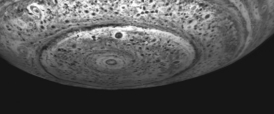
(Multiple Choice)
4.9/5 (80)
(80) What is the most volcanically active world in the Solar System?
(Multiple Choice)
4.8/5 (83)
(83) What aspect of Jupiter's near-space environment poses the biggest problem for satellites orbiting the planet?
(Essay)
4.9/5 (84)
(84) Why do clouds on Neptune form deeper in the atmosphere than those on Jupiter?
(Multiple Choice)
4.7/5 (89)
(89) For which of the following quantities do the giant planets have smaller characteristic values than the terrestrial planets?
(Multiple Choice)
4.8/5 (82)
(82) What process creates the zones and belts in Saturn's atmosphere?
(Short Answer)
4.9/5 (74)
(74) Which of the following bodies is closest in composition to the Sun?
(Multiple Choice)
4.9/5 (82)
(82) Why does a moon in a 2:1 orbital resonance with a planetary ring have such strong influence on it?
(Essay)
4.7/5 (73)
(73) The figure below shows Uranus at different points along its orbit,with its spin axis shown in orange.As measured in Earth years,how long is winter on Uranus? 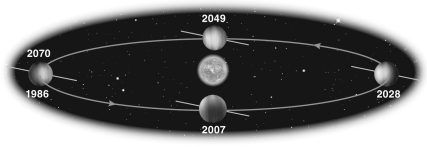
(Multiple Choice)
4.8/5 (93)
(93) Why does Jupiter gives off more energy than it receives from the Sun?
(Multiple Choice)
4.9/5 (82)
(82) What two factors are most responsible for the icy composition of Uranus and Neptune compared to the other giant planets?
(Essay)
4.7/5 (86)
(86) A moon in the outer Solar System with low albedo is likely:
(Multiple Choice)
4.8/5 (81)
(81) 
Filters
- Essay(0)
- Multiple Choice(0)
- Short Answer(0)
- True False(0)
- Matching(0)