



 Chat with AI
Exam 5: The Architecture and Birth of Planetary Systems

Exam 1: Getting Started: Science, astronomy, and Being Human70 Questions
Exam 2: A Universe Made, a Universe Discovered71 Questions
Exam 3: A Universe of Universal Laws71 Questions
Exam 4: A Universe of Universal Laws70 Questions
Exam 5: The Architecture and Birth of Planetary Systems70 Questions
Exam 6: Home Base: Earth and Moon70 Questions
Exam 7: Sibling Worlds: Mercury, Venus, and Mars70 Questions
Exam 8: Gas, ice, and Stone: the Outer Planets70 Questions
Exam 9: Life and the Search for Habitable Worlds70 Questions
Exam 10: The Sun As a Star70 Questions
Exam 11: Measuring the Stars: the Main Sequence and Its Meaning70 Questions
Exam 12: Nursery of the Stars: the Interstellar Medium and Star Formation70 Questions
Exam 13: To the Graveyard of Stars: the End Points of Stellar Evolution70 Questions
Exam 14: Down the Rabbit Hole: Relativity and Black Holes70 Questions
Exam 15: Our City of Stars: the Milky Way70 Questions
Exam 16: A Universe of Galaxies69 Questions
Exam 17: The Cosmic Web: the Large-Scale Structure of the Universe70 Questions
Exam 18: Cosmology70 Questions
Select questions type


Arrange the following solar system bodies in order of increasing average orbital inclination:
(Multiple Choice)
4.8/5  (72)
(72) Most of the asteroids in the asteroid belt are S-type.What does this tell us about their history?
(Essay)
4.8/5 (83)
(83) The orbits of gas giants can move after their formation because of:
(Multiple Choice)
4.9/5 (66)
(66) A bright,extended object appears in the sky one evening,visible to the naked eye.Over the next several weeks,it moves across the sky,becoming brighter as it approaches the Sun and then fainter again as it moves away.After six weeks,it fades away.This is most likely a(n):
(Multiple Choice)
4.8/5 (73)
(73) The physical principle most directly responsible for the shape of planetary systems is:
(Multiple Choice)
4.8/5 (96)
(96) The figure below shows the orbit of a comet around the Sun.Sketch the locations of the comet's ion and dust tails at points A,B,and C.
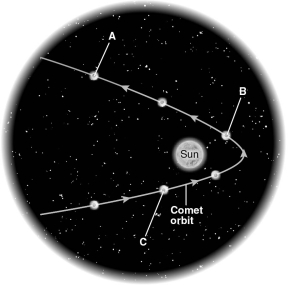
(Essay)
4.9/5 (79)
(79) The largest explosions in Earth's history were a result of:
(Multiple Choice)
4.9/5 (65)
(65) 
Filters
- Essay(0)
- Multiple Choice(0)
- Short Answer(0)
- True False(0)
- Matching(0)