



 Chat with AI
Exam 4: A Universe of Universal Laws

Exam 1: Getting Started: Science, astronomy, and Being Human70 Questions
Exam 2: A Universe Made, a Universe Discovered71 Questions
Exam 3: A Universe of Universal Laws71 Questions
Exam 4: A Universe of Universal Laws70 Questions
Exam 5: The Architecture and Birth of Planetary Systems70 Questions
Exam 6: Home Base: Earth and Moon70 Questions
Exam 7: Sibling Worlds: Mercury, Venus, and Mars70 Questions
Exam 8: Gas, ice, and Stone: the Outer Planets70 Questions
Exam 9: Life and the Search for Habitable Worlds70 Questions
Exam 10: The Sun As a Star70 Questions
Exam 11: Measuring the Stars: the Main Sequence and Its Meaning70 Questions
Exam 12: Nursery of the Stars: the Interstellar Medium and Star Formation70 Questions
Exam 13: To the Graveyard of Stars: the End Points of Stellar Evolution70 Questions
Exam 14: Down the Rabbit Hole: Relativity and Black Holes70 Questions
Exam 15: Our City of Stars: the Milky Way70 Questions
Exam 16: A Universe of Galaxies69 Questions
Exam 17: The Cosmic Web: the Large-Scale Structure of the Universe70 Questions
Exam 18: Cosmology70 Questions
Select questions type


An astronomer measures the spectrum of a star and finds that it emits the most intense light at 0.5 mm.What is its temperature?
(Multiple Choice)
5.0/5  (89)
(89) Which of the following portions of the electromagnetic spectrum must be observed from space?
(Multiple Choice)
4.9/5 (71)
(71) The figure below shows a model of an atom.If an electron begins in orbit #1,moves to orbit #4,then moves to orbit #3,and then to orbit #1,how has it interacted with light? 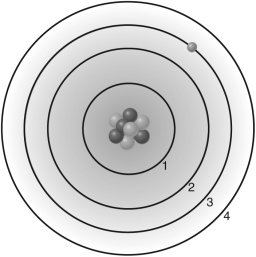
(Multiple Choice)
4.9/5 (94)
(94) Modern astronomical observatories sometimes shine lasers into the sky because they:
(Multiple Choice)
4.9/5 (77)
(77) The H alpha line of hydrogen produces photons in what part of the electromagnetic spectrum?
(Multiple Choice)
4.8/5 (82)
(82) Two stars are situated a distance 1 parsec apart.Both are a distance of 100 parsecs from Earth,as shown in the figure below.An astronomer would like to observe these stars individually with a radio telescope.Find the minimum diameter of her telescope if she decides to observe the stars at a wavelength of 1 m.

(Short Answer)
4.8/5 (78)
(78) What property of a star allows you to measure its composition?
(Multiple Choice)
4.7/5 (78)
(78) Two light waves have wavelengths of 200 nm and 400 nm,respectively.How are their frequencies related?
(Multiple Choice)
4.8/5 (74)
(74) Place the following varieties of light in order,from lowest to highest frequency: infrared,ultraviolet,microwave,visible,gamma rays.
(Multiple Choice)
4.8/5 (60)
(60) Which of the following is NOT an advantage of a reflecting telescope over a refracting telescope?
(Multiple Choice)
4.8/5 (88)
(88) The next generation of large near-infrared telescopes will be built at high,dry sites.List two reasons why.
(Essay)
4.9/5 (67)
(67) If your pupil is 1 cm across,how large does a telescope aperture have to be to collect one million times more light than your eye?
(Multiple Choice)
4.8/5 (77)
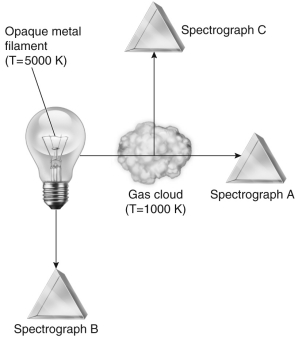
(77) Consider the experiment shown in the figure below.Describe the spectra observed by Spectrographs A,B,and C.
(Essay)
5.0/5 (69)
(69) An astronomer takes spectra of two stars,A and B.Star A's spectrum peaks at 200 nm,while star B's spectrum peaks at 800 nm.If the stars have identical sizes,how do their luminosities compare?
(Essay)
4.9/5 (77)
(77) 
Filters
- Essay(0)
- Multiple Choice(0)
- Short Answer(0)
- True False(0)
- Matching(0)