



 Chat with AI
Exam 22: Aprice Takers and the Competitive Process

Exam 1: The Economic Approach210 Questions
Exam 2: Asome Tools of the Economist257 Questions
Exam 3: Asupply,demand,and the Market Process405 Questions
Exam 4: Asupply and Demand: Applications and Extensions331 Questions
Exam 5: Difficult Cases for the Market and the Role of Government168 Questions
Exam 6: The Economics of Collective Decision-Making180 Questions
Exam 7: Ataking the Nations Economic Pulse288 Questions
Exam 8: Economic Fluctuations, unemployment, and Inflation242 Questions
Exam 9: Aan Introduction to Basic Macroeconomic Markets261 Questions
Exam 10: Dynamic Change, economic Fluctuations, and the Ad-As Model224 Questions
Exam 11: Fiscal Policy: the Keynesian View and Historical Perspective139 Questions
Exam 12: Fiscal Policy, incentives, and Secondary Effects171 Questions
Exam 13: Amoney and the Banking System260 Questions
Exam 14: Modern Macroeconomics and Monetary Policy220 Questions
Exam 15: Stabilization Policy, output, and Employment177 Questions
Exam 16: Creating an Environment for Growth and Prosperity142 Questions
Exam 17: Institutions,policies,and Cross-Country Differences in Income and Growth153 Questions
Exam 18: Gaining From International Trade222 Questions
Exam 19: International Finance and the Foreign Exchange Market162 Questions
Exam 20: Consumer Choice and Elasticity223 Questions
Exam 21: Acosts and the Supply of Goods231 Questions
Exam 22: Aprice Takers and the Competitive Process260 Questions
Exam 23: Price-Searcher Markets With Low Entry Barriers216 Questions
Exam 24: Aprice-Searcher Markets With High Entry Barriers254 Questions
Exam 25: The Supply of and Demand for Productive Resources200 Questions
Exam 26: Earnings, productivity, and the Job Market109 Questions
Exam 27: Investment, the Capital Market, and the Wealth of Nations129 Questions
Exam 28: Income Inequality and Poverty136 Questions
Exam 29: Government Spending and Taxation79 Questions
Exam 30: The Economics of Social Security54 Questions
Exam 31: The Stock Market: Its Function, Performance, and Potential As an Investment Opportunity70 Questions
Exam 32: Great Debates in Economics: Keynes Versus Hayek8 Questions
Exam 33: The Crisis of 2008: Causes and Lessons for the Future64 Questions
Exam 34: Lessons From the Great Depression60 Questions
Exam 35: Lessons From Japan and Canada72 Questions
Exam 36: The Federal Budget and the National Debt97 Questions
Exam 37: The Economics of Healthcare68 Questions
Exam 38: Education: Problems and Performance60 Questions
Exam 39: Earnings Differences Between Men and Women47 Questions
Exam 40: Do Labor Unions Increase the Wages of Workers74 Questions
Exam 41: The Question of Resource Exhaustion61 Questions
Exam 42: Difficult Environmental Cases and the Role of Government63 Questions
Select questions type


Several producers in industry A developed an improved technology that reduces the quantity of resources used to produce a given output.Which of the following would be expected?
(Multiple Choice)
4.8/5  (73)
(73) Figure 9-4
 -At the market price of $6 in Figure 9-4,indicate the firm's total revenue and total cost at its profit-maximizing level of output.
 (Multiple Choice)
4.8/5 (77)
(77) Consider a firm operating in a competitive price-taker market.The firm is producing 40 units of output,has an average cost of production equal to $5,and is earning $240 economic profit in the short run.What is the current market price?
(Multiple Choice)
4.8/5 (91)
(91) Figure 9-5
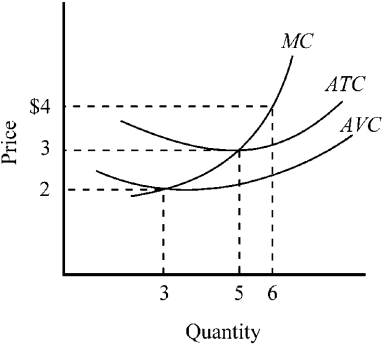 -If the market price in Figure 9-5 increases to $4,what output should the firm produce,and what would be the firm's maximum profit?
 (Multiple Choice)
4.9/5 (78)
(78) In competitive price-taker markets,if one firm raises its price,
(Multiple Choice)
4.8/5 (80)
(80) When the demand for a product falls,why do costs of production go down in an increasing cost industry?
(Essay)
5.0/5 (79)
(79) When the price of a product rises,the increase in quantity supplied will generally be greater in the long run than the short run because
(Multiple Choice)
4.9/5 (78)
(78) When consumer demand for a good produced in a price-taker market decreases,
(Multiple Choice)
4.8/5 (80)
(80) In the price-taker model,what impact does the individual firm have on the price of its product?
(Multiple Choice)
4.9/5 (77)
(77) Which of the following best describes the series of events shown in the figure? The original conditions prior to the change are shown by D₀ and S₀ (point A),and SLR is the market long-run supply curve.
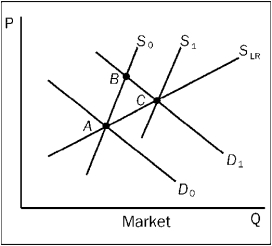
(Multiple Choice)
4.8/5 (85)
(85) Why will the long-run market supply curve for most products slope upward to the right?
(Multiple Choice)
4.8/5 (70)
(70) If firms in a price-taker industry were forced to install antipollution devices that increased their production costs,we should expect
(Multiple Choice)
4.9/5 (70)
(70) Suppose the total cost for various levels of output for a competitive price-taker firm are given in the table below:
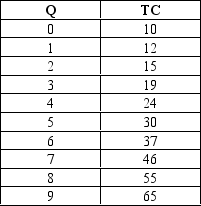 If the market price is $8,how many units should the firm produce to maximize profit?
 (Multiple Choice)
4.8/5 (82)
(82) A profit-maximizing entrepreneur will produce and sell an additional unit of output as long as
(Multiple Choice)
4.8/5 (85)
(85) In the short run,a profit-maximizing price taker will expand output as long as the market price exceeds
(Multiple Choice)
4.7/5 (84)
(84) Scenario 9-1
Assume a certain competitive price-taker firm is producing Q = 1,000 units of output.At Q = 1,000,the firm's marginal cost equals $15 and its average total cost equals $11.The firm sells its output for $12 per unit.
-Refer to Scenario 9-1.At Q = 1,000,the firm's profit amounts to
(Multiple Choice)
4.9/5 (90)
(90) The main difference between a firm that is a price searcher and a firm that is a price taker is that a
(Multiple Choice)
4.7/5 (79)
(79) If a firm competing in a price-taker market seeks to maximize profit,the firm should
(Multiple Choice)
4.7/5 (69)
(69) The ability of price-taker firms to freely expand or contract their businesses and to enter or exit the market means that
(Multiple Choice)
4.7/5 (77)
(77) 
Filters
- Essay(0)
- Multiple Choice(0)
- Short Answer(0)
- True False(0)
- Matching(0)