



 Chat with AI
Exam 22: Aprice Takers and the Competitive Process

Exam 1: The Economic Approach210 Questions
Exam 2: Asome Tools of the Economist257 Questions
Exam 3: Asupply,demand,and the Market Process405 Questions
Exam 4: Asupply and Demand: Applications and Extensions331 Questions
Exam 5: Difficult Cases for the Market and the Role of Government168 Questions
Exam 6: The Economics of Collective Decision-Making180 Questions
Exam 7: Ataking the Nations Economic Pulse288 Questions
Exam 8: Economic Fluctuations, unemployment, and Inflation242 Questions
Exam 9: Aan Introduction to Basic Macroeconomic Markets261 Questions
Exam 10: Dynamic Change, economic Fluctuations, and the Ad-As Model224 Questions
Exam 11: Fiscal Policy: the Keynesian View and Historical Perspective139 Questions
Exam 12: Fiscal Policy, incentives, and Secondary Effects171 Questions
Exam 13: Amoney and the Banking System260 Questions
Exam 14: Modern Macroeconomics and Monetary Policy220 Questions
Exam 15: Stabilization Policy, output, and Employment177 Questions
Exam 16: Creating an Environment for Growth and Prosperity142 Questions
Exam 17: Institutions,policies,and Cross-Country Differences in Income and Growth153 Questions
Exam 18: Gaining From International Trade222 Questions
Exam 19: International Finance and the Foreign Exchange Market162 Questions
Exam 20: Consumer Choice and Elasticity223 Questions
Exam 21: Acosts and the Supply of Goods231 Questions
Exam 22: Aprice Takers and the Competitive Process260 Questions
Exam 23: Price-Searcher Markets With Low Entry Barriers216 Questions
Exam 24: Aprice-Searcher Markets With High Entry Barriers254 Questions
Exam 25: The Supply of and Demand for Productive Resources200 Questions
Exam 26: Earnings, productivity, and the Job Market109 Questions
Exam 27: Investment, the Capital Market, and the Wealth of Nations129 Questions
Exam 28: Income Inequality and Poverty136 Questions
Exam 29: Government Spending and Taxation79 Questions
Exam 30: The Economics of Social Security54 Questions
Exam 31: The Stock Market: Its Function, Performance, and Potential As an Investment Opportunity70 Questions
Exam 32: Great Debates in Economics: Keynes Versus Hayek8 Questions
Exam 33: The Crisis of 2008: Causes and Lessons for the Future64 Questions
Exam 34: Lessons From the Great Depression60 Questions
Exam 35: Lessons From Japan and Canada72 Questions
Exam 36: The Federal Budget and the National Debt97 Questions
Exam 37: The Economics of Healthcare68 Questions
Exam 38: Education: Problems and Performance60 Questions
Exam 39: Earnings Differences Between Men and Women47 Questions
Exam 40: Do Labor Unions Increase the Wages of Workers74 Questions
Exam 41: The Question of Resource Exhaustion61 Questions
Exam 42: Difficult Environmental Cases and the Role of Government63 Questions
Select questions type


Firms that can choose what price they will charge for their product and can increase the number of units sold by reducing price are called
(Multiple Choice)
4.9/5  (67)
(67) Suppose wheat farmers are price takers.If wheat farmers are currently making economic profits,over time we would expect that
(Multiple Choice)
4.9/5 (83)
(83) Suppose the equilibrium price in a competitive price-taker market is $10 and a firm in the industry charges $9.Which of the following is true?
(Multiple Choice)
5.0/5 (89)
(89) The price-taker firm should discontinue production immediately if
(Multiple Choice)
4.8/5 (90)
(90) If marginal revenue exceeds marginal cost at the current level of output,profit will increase when output is expanded because
(Multiple Choice)
4.8/5 (81)
(81) Figure 9-9
 -When the market price is $60 in Figure 9-9,the firm's maximum daily profit will be approximately
 (Multiple Choice)
4.8/5 (80)
(80) Figure 9-7
 -The average total cost (ATC)and marginal costs (MC)of a firm producing in a price-taker industry are depicted in Figure 9-7.If the current market price of the firm's product is $3,what output should this firm produce per week?
 (Multiple Choice)
4.9/5 (94)
(94) If the demand and marginal revenue curves confronting firm A are identical,it may be concluded that firm A is a
(Multiple Choice)
5.0/5 (76)
(76) Figure 9-8
 -At the market price of $3 in Figure 9-8,indicate the firm's total revenue and total cost at its profit-maximizing level of output.
 (Multiple Choice)
4.8/5 (76)
(76) A price-taker market tends toward a state of long-run equilibrium in which firms earn only a normal rate of return (zero economic profits)because
(Multiple Choice)
4.9/5 (68)
(68) If profit-seeking entrepreneurs are going to be successful,they must
(Multiple Choice)
4.8/5 (89)
(89) Figure 9-3
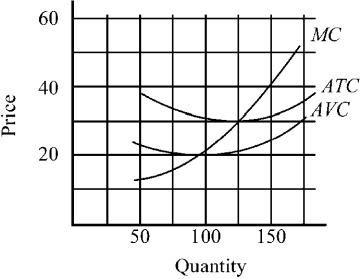 -For Figure 9-3,if the market price is $30,indicate the firm's profit-maximizing output and maximum profit.
 (Multiple Choice)
4.8/5 (89)
(89) When firms in a price-taker market are temporarily able to charge prices that exceed their production costs,
(Multiple Choice)
4.7/5 (78)
(78) Which of the following statements best reflects the production decision of a profit-maximizing firm in a competitive price-taker market when price falls below the minimum of average variable cost?
(Multiple Choice)
4.8/5 (88)
(88) Table 9-2
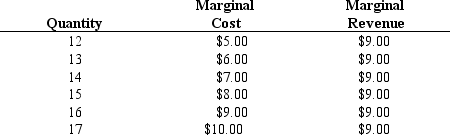 -Refer to Table 9-2.This table provides information on a competitive price-taker firm's output,marginal revenue,and marginal cost.If the firm is currently producing 14 units,what would you advise them to do?
 (Multiple Choice)
4.8/5 (78)
(78) Which of the following conditions will be present when a price-taker market is in long-run equilibrium?
(Multiple Choice)
4.7/5 (74)
(74) If an amusement park that is highly profitable during the summer months is unable to cover its variable costs during the winter months,it should
(Multiple Choice)
4.8/5 (87)
(87) Scenario 9-1
Assume a certain competitive price-taker firm is producing Q = 1,000 units of output.At Q = 1,000,the firm's marginal cost equals $15 and its average total cost equals $11.The firm sells its output for $12 per unit.
-Refer to Scenario 9-1.At Q = 999,the firm's total cost amounts to
(Multiple Choice)
4.9/5 (80)
(80) 
Filters
- Essay(0)
- Multiple Choice(0)
- Short Answer(0)
- True False(0)
- Matching(0)