



 Chat with AI
Exam 12: Fiscal Policy, incentives, and Secondary Effects

Exam 1: The Economic Approach210 Questions
Exam 2: Asome Tools of the Economist257 Questions
Exam 3: Asupply,demand,and the Market Process405 Questions
Exam 4: Asupply and Demand: Applications and Extensions331 Questions
Exam 5: Difficult Cases for the Market and the Role of Government168 Questions
Exam 6: The Economics of Collective Decision-Making180 Questions
Exam 7: Ataking the Nations Economic Pulse288 Questions
Exam 8: Economic Fluctuations, unemployment, and Inflation242 Questions
Exam 9: Aan Introduction to Basic Macroeconomic Markets261 Questions
Exam 10: Dynamic Change, economic Fluctuations, and the Ad-As Model224 Questions
Exam 11: Fiscal Policy: the Keynesian View and Historical Perspective139 Questions
Exam 12: Fiscal Policy, incentives, and Secondary Effects171 Questions
Exam 13: Amoney and the Banking System260 Questions
Exam 14: Modern Macroeconomics and Monetary Policy220 Questions
Exam 15: Stabilization Policy, output, and Employment177 Questions
Exam 16: Creating an Environment for Growth and Prosperity142 Questions
Exam 17: Institutions,policies,and Cross-Country Differences in Income and Growth153 Questions
Exam 18: Gaining From International Trade222 Questions
Exam 19: International Finance and the Foreign Exchange Market162 Questions
Exam 20: Consumer Choice and Elasticity223 Questions
Exam 21: Acosts and the Supply of Goods231 Questions
Exam 22: Aprice Takers and the Competitive Process260 Questions
Exam 23: Price-Searcher Markets With Low Entry Barriers216 Questions
Exam 24: Aprice-Searcher Markets With High Entry Barriers254 Questions
Exam 25: The Supply of and Demand for Productive Resources200 Questions
Exam 26: Earnings, productivity, and the Job Market109 Questions
Exam 27: Investment, the Capital Market, and the Wealth of Nations129 Questions
Exam 28: Income Inequality and Poverty136 Questions
Exam 29: Government Spending and Taxation79 Questions
Exam 30: The Economics of Social Security54 Questions
Exam 31: The Stock Market: Its Function, Performance, and Potential As an Investment Opportunity70 Questions
Exam 32: Great Debates in Economics: Keynes Versus Hayek8 Questions
Exam 33: The Crisis of 2008: Causes and Lessons for the Future64 Questions
Exam 34: Lessons From the Great Depression60 Questions
Exam 35: Lessons From Japan and Canada72 Questions
Exam 36: The Federal Budget and the National Debt97 Questions
Exam 37: The Economics of Healthcare68 Questions
Exam 38: Education: Problems and Performance60 Questions
Exam 39: Earnings Differences Between Men and Women47 Questions
Exam 40: Do Labor Unions Increase the Wages of Workers74 Questions
Exam 41: The Question of Resource Exhaustion61 Questions
Exam 42: Difficult Environmental Cases and the Role of Government63 Questions
Select questions type


The modern consensus view of fiscal policy stresses

Free
(Multiple Choice)
4.8/5  (91)
(91) Correct Answer: Verified
D
Use the figure below to answer the following question(s).
Figure 12-1
 -Refer to Figure 12-1.If the output of the economy is Y₁,which of the following would a new classical economist be most likely to favor?
Free
(Multiple Choice)
4.9/5 (75)
(75) Correct Answer:Verified
VerifiedD
Ricardian Equivalence maintains that an increase in government spending financed by debt will result in a corresponding increase in
Free
(Multiple Choice)
5.0/5 (66)
(66) Correct Answer:Verified
VerifiedA
Which of the following is the best explanation of how expansionary fiscal policy can crowd out net exports?
(Multiple Choice)
4.8/5 (97)
(97) Which of the following is part of the synthesis view of fiscal policy?
(Multiple Choice)
4.8/5 (94)
(94) Both the crowding-out effect and new classical model indicate that
(Multiple Choice)
5.0/5 (81)
(81) According to the Keynesian view,government spending will have its greatest impact during a severe recession because
(Multiple Choice)
4.9/5 (87)
(87) Which of the following will be most likely to dampen the expansionary effects of an increase in government spending financed by borrowing?
(Multiple Choice)
4.9/5 (88)
(88) Public choice analysis indicates that it will be politically more attractive to
(Multiple Choice)
4.8/5 (82)
(82) Which of the following groups would be least likely to support a balanced budget amendment to the U.S.Constitution?
(Multiple Choice)
4.8/5 (84)
(84) Expansionary fiscal policy during a recession is most effective when it
(Multiple Choice)
5.0/5 (91)
(91) Which of the following best explains why high marginal tax rates retard output?
(Multiple Choice)
4.8/5 (70)
(70) Use the figure below to answer the following question(s).
Figure 12-1
-Refer to Figure 12-2.When the economy is operating at point a,reliance on the self-correcting mechanism will
-Refer to Figure 12-2.When the economy is operating at point a,reliance on the self-correcting mechanism will (Multiple Choice)
4.8/5 (79)
(79) Keynesian critics would argue that expansion in government debt during a recession would lead to
(Multiple Choice)
4.8/5 (88)
(88) Other things constant,a reduction in marginal tax rates will tend to increase aggregate supply because the lower taxes will increase
(Multiple Choice)
4.9/5 (81)
(81) Use the figure below to answer the following question(s).
Figure 12-3
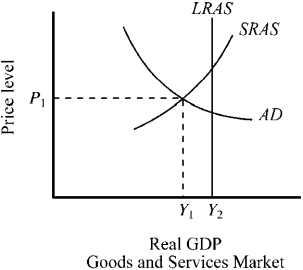 -Refer to Figure 12-3.If an economy is currently operating at Y₁,which of the following would a Keynesian economist be most likely to favor?
 (Multiple Choice)
4.8/5 (79)
(79) What is the "crowding-out" effect? How does the crowding-out effect influence the potency of fiscal policy?
(Essay)
4.8/5 (96)
(96) Why might an expansion in government spending increase the severity of the coordination problem during a recession?
(Multiple Choice)
4.8/5 (89)
(89) If a budget surplus leads to a decrease in U.S.real interest rates,the lower rates will tend to cause
(Multiple Choice)
4.7/5 (65)
(65) 
Filters
- Essay(0)
- Multiple Choice(0)
- Short Answer(0)
- True False(0)
- Matching(0)