



 Chat with AI
Exam 14: Modern Macroeconomics and Monetary Policy

Exam 1: The Economic Approach210 Questions
Exam 2: Asome Tools of the Economist257 Questions
Exam 3: Asupply,demand,and the Market Process405 Questions
Exam 4: Asupply and Demand: Applications and Extensions331 Questions
Exam 5: Difficult Cases for the Market and the Role of Government168 Questions
Exam 6: The Economics of Collective Decision-Making180 Questions
Exam 7: Ataking the Nations Economic Pulse288 Questions
Exam 8: Economic Fluctuations, unemployment, and Inflation242 Questions
Exam 9: Aan Introduction to Basic Macroeconomic Markets261 Questions
Exam 10: Dynamic Change, economic Fluctuations, and the Ad-As Model224 Questions
Exam 11: Fiscal Policy: the Keynesian View and Historical Perspective139 Questions
Exam 12: Fiscal Policy, incentives, and Secondary Effects171 Questions
Exam 13: Amoney and the Banking System260 Questions
Exam 14: Modern Macroeconomics and Monetary Policy220 Questions
Exam 15: Stabilization Policy, output, and Employment177 Questions
Exam 16: Creating an Environment for Growth and Prosperity142 Questions
Exam 17: Institutions,policies,and Cross-Country Differences in Income and Growth153 Questions
Exam 18: Gaining From International Trade222 Questions
Exam 19: International Finance and the Foreign Exchange Market162 Questions
Exam 20: Consumer Choice and Elasticity223 Questions
Exam 21: Acosts and the Supply of Goods231 Questions
Exam 22: Aprice Takers and the Competitive Process260 Questions
Exam 23: Price-Searcher Markets With Low Entry Barriers216 Questions
Exam 24: Aprice-Searcher Markets With High Entry Barriers254 Questions
Exam 25: The Supply of and Demand for Productive Resources200 Questions
Exam 26: Earnings, productivity, and the Job Market109 Questions
Exam 27: Investment, the Capital Market, and the Wealth of Nations129 Questions
Exam 28: Income Inequality and Poverty136 Questions
Exam 29: Government Spending and Taxation79 Questions
Exam 30: The Economics of Social Security54 Questions
Exam 31: The Stock Market: Its Function, Performance, and Potential As an Investment Opportunity70 Questions
Exam 32: Great Debates in Economics: Keynes Versus Hayek8 Questions
Exam 33: The Crisis of 2008: Causes and Lessons for the Future64 Questions
Exam 34: Lessons From the Great Depression60 Questions
Exam 35: Lessons From Japan and Canada72 Questions
Exam 36: The Federal Budget and the National Debt97 Questions
Exam 37: The Economics of Healthcare68 Questions
Exam 38: Education: Problems and Performance60 Questions
Exam 39: Earnings Differences Between Men and Women47 Questions
Exam 40: Do Labor Unions Increase the Wages of Workers74 Questions
Exam 41: The Question of Resource Exhaustion61 Questions
Exam 42: Difficult Environmental Cases and the Role of Government63 Questions
Select questions type


Given the strict quantity theory of money,if the quantity of money doubled,prices would
(Multiple Choice)
4.8/5  (84)
(84) In response to a severe recession,the Fed more than doubled the monetary base and pushed short-term interest rates to near zero during 2009-2010.What happened in 2011?
(Multiple Choice)
4.8/5 (80)
(80) According to the quantity theory of money,which one of the following economic variables would change in response to an increase in the money supply?
(Multiple Choice)
4.9/5 (83)
(83) If there is a "long and variable time lag" between when a change in monetary policy is instituted and when it impacts aggregate demand and output,this will
(Multiple Choice)
5.0/5 (67)
(67) The short run sequence of events following an unanticipated shift to a more expansionary monetary policy would be
(Multiple Choice)
4.9/5 (73)
(73) The short run sequence of events following an unanticipated shift to a more restrictive monetary policy would be
(Multiple Choice)
4.9/5 (77)
(77) Beginning from full-employment equilibrium,illustrate graphically how each of the following would impact the economy.
a.the short-run impact of an unanticipated decrease in the money supply
b.the long-run impact of an unanticipated decrease in the money supply
(Essay)
4.9/5 (80)
(80) If the Federal Reserve wanted to expand the money supply in order to increase output,it should
(Multiple Choice)
4.8/5 (83)
(83) An analysis of countries experiencing rapid inflation indicates that inflation is generally
(Multiple Choice)
4.8/5 (74)
(74) An unanticipated shift to a more restrictive monetary policy by the Fed will
(Multiple Choice)
4.8/5 (86)
(86) In the 1960s and 1970s,the primary indicator of monetary policy was
(Multiple Choice)
4.8/5 (77)
(77) In 2008,nominal GDP was equal to $14,265 billion while the M1 money supply was $1,423 billion.What was the velocity of the M1 money stock?
(Multiple Choice)
4.8/5 (89)
(89) Answer the following questions:
a.What is the equation of exchange? Explain each component.
b.What assumptions are placed on the equation of exchange to generate the quantity theory of money?
c.Explain the quantity theory of money and what it implies about the impact of changes in the money supply on real output and prices.
(Essay)
4.8/5 (79)
(79) Which of the following will make it difficult for the Fed to institute shifts in monetary policy in a manner that will promote economic stability?
(Multiple Choice)
4.7/5 (65)
(65) Figure 14-8
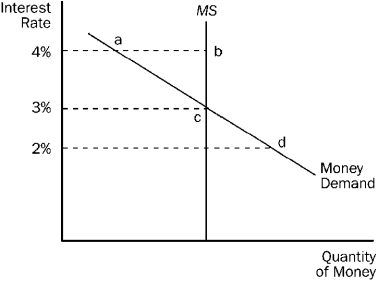 -Refer to Figure 14-8.At an interest rate of 4 percent there is excess
 (Multiple Choice)
4.8/5 (71)
(71) 
Filters
- Essay(0)
- Multiple Choice(0)
- Short Answer(0)
- True False(0)
- Matching(0)