



 Chat with AI
Exam 14: Modern Macroeconomics and Monetary Policy

Exam 1: The Economic Approach210 Questions
Exam 2: Asome Tools of the Economist257 Questions
Exam 3: Asupply,demand,and the Market Process405 Questions
Exam 4: Asupply and Demand: Applications and Extensions331 Questions
Exam 5: Difficult Cases for the Market and the Role of Government168 Questions
Exam 6: The Economics of Collective Decision-Making180 Questions
Exam 7: Ataking the Nations Economic Pulse288 Questions
Exam 8: Economic Fluctuations, unemployment, and Inflation242 Questions
Exam 9: Aan Introduction to Basic Macroeconomic Markets261 Questions
Exam 10: Dynamic Change, economic Fluctuations, and the Ad-As Model224 Questions
Exam 11: Fiscal Policy: the Keynesian View and Historical Perspective139 Questions
Exam 12: Fiscal Policy, incentives, and Secondary Effects171 Questions
Exam 13: Amoney and the Banking System260 Questions
Exam 14: Modern Macroeconomics and Monetary Policy220 Questions
Exam 15: Stabilization Policy, output, and Employment177 Questions
Exam 16: Creating an Environment for Growth and Prosperity142 Questions
Exam 17: Institutions,policies,and Cross-Country Differences in Income and Growth153 Questions
Exam 18: Gaining From International Trade222 Questions
Exam 19: International Finance and the Foreign Exchange Market162 Questions
Exam 20: Consumer Choice and Elasticity223 Questions
Exam 21: Acosts and the Supply of Goods231 Questions
Exam 22: Aprice Takers and the Competitive Process260 Questions
Exam 23: Price-Searcher Markets With Low Entry Barriers216 Questions
Exam 24: Aprice-Searcher Markets With High Entry Barriers254 Questions
Exam 25: The Supply of and Demand for Productive Resources200 Questions
Exam 26: Earnings, productivity, and the Job Market109 Questions
Exam 27: Investment, the Capital Market, and the Wealth of Nations129 Questions
Exam 28: Income Inequality and Poverty136 Questions
Exam 29: Government Spending and Taxation79 Questions
Exam 30: The Economics of Social Security54 Questions
Exam 31: The Stock Market: Its Function, Performance, and Potential As an Investment Opportunity70 Questions
Exam 32: Great Debates in Economics: Keynes Versus Hayek8 Questions
Exam 33: The Crisis of 2008: Causes and Lessons for the Future64 Questions
Exam 34: Lessons From the Great Depression60 Questions
Exam 35: Lessons From Japan and Canada72 Questions
Exam 36: The Federal Budget and the National Debt97 Questions
Exam 37: The Economics of Healthcare68 Questions
Exam 38: Education: Problems and Performance60 Questions
Exam 39: Earnings Differences Between Men and Women47 Questions
Exam 40: Do Labor Unions Increase the Wages of Workers74 Questions
Exam 41: The Question of Resource Exhaustion61 Questions
Exam 42: Difficult Environmental Cases and the Role of Government63 Questions
Select questions type


Which one of the following policies would be most appropriate if the economy is operating beyond its long-run potential capacity?
(Multiple Choice)
4.8/5  (65)
(65) If the Federal Reserve lowered the reserve requirements imposed on the banking industry,which of the following will most likely happen in the short run?
(Multiple Choice)
4.8/5 (77)
(77) Since 1980,changes in the nature of both the M1 and M2 money supply have
(Multiple Choice)
4.8/5 (80)
(80) If the velocity of the M1 money supply is 4 and nominal GDP is $200 billion,the stock of money in circulation must be
(Multiple Choice)
4.8/5 (82)
(82) If the long-run equilibrium of an economy is disrupted by an unexpected shift to a more expansionary monetary policy,the policy shift will
(Multiple Choice)
4.9/5 (72)
(72) During the last two decades,the Fed has relied more extensively on ___________ in its conduct of monetary policy.(Fill in the blank)
(Multiple Choice)
5.0/5 (72)
(72) When the Fed conducts expansionary monetary policy,lower short-term interest rates will tend to stimulate the economy.How will the change in the velocity of money affect this result?
(Multiple Choice)
4.9/5 (69)
(69) An analysis of countries experiencing rapid inflation indicates that inflation is generally
(Multiple Choice)
4.9/5 (90)
(90) When the Fed purchases more bonds and,thereby,increases the money supply,the initial effects of the more expansionary monetary policy will often be weakened as a result of
(Multiple Choice)
4.9/5 (90)
(90) A study of countries with high inflation rates indicates that the inflation is generally
(Multiple Choice)
4.8/5 (71)
(71) What happens to the aggregate demand curve when the Fed reduces the money supply?
(Multiple Choice)
4.9/5 (86)
(86) If a country was operating well below its long-run capacity (potential GDP),the initial impact of an unanticipated increase in the money supply would most likely result in an increase in
(Multiple Choice)
4.8/5 (85)
(85) Use the figure below to answer the following question(s).
Figure 14-9
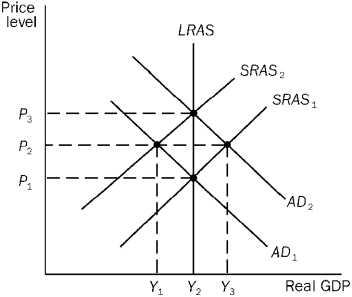 AD₁ and SRAS₁ indicate the initial conditions in an economy,with the current level of output,Y₂,being the full employment level,and the current price level being P₁.
-Refer to Figure 14-9.If the Fed unexpectedly increases the money supply,in the long run,the impact of the unanticipated expansionary policy will be a movement to
AD₁ and SRAS₁ indicate the initial conditions in an economy,with the current level of output,Y₂,being the full employment level,and the current price level being P₁.
-Refer to Figure 14-9.If the Fed unexpectedly increases the money supply,in the long run,the impact of the unanticipated expansionary policy will be a movement to (Multiple Choice)
4.7/5 (77)
(77) When the Fed unexpectedly increases the money supply,it will cause an increase in aggregate demand because
(Multiple Choice)
4.9/5 (84)
(84) Empirical studies indicate that the velocity of money tends to increase when interest rates rise.Which of the following best explains why this is true?
(Multiple Choice)
4.9/5 (87)
(87) If the Fed unexpectedly increases the money supply,real GDP
(Multiple Choice)
4.8/5 (89)
(89) When the Fed unexpectedly increases the money supply,it will cause an increase in aggregate demand because
(Multiple Choice)
4.9/5 (69)
(69) According to the monetarists,what is the primary cause of a recession? Explain the steps by which reductions in the money supply lead to reductions in real output.
(Essay)
4.8/5 (65)
(65) 
Filters
- Essay(0)
- Multiple Choice(0)
- Short Answer(0)
- True False(0)
- Matching(0)