



 Chat with AI
Exam 3: Cost-Benefit and Cost-Effectiveness Analysis


Explain why the concept of "expected value of a medical treatment" makes more sense when applied to a large group of people rather than when an individual patient makes a decision.

 (94)
 Verified
Expected value is equal to the probability of a successful outcome multiplied by the expected benefit. This is appropriate when a large number of outcomes can be observed. For an individual, the outcome is generally not equal to a probability multiplied by an expected benefit. Individuals usually realize a benefit from a treatment or do not realize a benefit. For example, if a surgery saves a life, a person either lives or dies. For a large group, when an expected outcome incorporates a probability of death = .5, it means that half of the people in the group are expected to die after the treatment. Thus, total benefits from the treatment would be realized by only half of the people in the group:
[Expected value of total benefits for a group] = [Number of people in the group] * 0.5
A cost effectiveness study evaluates whether or not the benefits from inserting a drug eluting coronary stent add enough years of life expectancy to justify the cost; a cost-benefit study evaluates whether a drug eluting coronary stent, a beta blocker drug or cardiac bypass surgery might provide the most additional years of life expectancy per dollar spent.
(69) VerifiedFalse
In the hypothetical example that follows, patients coming into a clinic with disease symptoms are classified as having varying degrees of severity, from Stage 0 to Stage 4. Stage 4 represents the most severe symptoms; Stage 0 includes those with symptoms only but not the disease. The available treatment is expected to benefit those groups differently, and add extra years of life to each person as shown in the Gain (each person) row in the table. Please answer questions 5 through 7.
? Stage 4 Stage 3 Stage 2 Stage 1 Stage 0 Gain (each person) 45 30 4 1 0 Number of persons coming to clinic 4 4 12 20 60
-Assuming that the clinic treats first those patients who are sickest and stand to benefit most, the total benefits obtained by treating more and more patients can be displayed graphically, where the total benefits line eventually flattens out. This is often called "flat of the curve" medicine.
(81) VerifiedTrue
A U.S. emergency relief agency is considering sending a team of experts to another country to treat a severely contagious disease outbreak. Each team member is paid $10,000 for this one-week-long job. The agency estimates effectiveness as follows:
? Number of Team Members Number of Deaths 0 1,000 5 400 10 150 15 30 20 30
-If the Agency is considering sending a team of 15 members vs. a team of 10 members, what will be the additional cost of sending the larger team?
(81) A kidney cancer drug delays cancer progression for six months, with no known side effects. An estimated treatment cost is $54,000. What is the cost per Quality Adjusted Life Year (QALY)?
(82) Cost-benefit analysis of a childhood immunization program is straight-forward analysis because the costs of the drugs are well known and the benefits to individual children are easy to calculate.
(74) Many useful medical technologies become wasteful when they are expanded to include low-risk individuals.
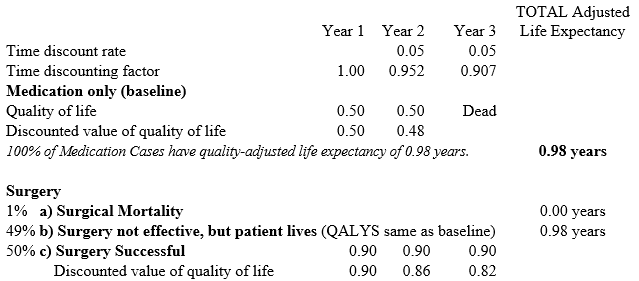
(74) Consider a hypothetical example in which a patient has a condition in which she can expect to live only 2 more years on medications, with her quality of life reduced to 50% during those 2 years. With successful surgery as an alternative, she can expect instead to live 3 years with a better quality of life, 90%. Surgical mortality rate is 1% and the surgery is successful half the time. Using a 5% time discount rate, a student in health economics class correctly sets up the analysis.
 -If you calculate the cost per QALY using a discount rate of 3%,
 (72) Suppose the state government passes a law that sets a minimum size for physical rehabilitation facility (presumably in order to gain economies of scale). If you were asked to do a cost-effectiveness analysis of the proposal, what alternatives would you consider? Which costs would be important to consider? Why?
(74) It has been observed that some people are willing to accept a more dangerous job for a higher salary. If a study estimates that for each .01% increase in risk of death, an additional $360 in annual salary was observed, the estimated value of life is
(65) Cost-effectiveness analysis is a limiting case of the general cost-benefit analysis.
(78) A U.S. emergency relief agency is considering sending a team of experts to another country to treat a severely contagious disease outbreak. Each team member is paid $10,000 for this one-week-long job. The agency estimates effectiveness as follows:
? Number of Team Members Number of Deaths 0 1,000 5 400 10 150 15 30 20 30
-Which decision rule is relevant for the decision making in this project?
(86) A U.S. emergency relief agency is considering sending a team of experts to another country to treat a severely contagious disease outbreak. Each team member is paid $10,000 for this one-week-long job. The agency estimates effectiveness as follows:
? Number of Team Members Number of Deaths 0 1,000 5 400 10 150 15 30 20 30
-Diminishing marginal returns sets in with
(71) Consider a hypothetical example in which a patient has a condition in which she can expect to live only 2 more years on medications, with her quality of life reduced to 50% during those 2 years. With successful surgery as an alternative, she can expect instead to live 3 years with a better quality of life, 90%. Surgical mortality rate is 1% and the surgery is successful half the time. Using a 5% time discount rate, a student in health economics class correctly sets up the analysis.
-If the patient decides to have the surgery, the net gain in discounted QALYs with surgery (compared to the baseline option of taking medications instead) is
-If the patient decides to have the surgery, the net gain in discounted QALYs with surgery (compared to the baseline option of taking medications instead) is (68) One of the weak points in the Jones-Lee Approach to estimating Value of Life is that
(76) Consider a hypothetical example in which a patient has a condition in which she can expect to live only 2 more years on medications, with her quality of life reduced to 50% during those 2 years. With successful surgery as an alternative, she can expect instead to live 3 years with a better quality of life, 90%. Surgical mortality rate is 1% and the surgery is successful half the time. Using a 5% time discount rate, a student in health economics class correctly sets up the analysis.
-If the surgery costs $20,000, the cost per QALY gained is
-If the surgery costs $20,000, the cost per QALY gained is (80) The estimate of the value of benefits expected from a treatment depends on the viewpoint of the party benefitting from that treatment.
(75) Physicians generally focus on tradeoffs. Health care economists focus on maximizing benefits to society as a whole.
(70) In the hypothetical example that follows, patients coming into a clinic with disease symptoms are classified as having varying degrees of severity, from Stage 0 to Stage 4. Stage 4 represents the most severe symptoms; Stage 0 includes those with symptoms only but not the disease. The available treatment is expected to benefit those groups differently, and add extra years of life to each person as shown in the Gain (each person) row in the table. Please answer questions 5 through 7.
? Stage 4 Stage 3 Stage 2 Stage 1 Stage 0 Gain (each person) 45 30 4 1 0 Number of persons coming to clinic 4 4 12 20 60
-Marginal analysis shows that more than 80% of the total gains are realized by treating only the sickest patients, Stage 4 and Stage 3 patients.
(74) 
Filters
- Essay(0)
- Multiple Choice(0)
- Short Answer(0)
- True False(0)
- Matching(0)