



 Chat with AI
Exam 3: Cost-Benefit and Cost-Effectiveness Analysis

Exam 1: Choices: Money, Medicine, and Health30 Questions
Exam 2: Demand and Supply30 Questions
Exam 3: Cost-Benefit and Cost-Effectiveness Analysis30 Questions
Exam 4: Health Insurance: Financing Medical Care30 Questions
Exam 5: Insurance Contracts and Managed Care29 Questions
Exam 6: Physicians30 Questions
Exam 7: Medical Education, Organization, and Business Practices30 Questions
Exam 8: Hospitals30 Questions
Exam 9: Management and Regulations of Hospital Costs29 Questions
Exam 10: Long-Term Care30 Questions
Exam 11: Pharmaceuticals30 Questions
Exam 12: Financing and Ownership of Health Care Providers29 Questions
Exam 13: Macroeconomics and Medical Care30 Questions
Exam 14: The Role of Government and Public Goods30 Questions
Exam 15: History, Demography, and the Growth of Modern Medicine30 Questions
Exam 16: International Comparisons of Health and Health Expenditures31 Questions
Exam 17: Economic Evaluation of Health Policy: The Patient Protection and Affordable Care Act of 201030 Questions
Exam 18: Value for Money in the Future of Health Care30 Questions
Select questions type


In the hypothetical example that follows, patients coming into a clinic with disease symptoms are classified as having varying degrees of severity, from Stage 0 to Stage 4. Stage 4 represents the most severe symptoms; Stage 0 includes those with symptoms only but not the disease. The available treatment is expected to benefit those groups differently, and add extra years of life to each person as shown in the Gain (each person) row in the table. Please answer questions 5 through 7.
? Stage 4 Stage 3 Stage 2 Stage 1 Stage 0 Gain (each person) 45 30 4 1 0 Number of persons coming to clinic 4 4 12 20 60
-"Flat of the curve" medicine means that if patients with Stage 0 disease symptoms are treated, the marginal benefits of the treatment are less than the marginal cost of treating symptoms.
(True/False)
4.9/5  (78)
(78) Please explain why the decisions on the margin are generally more hotly debated in developed countries like the U.S. rather than in less developed countries like Tanzania. Consider how treatment decisions would vary for an infant suffering from a stomach virus in U.S. compared with Tanzania.
(Essay)
4.8/5 (75)
(75) The primary costs to be accounted for in health care projects include all of the following except:
(Multiple Choice)
4.8/5 (72)
(72) If a quality of life value of 1.00 QALY is the perfect health reference state, explain what a quality of life adjustment factor of 0.50 per year over 10 years means if one undergoes kidney transplant. What factors may survey respondents be asked to consider when estimating such a value?
(Essay)
4.8/5 (69)
(69) A U.S. emergency relief agency is considering sending a team of experts to another country to treat a severely contagious disease outbreak. Each team member is paid $10,000 for this one-week-long job. The agency estimates effectiveness as follows:
? Number of Team Members Number of Deaths 0 1,000 5 400 10 150 15 30 20 30
-If saving a life is valued at $100,000, what is the optimal number of people the agency should send?
(Multiple Choice)
4.8/5 (86)
(86) Consider the following hypothetical situation. A common infant vaccine which prevents polio costs pennies to produce and the country has had almost 100% vaccination rates; however, recently, the vaccine has been linked to another life threatening disease, ABC-itis. Outbreaks of polio are now found in small pockets around the country due to decreases in the vaccination rate. Discuss the cost benefit analysis involved in providing free vaccinations at pre-schools, daycare facilities and elementary schools around the nation. Consider the perspective of patients, providers, payers, government, and society.
(Essay)
4.8/5 (89)
(89) Consider a hypothetical example in which a patient has a condition in which she can expect to live only 2 more years on medications, with her quality of life reduced to 50% during those 2 years. With successful surgery as an alternative, she can expect instead to live 3 years with a better quality of life, 90%. Surgical mortality rate is 1% and the surgery is successful half the time. Using a 5% time discount rate, a student in health economics class correctly sets up the analysis.
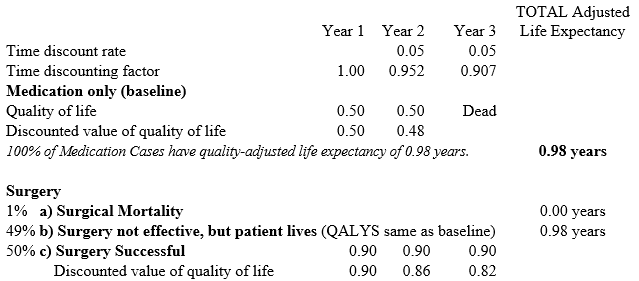 -If the patient decides to have the surgery (compared to the baseline option of taking medications instead), the quality adjusted life expectancy (number of QALYs) after accounting for both probability of success and surgical mortality is
 (Multiple Choice)
4.8/5 (84)
(84) A U.S. emergency relief agency is considering sending a team of experts to another country to treat a severely contagious disease outbreak. Each team member is paid $10,000 for this one-week-long job. The agency estimates effectiveness as follows:
? Number of Team Members Number of Deaths 0 1,000 5 400 10 150 15 30 20 30
-If the Agency is considering sending a team of 15 members vs. a team of 10 members, what will be the marginal cost per each marginal life saved by the larger team?
(Multiple Choice)
4.8/5 (86)
(86) A U.S. emergency relief agency is considering sending a team of experts to another country to treat a severely contagious disease outbreak. Each team member is paid $10,000 for this one-week-long job. The agency estimates effectiveness as follows:
? Number of Team Members Number of Deaths 0 1,000 5 400 10 150 15 30 20 30
-If the Agency is considering sending a team of 15 members vs. a team of 10 members, how many additional lives would the larger team be able to save?
(Multiple Choice)
4.9/5 (82)
(82) Choices based on marginal, rather than average, benefits and costs will tend to overproduce medical services.
(True/False)
4.8/5 (79)
(79) 
Filters
- Essay(0)
- Multiple Choice(0)
- Short Answer(0)
- True False(0)
- Matching(0)