Multiple Choice
Consider a hypothetical example in which a patient has a condition in which she can expect to live only 2 more years on medications, with her quality of life reduced to 50% during those 2 years. With successful surgery as an alternative, she can expect instead to live 3 years with a better quality of life, 90%. Surgical mortality rate is 1% and the surgery is successful half the time. Using a 5% time discount rate, a student in health economics class correctly sets up the analysis.
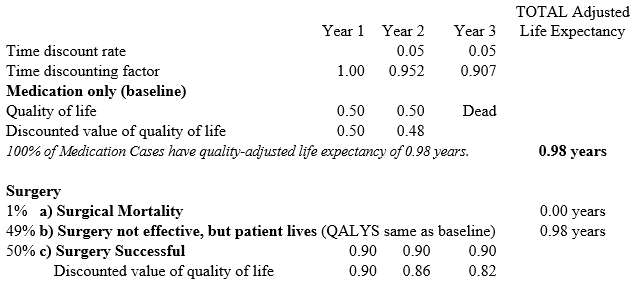
-If the patient decides to have the surgery (compared to the baseline option of taking medications instead) , the quality adjusted life expectancy (number of QALYs) after accounting for both probability of success and surgical mortality is
A) 2.58.
B) 1.77.
C) 0.98.
D) 0.79.
E) 0.48.
Correct Answer:

Verified
Correct Answer:
Verified
Q20: In the hypothetical example that follows,
Q21: In the hypothetical example that follows,
Q22: Please explain why the decisions on the
Q23: The primary costs to be accounted for
Q24: If a quality of life value of
Q25: A U.S. emergency relief agency is
Q26: Consider the following hypothetical situation. A common
Q28: A U.S. emergency relief agency is
Q29: A U.S. emergency relief agency is
Q30: Choices based on marginal, rather than average,