Multiple Choice
Consider a hypothetical example in which a patient has a condition in which she can expect to live only 2 more years on medications, with her quality of life reduced to 50% during those 2 years. With successful surgery as an alternative, she can expect instead to live 3 years with a better quality of life, 90%. Surgical mortality rate is 1% and the surgery is successful half the time. Using a 5% time discount rate, a student in health economics class correctly sets up the analysis.
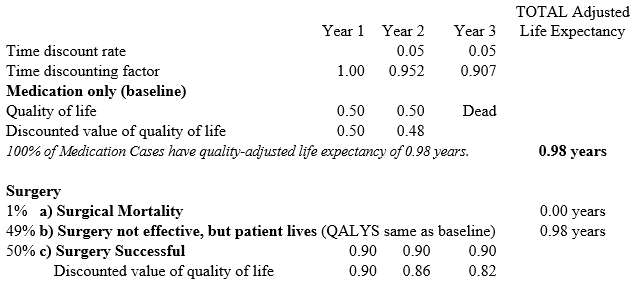
-If the surgery costs $20,000, the cost per QALY gained is
A) $20,000.
B) less than $20,000.
C) more than $20,000, but less than $25,000.
D) more than $25,000, but less than $30,000.
E) $12,470.
Correct Answer:

Verified
Correct Answer:
Verified
Q11: Cost-effectiveness analysis is a limiting case of
Q12: A U.S. emergency relief agency is
Q13: A U.S. emergency relief agency is
Q14: Consider a hypothetical example in which a
Q15: One of the weak points in the
Q17: A problem with Cost-Benefit Analysis is that<br>A)
Q18: The estimate of the value of benefits
Q19: Physicians generally focus on tradeoffs. Health care
Q20: In the hypothetical example that follows,
Q21: In the hypothetical example that follows,