Multiple Choice
Consider a hypothetical example in which a patient has a condition in which she can expect to live only 2 more years on medications, with her quality of life reduced to 50% during those 2 years. With successful surgery as an alternative, she can expect instead to live 3 years with a better quality of life, 90%. Surgical mortality rate is 1% and the surgery is successful half the time. Using a 5% time discount rate, a student in health economics class correctly sets up the analysis.
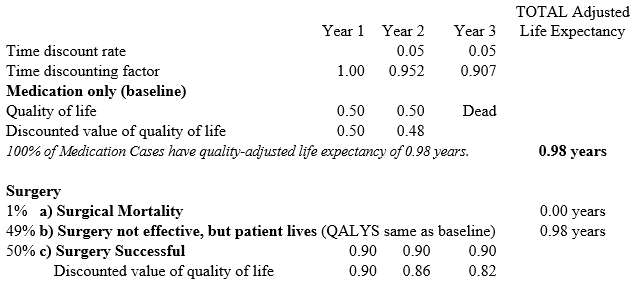
-If the patient decides to have the surgery, the net gain in discounted QALYs with surgery (compared to the baseline option of taking medications instead) is
A) 2.58.
B) 1.77.
C) 0.98.
D) 0.79
E) 0.48.
Correct Answer:

Verified
Correct Answer:
Verified
Q9: Suppose the state government passes a law
Q10: It has been observed that some people
Q11: Cost-effectiveness analysis is a limiting case of
Q12: A U.S. emergency relief agency is
Q13: A U.S. emergency relief agency is
Q15: One of the weak points in the
Q16: Consider a hypothetical example in which a
Q17: A problem with Cost-Benefit Analysis is that<br>A)
Q18: The estimate of the value of benefits
Q19: Physicians generally focus on tradeoffs. Health care