



 Chat with AI
Exam 13: The Costs of Production

Exam 1: Ten Principles of Economics237 Questions
Exam 2: Thinking Like an Economist267 Questions
Exam 3: Interdependence and the Gains From Trade217 Questions
Exam 4: The Market Forces of Supply and Demand303 Questions
Exam 5: Elasticity and Its Applications282 Questions
Exam 6: Supply, demand, and Government Policies252 Questions
Exam 7: Consumers, producers, and the Efficiency of Markets248 Questions
Exam 8: Application: the Costs of Taxation245 Questions
Exam 9: Application: International Trade245 Questions
Exam 10: Externalities288 Questions
Exam 11: Public Goods and Common Resources258 Questions
Exam 12: The Design of the Tax System328 Questions
Exam 13: The Costs of Production303 Questions
Exam 14: Firms in Competitive Markets271 Questions
Exam 15: Monopoly306 Questions
Exam 16: Oligopoly291 Questions
Exam 17: Monopolistic Competition257 Questions
Exam 18: The Markets for the Factors of Production284 Questions
Exam 19: Earnings and Discrimination286 Questions
Exam 20: Income Inequality and Poverty247 Questions
Exam 21: The Theory of Consumer Choice238 Questions
Exam 22: Frontiers of Microeconomics199 Questions
Exam 23: Measuring a Nations Income215 Questions
Exam 24: Measuring the Cost of Living208 Questions
Exam 25: Production and Growth240 Questions
Exam 26: Saving, investment, and the Financial System282 Questions
Exam 27: The Basic Tools of Finance249 Questions
Exam 28: Unemployment242 Questions
Exam 29: The Monetary System277 Questions
Exam 30: Money Growth and Inflation224 Questions
Exam 31: Open-Economy Macroeconomics: Basic Concepts256 Questions
Exam 32: A Macroeconomic Theory of the Open Economy217 Questions
Exam 33: Aggregate Demand and Aggregate Supply302 Questions
Exam 34: The Influence of Monetary and Fiscal Policy on Aggregate Demand249 Questions
Exam 35: The Short Run Trade Off Between Inflation and Unemployment246 Questions
Exam 36: Five Debates Over Macroeconomic Policy140 Questions
Select questions type


The shape of the total cost curve is unrelated to the shape of the production function.
(True/False)
4.8/5  (90)
(90) Scenario 13-1
Joe wants to start his own business. The business he wants to start will require that he purchase a factory that costs $400,000. Joe currently has $500,000 in the bank earning 3 percent interest per year.
-Refer to Scenario 13-1.If Joe purchases the factory with his own money,what is the annual implicit opportunity cost of purchasing the factory?
(Multiple Choice)
4.7/5 (68)
(68) The average total cost when 5 units of output are produced is $30,and the marginal cost of the sixth unit of output is $60.What is the average total cost when six units are produced?
(Multiple Choice)
4.8/5 (91)
(91) For Firm A,when four units of output are produced,the total cost is $175 and the average variable cost is $33.75.What would the average fixed cost be if ten units were produced?
(Multiple Choice)
4.9/5 (80)
(80) In some cases,specialization allows larger factories to produce goods at a lower average cost than smaller factories.
(True/False)
4.9/5 (74)
(74) To an economist,it is conceivable that the objective that motivates an individual entrepreneur to start a business arises from
(Multiple Choice)
4.8/5 (87)
(87) According to the mathematical laws that govern the relationship between average total cost and marginal cost,where must these two curves intersect?
(Essay)
4.7/5 (80)
(80) Figure 13-6
The curves below reflect information about the cost structure of a firm.
 -Refer to Figure 13-6.Which of the curves is most likely to represent average fixed cost?
 (Multiple Choice)
4.9/5 (69)
(69) Accountants keep track of the money that flows into and out of firms.
(True/False)
5.0/5 (85)
(85) Table 13-6
Adrian's Premium Chocolates produces boxes of chocolates for its mail order catalogue business. She rents a small room for $150 a week in the downtown business district that serves as her factory. She can hire workers for $275 a week. There are no implicit costs.
 -Refer to Table 13-6.Adrian has received an order for 3,000 boxes of chocolates for next week.If she expects that the trend in the marginal product of labor will continue in the same direction,it is most likely that her best decision will be to
 (Multiple Choice)
4.8/5 (74)
(74) Figure 13-8
The figure below depicts average total cost functions for a firm that produces automobiles.
 -Refer to Figure 13-8.At levels of output below M the firm experiences
 (Multiple Choice)
4.7/5 (66)
(66) Diminishing marginal product exists when the production function becomes flatter as inputs increase.
(True/False)
4.8/5 (85)
(85) Figure 13-9
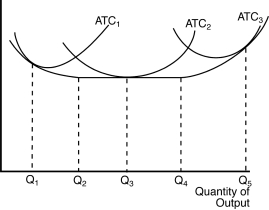 -Refer to Figure 13-9.The firm experiences diseconomies of scale if it changes its level of output
 (Multiple Choice)
4.8/5 (77)
(77) Economists normally assume that the goal of a firm is to (i) sell as much of their product as possible.
(ii) set the price of their product as high as possible.
(iii) maximize profit.
(Multiple Choice)
4.8/5 (73)
(73) The minimum points of the average variable cost and average total cost curves occur where
(Multiple Choice)
4.7/5 (90)
(90) Table 13-3
 -Refer to Table 13-3.Assume Gallo's currently employs 2 workers.What is the marginal product of labor when Gallo's adds a 3rd worker?
 (Multiple Choice)
4.8/5 (84)
(84) Scenario 13-3
Tony is a wheat farmer, but he also spends part of his day teaching guitar lessons. Due to the popularity of his local country western band, Farmer Tony has more students requesting lessons than he has time for if he is to also maintain his farming business. Farmer Tony charges $25 an hour for his guitar lessons. One spring day, he spends 10 hours in his fields planting $130 worth of seeds on his farm. He expects that the seeds he planted will yield $300 worth of wheat.
-Refer to Scenario 13-3.What is the total opportunity cost of the day that Farmer Tony incurred for his spring day in the field planting wheat?
(Multiple Choice)
4.9/5 (67)
(67) 
Filters
- Essay(0)
- Multiple Choice(0)
- Short Answer(0)
- True False(0)
- Matching(0)