



 Chat with AI
Exam 13: The Costs of Production

Exam 1: Ten Principles of Economics237 Questions
Exam 2: Thinking Like an Economist267 Questions
Exam 3: Interdependence and the Gains From Trade217 Questions
Exam 4: The Market Forces of Supply and Demand303 Questions
Exam 5: Elasticity and Its Applications282 Questions
Exam 6: Supply, demand, and Government Policies252 Questions
Exam 7: Consumers, producers, and the Efficiency of Markets248 Questions
Exam 8: Application: the Costs of Taxation245 Questions
Exam 9: Application: International Trade245 Questions
Exam 10: Externalities288 Questions
Exam 11: Public Goods and Common Resources258 Questions
Exam 12: The Design of the Tax System328 Questions
Exam 13: The Costs of Production303 Questions
Exam 14: Firms in Competitive Markets271 Questions
Exam 15: Monopoly306 Questions
Exam 16: Oligopoly291 Questions
Exam 17: Monopolistic Competition257 Questions
Exam 18: The Markets for the Factors of Production284 Questions
Exam 19: Earnings and Discrimination286 Questions
Exam 20: Income Inequality and Poverty247 Questions
Exam 21: The Theory of Consumer Choice238 Questions
Exam 22: Frontiers of Microeconomics199 Questions
Exam 23: Measuring a Nations Income215 Questions
Exam 24: Measuring the Cost of Living208 Questions
Exam 25: Production and Growth240 Questions
Exam 26: Saving, investment, and the Financial System282 Questions
Exam 27: The Basic Tools of Finance249 Questions
Exam 28: Unemployment242 Questions
Exam 29: The Monetary System277 Questions
Exam 30: Money Growth and Inflation224 Questions
Exam 31: Open-Economy Macroeconomics: Basic Concepts256 Questions
Exam 32: A Macroeconomic Theory of the Open Economy217 Questions
Exam 33: Aggregate Demand and Aggregate Supply302 Questions
Exam 34: The Influence of Monetary and Fiscal Policy on Aggregate Demand249 Questions
Exam 35: The Short Run Trade Off Between Inflation and Unemployment246 Questions
Exam 36: Five Debates Over Macroeconomic Policy140 Questions
Select questions type


Table 13-6
Adrian's Premium Chocolates produces boxes of chocolates for its mail order catalogue business. She rents a small room for $150 a week in the downtown business district that serves as her factory. She can hire workers for $275 a week. There are no implicit costs.
 -Refer to Table 13-6.During the week of July 4th,Adrian doesn't box any chocolates.What are her costs during the week?
 (Multiple Choice)
4.9/5  (80)
(80) Scenario 13-5
A certain firm produces and sells staplers. Last year, it produced 7,000 staplers and sold each stapler for $6. In producing the 7,000 staplers, it incurred variable costs of $28,000 and a total cost of $45,000.
-Refer to Scenario 13-5.The firm's fixed costs amounted to
(Multiple Choice)
4.8/5 (76)
(76) Which of the following would be categorized as an implicit cost? (i) forgone investment opportunities
(ii) wages of workers
(iii) raw materials costs
(Multiple Choice)
4.8/5 (78)
(78) When adding another unit of labor leads to an increase in output that is smaller than the increases in output that resulted from adding previous units of labor,we have the property of
(Multiple Choice)
4.9/5 (72)
(72) Figure 13-5
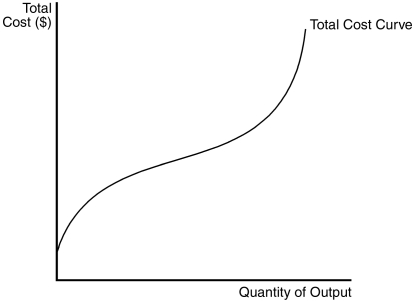 -Refer to Figure 13-5.Which of the following can be inferred from the figure above? (i) Marginal cost is increasing at all levels of output.
(ii) Marginal product is increasing at low levels of output.
(iii) Marginal product is decreasing at high levels of output.
-Refer to Figure 13-5.Which of the following can be inferred from the figure above? (i) Marginal cost is increasing at all levels of output.
(ii) Marginal product is increasing at low levels of output.
(iii) Marginal product is decreasing at high levels of output. (Multiple Choice)
5.0/5 (76)
(76) What effect,if any,does diminishing marginal product have on the shape of the marginal cost curve?
(Essay)
5.0/5 (86)
(86) At all levels of production beyond the point where the marginal cost curve crosses the average variable cost curve,average variable cost
(Multiple Choice)
4.8/5 (73)
(73) Suppose a certain firm is able to produce 165 units of output per day when 15 workers are hired.The firm is able to produce 176 units of output per day when 16 workers are hired (holding other inputs fixed).Then the marginal product of the 16th worker is
(Multiple Choice)
4.8/5 (82)
(82) The cost of producing the typical unit of output is the firm's
(Multiple Choice)
4.9/5 (73)
(73) The average total cost curve is unaffected by diminishing marginal product.
(True/False)
4.9/5 (76)
(76) Scenario 13-5
A certain firm produces and sells staplers. Last year, it produced 7,000 staplers and sold each stapler for $6. In producing the 7,000 staplers, it incurred variable costs of $28,000 and a total cost of $45,000.
-Refer to Scenario 13-5.In producing the 7,000 staplers,the firm's average fixed cost was
(Multiple Choice)
4.8/5 (81)
(81) Table 13-3
 -Refer to Table 13-3.Each worker at Gallo's cork factory costs $12 per hour.The cost of each machine is $20 per day regardless of the number of corks produced.What is the total daily cost of producing at a rate of 55 units per hour if Gallo's operates 8 hours per day?
 (Multiple Choice)
4.9/5 (65)
(65) Scenario 13-2
Zach took $400,000 out of the bank and used it to start his new cookie business. The bank account pays 3 percent interest per year. During the first year of his business, Zach sold 6,000 boxes of cookies for $2.50 per box. Also, during the first year, the cookie business incurred costs that required outlays of money amounting to $9,000.
-Refer to Scenario 13-2.Zach's accounting profit for the year was
(Multiple Choice)
4.9/5 (95)
(95) The amount of money that a wheat farmer could have earned if he had planted barley instead of wheat is
(Multiple Choice)
4.8/5 (76)
(76) When comparing short-run average total cost with long-run average total cost at a given level of output,
(Multiple Choice)
4.8/5 (80)
(80) The amount by which total cost rises when the firm produces one additional unit of output is called
(Multiple Choice)
4.8/5 (95)
(95) 
Filters
- Essay(0)
- Multiple Choice(0)
- Short Answer(0)
- True False(0)
- Matching(0)