



 Chat with AI
Exam 10: Externalities

Exam 1: Ten Principles of Economics237 Questions
Exam 2: Thinking Like an Economist267 Questions
Exam 3: Interdependence and the Gains From Trade217 Questions
Exam 4: The Market Forces of Supply and Demand303 Questions
Exam 5: Elasticity and Its Applications282 Questions
Exam 6: Supply, demand, and Government Policies252 Questions
Exam 7: Consumers, producers, and the Efficiency of Markets248 Questions
Exam 8: Application: the Costs of Taxation245 Questions
Exam 9: Application: International Trade245 Questions
Exam 10: Externalities288 Questions
Exam 11: Public Goods and Common Resources258 Questions
Exam 12: The Design of the Tax System328 Questions
Exam 13: The Costs of Production303 Questions
Exam 14: Firms in Competitive Markets271 Questions
Exam 15: Monopoly306 Questions
Exam 16: Oligopoly291 Questions
Exam 17: Monopolistic Competition257 Questions
Exam 18: The Markets for the Factors of Production284 Questions
Exam 19: Earnings and Discrimination286 Questions
Exam 20: Income Inequality and Poverty247 Questions
Exam 21: The Theory of Consumer Choice238 Questions
Exam 22: Frontiers of Microeconomics199 Questions
Exam 23: Measuring a Nations Income215 Questions
Exam 24: Measuring the Cost of Living208 Questions
Exam 25: Production and Growth240 Questions
Exam 26: Saving, investment, and the Financial System282 Questions
Exam 27: The Basic Tools of Finance249 Questions
Exam 28: Unemployment242 Questions
Exam 29: The Monetary System277 Questions
Exam 30: Money Growth and Inflation224 Questions
Exam 31: Open-Economy Macroeconomics: Basic Concepts256 Questions
Exam 32: A Macroeconomic Theory of the Open Economy217 Questions
Exam 33: Aggregate Demand and Aggregate Supply302 Questions
Exam 34: The Influence of Monetary and Fiscal Policy on Aggregate Demand249 Questions
Exam 35: The Short Run Trade Off Between Inflation and Unemployment246 Questions
Exam 36: Five Debates Over Macroeconomic Policy140 Questions
Select questions type


Refer to Figure 10-8.This graph shows the market for pollution when permits are issued to firms and traded in the marketplace.The equilibrium number of permits is
(Multiple Choice)
4.9/5  (80)
(80) If the production of computer chips yields greater technology spillovers than the production of potato chips,the government should
(Multiple Choice)
4.9/5 (93)
(93) Suppose that meat producers create a negative externality.Further suppose that the government imposes a tax on the producers equal to the per-unit externality.What is the relationship between the equilibrium quantity and the socially optimal quantity of meat to be produced?
(Multiple Choice)
4.8/5 (69)
(69) Nancy loves to landscape her yard,but her neighbor Lee places a low value on his landscaping.When Lee's grass is neglected and gets long,Nancy will mow it for Lee.This is an example of
(Multiple Choice)
4.9/5 (78)
(78) Most economists prefer regulation to taxation because regulation corrects market inefficiencies at a lower cost than taxation does.
(True/False)
4.8/5 (84)
(84) Which of the following statements about a well-maintained yard best conveys the general nature of the externality?
(Multiple Choice)
4.8/5 (90)
(90) When a negative externality exists in a market,the cost to producers
(Multiple Choice)
4.9/5 (76)
(76) The Coase theorem suggests that private markets may not be able to solve the problem of externalities
(Multiple Choice)
4.8/5 (77)
(77) Most taxes distort incentives and move the allocation of resources away from the social optimum.Why do corrective taxes avoid the disadvantages of most other taxes?
(Multiple Choice)
4.8/5 (89)
(89) Two firms,A and B,each currently dump 50 tons of chemicals into the local river.The government has decided to reduce the pollution and from now on will require a pollution permit for each ton of pollution dumped into the river.The government gives each firm 20 pollution permits,which it can either use or sell to the other firm.It costs Firm A $100 for each ton of pollution that it eliminates before it reaches the river,and it costs Firm B $50 for each ton of pollution that it eliminates before it reaches the river.It is likely that
(Multiple Choice)
4.8/5 (88)
(88) In the case of a technology spillover,internalizing a positive externality will cause the supply curve of an industry to
(Multiple Choice)
4.9/5 (80)
(80) Externalities can be corrected by each of the following except
(Multiple Choice)
5.0/5 (72)
(72) The proposition that if private parties can bargain without cost over the allocation of resources,they can solve the problem of externalities on their own,is called
(Multiple Choice)
4.9/5 (86)
(86) If the government wanted to ensure that the market reaches the socially optimal equilibrium in the presence of a technology spillover,it should
(Multiple Choice)
4.8/5 (89)
(89) Suppose that at present there are no laws to restrict pollution produced by the widget industry.Assume that the supply and demand curves are linear and that the market price of a widget is $20.If the government imposes a tax equal in value to the cost of the pollution,then firms would continue to produce widgets if
(Multiple Choice)
4.7/5 (84)
(84) Figure 10-4
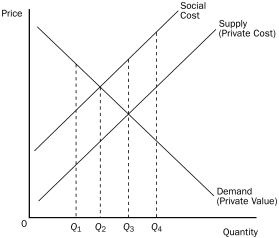 -Refer to Figure 10-4.If this market currently produces Q₂,total economic well-being would be maximized if
 (Multiple Choice)
4.8/5 (85)
(85) 
Filters
- Essay(0)
- Multiple Choice(0)
- Short Answer(0)
- True False(0)
- Matching(0)