



 Chat with AI
Exam 10: Externalities

Exam 1: Ten Principles of Economics237 Questions
Exam 2: Thinking Like an Economist267 Questions
Exam 3: Interdependence and the Gains From Trade217 Questions
Exam 4: The Market Forces of Supply and Demand303 Questions
Exam 5: Elasticity and Its Applications282 Questions
Exam 6: Supply, demand, and Government Policies252 Questions
Exam 7: Consumers, producers, and the Efficiency of Markets248 Questions
Exam 8: Application: the Costs of Taxation245 Questions
Exam 9: Application: International Trade245 Questions
Exam 10: Externalities288 Questions
Exam 11: Public Goods and Common Resources258 Questions
Exam 12: The Design of the Tax System328 Questions
Exam 13: The Costs of Production303 Questions
Exam 14: Firms in Competitive Markets271 Questions
Exam 15: Monopoly306 Questions
Exam 16: Oligopoly291 Questions
Exam 17: Monopolistic Competition257 Questions
Exam 18: The Markets for the Factors of Production284 Questions
Exam 19: Earnings and Discrimination286 Questions
Exam 20: Income Inequality and Poverty247 Questions
Exam 21: The Theory of Consumer Choice238 Questions
Exam 22: Frontiers of Microeconomics199 Questions
Exam 23: Measuring a Nations Income215 Questions
Exam 24: Measuring the Cost of Living208 Questions
Exam 25: Production and Growth240 Questions
Exam 26: Saving, investment, and the Financial System282 Questions
Exam 27: The Basic Tools of Finance249 Questions
Exam 28: Unemployment242 Questions
Exam 29: The Monetary System277 Questions
Exam 30: Money Growth and Inflation224 Questions
Exam 31: Open-Economy Macroeconomics: Basic Concepts256 Questions
Exam 32: A Macroeconomic Theory of the Open Economy217 Questions
Exam 33: Aggregate Demand and Aggregate Supply302 Questions
Exam 34: The Influence of Monetary and Fiscal Policy on Aggregate Demand249 Questions
Exam 35: The Short Run Trade Off Between Inflation and Unemployment246 Questions
Exam 36: Five Debates Over Macroeconomic Policy140 Questions
Select questions type


Corrective taxes are typically advocated to correct for the effects of
(Multiple Choice)
4.9/5  (81)
(81) This figure reflects the market for outdoor concerts in a public park surrounded by residential neighborhoods.
Figure 10-3
 -Refer to Figure 10-3.The social cost curve is above the supply curve because
 (Multiple Choice)
4.8/5 (80)
(80) The social cost of pollution includes the private costs of the producers plus the costs to those bystanders adversely affected by the pollution.
(True/False)
5.0/5 (81)
(81) When the government intervenes in markets with externalities,it does so in order to
(Multiple Choice)
4.9/5 (80)
(80) The Coase theorem suggests that efficient solutions to externalities can be determined through bargaining.Under what circumstances will private bargaining fail to produce a solution?
(Essay)
4.7/5 (58)
(58) Negative externalities lead markets to produce a smaller quantity of a good than is socially desirable,while positive externalities lead markets to produce a larger quantity of a good than is socially desirable.
(True/False)
4.8/5 (66)
(66) Suppose that smoking creates a negative externality.What can the government do to equate the equilibrium quantity of cigarettes and the socially optimal quantity of cigarettes smoked?
(Multiple Choice)
4.8/5 (79)
(79) The Environmental Protection Agency (EPA)cannot reach a target level of pollution through the use of pollution permits.
(True/False)
4.8/5 (86)
(86) Which of the following best defines the situation where one firm's research yields knowledge that is used by society as a whole?
(Multiple Choice)
4.8/5 (88)
(88) If the government were to impose a fine of $1,000 for each unit of air-pollution released by a steel mill,the policy would be considered
(Multiple Choice)
4.9/5 (81)
(81) In which of the following cases is the Coase theorem most likely to solve the externality?
(Multiple Choice)
4.9/5 (72)
(72) Since externalities tend to keep markets from reaching a socially optimal equilibrium,government action
(Multiple Choice)
5.0/5 (69)
(69) Government intervention that aims to promote technology-enhancing industries is called
(Multiple Choice)
5.0/5 (75)
(75) Figure 10-7
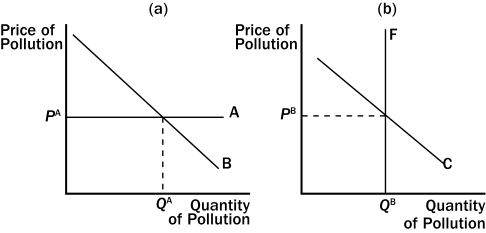 -Refer to Figure 10-7.Which graph illustrates a regulation?
 (Multiple Choice)
5.0/5 (81)
(81) If a market is characterized by a positive externality that is not the result of a technology spillover,
(Multiple Choice)
4.9/5 (82)
(82) Using a supply and demand diagram,demonstrate how a positive externality leads to market inefficiency.How might the government help to eliminate this inefficiency?
(Essay)
4.9/5 (96)
(96) 
Filters
- Essay(0)
- Multiple Choice(0)
- Short Answer(0)
- True False(0)
- Matching(0)