



 Chat with AI
Exam 10: Externalities

Exam 1: Ten Principles of Economics237 Questions
Exam 2: Thinking Like an Economist267 Questions
Exam 3: Interdependence and the Gains From Trade217 Questions
Exam 4: The Market Forces of Supply and Demand303 Questions
Exam 5: Elasticity and Its Applications282 Questions
Exam 6: Supply, demand, and Government Policies252 Questions
Exam 7: Consumers, producers, and the Efficiency of Markets248 Questions
Exam 8: Application: the Costs of Taxation245 Questions
Exam 9: Application: International Trade245 Questions
Exam 10: Externalities288 Questions
Exam 11: Public Goods and Common Resources258 Questions
Exam 12: The Design of the Tax System328 Questions
Exam 13: The Costs of Production303 Questions
Exam 14: Firms in Competitive Markets271 Questions
Exam 15: Monopoly306 Questions
Exam 16: Oligopoly291 Questions
Exam 17: Monopolistic Competition257 Questions
Exam 18: The Markets for the Factors of Production284 Questions
Exam 19: Earnings and Discrimination286 Questions
Exam 20: Income Inequality and Poverty247 Questions
Exam 21: The Theory of Consumer Choice238 Questions
Exam 22: Frontiers of Microeconomics199 Questions
Exam 23: Measuring a Nations Income215 Questions
Exam 24: Measuring the Cost of Living208 Questions
Exam 25: Production and Growth240 Questions
Exam 26: Saving, investment, and the Financial System282 Questions
Exam 27: The Basic Tools of Finance249 Questions
Exam 28: Unemployment242 Questions
Exam 29: The Monetary System277 Questions
Exam 30: Money Growth and Inflation224 Questions
Exam 31: Open-Economy Macroeconomics: Basic Concepts256 Questions
Exam 32: A Macroeconomic Theory of the Open Economy217 Questions
Exam 33: Aggregate Demand and Aggregate Supply302 Questions
Exam 34: The Influence of Monetary and Fiscal Policy on Aggregate Demand249 Questions
Exam 35: The Short Run Trade Off Between Inflation and Unemployment246 Questions
Exam 36: Five Debates Over Macroeconomic Policy140 Questions
Select questions type


If education produces positive externalities,we would expect
(Multiple Choice)
4.7/5  (90)
(90) Two firms,A and B,each currently dump 50 tons of chemicals into the local river.The government has decided to reduce the pollution and from now on will require a pollution permit for each ton of pollution dumped into the river.It costs Firm A $100 for each ton of pollution that it eliminates before it reaches the river,and it costs Firm B $50 for each ton of pollution that it eliminates before it reaches the river.The government gives each firm 20 pollution permits.Government officials are not sure whether to allow the firms to buy or sell the pollution permits to each other.What is the total cost of reducing pollution if firms are not allowed to buy and sell pollution permits from each other? What is the total cost of reducing pollution if the firms are allowed to buy and sell permits from each other? You should assume that any firm that buys a permit pays the highest price for that permit.
(Multiple Choice)
4.7/5 (89)
(89) If the government were to limit the release of air-pollution produced by a steel mill to 75 parts per million,the policy would be considered a
(Multiple Choice)
4.9/5 (76)
(76) Government intervention is necessary to correct all externalities.
(True/False)
4.8/5 (77)
(77) Suppose that a firm produces electricity by burning coal.The production process creates a negative externality of air pollution.If the firm does not internalize the cost of the externality,it will produce where
(Multiple Choice)
4.9/5 (83)
(83) Which of the following is an example of a positive externality?
(Multiple Choice)
4.8/5 (72)
(72) Dioxin emission that results from the production of paper is a good example of a negative externality because
(Multiple Choice)
4.9/5 (96)
(96) In many cases selling pollution permits is a better method for reducing pollution than imposing a corrective tax because
(Multiple Choice)
4.8/5 (76)
(76) If it is illegal for a biochemical manufacturer to release its waste into a nearby stream,then this is an example of
(Multiple Choice)
5.0/5 (87)
(87) Figure 10-1
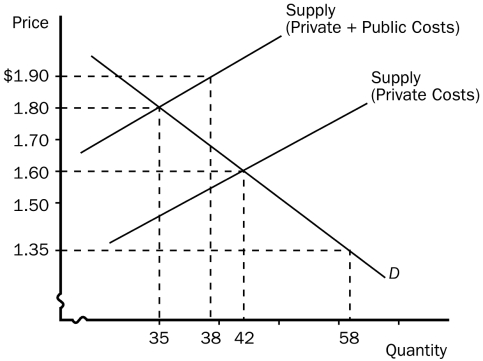 -Refer to Figure 10-1.This graph represents the tobacco industry.The socially optimal price and quantity are
 (Multiple Choice)
4.9/5 (61)
(61) Corrective taxes that are imposed upon the producer of a nasty smell can be successful in reducing that smell because the tax makes the producer
(Multiple Choice)
4.8/5 (89)
(89) Suppose that an MBA degree creates no externality because the benefits of an MBA are internalized by the student in the form of higher wages.If there are no government subsidies for MBAs,then which of the following statements is correct?
(Multiple Choice)
4.8/5 (83)
(83) If a paper manufacturer does not bear the entire cost of the dioxin it emits,it will
(Multiple Choice)
4.7/5 (72)
(72) Which of the following is the most effective way to internalize a technology spillover?
(Multiple Choice)
4.8/5 (67)
(67) Figure 10-2
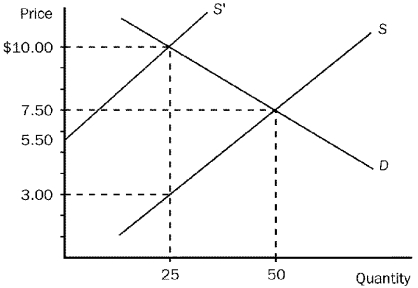 -Refer to Figure 10-2.Suppose that the production of soccer balls creates a social cost which is depicted in the graph above.If the government wanted to force the firm to internalize the cost of the externality,what action should it take?
 (Multiple Choice)
4.8/5 (84)
(84) Which of the following is not an effective method to reduce negative externalities?
(Multiple Choice)
4.9/5 (88)
(88) 
Filters
- Essay(0)
- Multiple Choice(0)
- Short Answer(0)
- True False(0)
- Matching(0)